Total Pageviews

Translate

Wednesday, 3 May 2023

Web Page 3066 4th May 2023 First Picture: Marion Ryan
Second Picture: With Paul and Barry Ryan
Third Picture: Spot the Tune
Forth Picture: With Jackie Rae
Marion Ryan Marion Ryan was born on 4th February 1931 and died on 15th January 1999 she was a British singer in the 1950s in the early years of British Independent Television. She was once called "the Marilyn Monroe of popular song". Marion Ryan was born in Middlesbrough, North Riding of Yorkshire, England, where she attended Notre Dame Collegiate School for Girls in Leeds, now Notre Dame Catholic Sixth Form College. She was working in a hosiery shop in Leeds and broke into show business when she approached Ray Ellington who was performing at the Locarno in Liverpool in July 1953 and asked to sing with his quartet. He allowed her to do so and the audience reaction was so good he signed her up to work with the quartet. She made her debut with them at the Locarno, Glasgow in September 1953. Her first radio appearance took place on the show "Stepping Out at Radio Roadhouse" on the Light Programme on October 27, 1953 when the Ellington quartet were the guest band She continued to tour with Ellington until 1957 and made further radio appearances with them including the popular Goon Show. She began recording for Pye Nixa in 1956 and mainly made cover versions of American hits. Her version of "Love Me Forever" peaked at number five on the UK Singles Chart in 1958. Her first LP "A Lady Loves" was released in 1959. Beginning in June 1956, she was the regular singer in the popular musical quiz Spot the Tune[ on Granada Television for seven years, with a total of 209 half-hour programmes, which featured several star hosts including disc-jockey Pete Murray, the Canadian pop singer Jackie Rae, and the comedians Ken Platt and Ted Ray, and also Peter Knight and his orchestra. The show re-emerged in the 1970s as Name That Tune. Marion Ryan went solo in 1957 and undertook her first variety tour[ and then went on tour with Cyril Stapleton and his Show Band. She made six appearances in BBC's Six-Five Special in 1957 and 1958 and she appeared in the Royal Variety Performance in 1959. She appeared on Sunday Night at the London Palladium in 1963 and made one brief appearance as herself in the film It's All Happening, with singer Tommy Steele the same year. She had important guest spots on The Bob Hope Show in 1958 and The Bing Crosby Show in 1961. Her first marriage at the age of 17 was to Lloyd George Frederick Sapherson (known as Fred) (1913-2001) in the second quarter of 1948.] They had twin sons, Barry and Paul (born Leeds, West Riding of Yorkshire, 24 October 1948). In 1969 she married the show business agent Harold Davison (1922-2011) and they had a daughter named Caroline. After which she gradually eased herself into retirement. She died from a heart attack at age 67 in Boca Raton, Florida, United States. Stay in touch Peter

Thursday, 27 April 2023

Web Page 3064 27th April 2023 First Picture: Children’s Film Foundation banner
Second Picture: Early Haley Mills film
Third Picture: Still from a Foundation film
The Children's Film Foundation (CFF) was a non-profit organisation which made films for children in the United Kingdom originally to be shown as part of children's Saturday morning matinĂ©e cinema programming. The films typically were about 55 minutes long. The Foundation was formed in 1951 following the Wheare report that criticised the suitability of American programming for Saturday morning pictures. Mary Field was appointed chief executive. The Foundation was initially funded by the Eady Levy (a tax on box office receipts), receiving 5% of the Levy and the initial budget was £60,000 per year. The Foundation made around six films a year most lasted less than an hour and were shot in less than two weeks. The films featured future British stars including Leslie Ash, Keith Chegwin, Phil Collins, Michael Crawford, Phil Daniels, Dexter Fletcher, Sadie Frost, Susan George, David Hemmings, Frazer Hines, Gary Kemp, Richard O'Sullivan, Linda Robson, Pauline Quirke, Sally Thomsett, Dennis Waterman, Carol White, Jack Wild and Matthew Wright. The films also include early films from British directors such as James Hill, Gerald Thomas, Don Chaffey, Lewis Gilbert and John Guillermin. It also used established directors such as Charles Frend and The Boy Who Turned Yellow (1972) was the last film production by Michael Powell and Emeric Pressburger. Some of the films were critically recognized, winning awards at the Cannes Film Festival, Moscow Film Festival and Venice Film Festival. The films were also popular on US TV and in 16mm showings in public libraries in Germany, Japan, Canada and South Africa. By 1980, attendances for Saturday morning matinĂ©es were dwindling and the Foundation's annual funding was reduced from £530,000 a year to £330,000. The Eady Levy was abolished in 1985 and the Foundation made a few further films in the mid-1980s, by which time it had been renamed the Children's Film and Television Foundation. Its last production was Just Ask for Diamond in 1988 It made no films of its own after the mid-1980s, but it survived under its revised name, and in recent years has provided fun ding for other projects. Many of its films, dating back to the 1960s, were shown on the BBC in the 1980s, in the Friday Film Special strand. Frank Richard Wells (1903–82), second son of H. G. Wells and Amy Catherine Robbins, was a main executive at the CFF. In 2012 The Children's Film and Television Foundation changed its name and broadened its role to become the Children's Media Foundation. Its archive is now held at the BFI National Archive. Stay in touch Peter GSSEDITOR@gmail.com

Thursday, 20 April 2023

Web Page 3062 20th April 2023 First Picture: Gas Poker
Second Picture: Gas Fridge
Third Picture: Gas Light
Forth Picture: Gas Iron
Gas With the recent problems of within the energy area it got me to thinking how the used of gas has changed since our formative days. Here are some examples which have come to mind. One of the strangest items in my home in those days was the gas poker. We had a gas plug in point next to the fireplaces in the front and back room. This appliance was rarely used as my parents relieved on laying a proper fire so it would catch and burn away on its own. One strange things that I remember is when the engineer came to convert us to North Sea gas he insisted on converting the gas poke even though my mother told him that we did not use it. My wife’s grandmother lived in a cottage in St. Ives just outside Ringwood which was built in 1897 in the year of Queen Victoria’s Jubilee and was the first brick built house in the village, However not all rooms had the full domestic services. The upstairs rooms were only lit by a wandering lead attached to the stair rail, rather precarious. However, there was no electric light in the kitchen just one gas light on a bracket on the wall. I remember the comforting pop as the mantle lit and the soft warm light around the kitchen as it hissed away quietly to itself. Mind you that was not the only feature in the kitchen as in one corner was a built-in washing copper which was heated by a wood fire underneath, Looking at the other side of my family my maternal grandmother, when she was living in London owned a gas iron. The gas was attached to the iron from the domestic gas supply through the tap and tube at the back of the iron. There were two rows of six jets inside the body of the iron, and gas flowed from these jets, which were then lit. This heated the metal base, making it hot enough to press out creases. The thing always made a scary hissing noise which scared me intensely, luckily when she moved south to live with us she left it behind. I never really understood how a gas refrigerator worked as we never had one but our neighbour did and I remember my father being asked to go round and relight her fridge. I went along and watched but I still do not really understand how they worked. Some folks had a three legged free standing boiler in the kitchen for boiling whites the but my mother always boiled her white in a large pan on the gas cooker. I cannot finish without mentioning the geyser we had mounted over the bath in Drayton. This thing had a pilot light that was turned sideways into the main gas burners. The geyser would then make a horrendous pop and would scare us all to death. Stay in touch Peter gsseditor@gmail.com

Wednesday, 12 April 2023

Web Page 3060 13th April 2023 First Picture: Portsdown Hill
Second Picture: Chalk Pit
Third Picture:Farlington Marshes
Looking Back. When we were growing up we never once questioned what our parents income was. We did not eat a lot of fast food as it was considered a treat and not a food group. We ate home made meals consisting of mainly meat, potatoes and vegetables and the vegetables were not an optional choice because if you did not eat your vegetables there would be no dessert for you that day We grew up during a time when we mowed lawns, pulled up weeds, babysat and helped our neighbours to earn extra pocket money. We were, by no means given everything that we wanted but we were satisfied. We went outside in the open air to play, we toured around on our bikes, went out with friends, played hide and seek, we went swimming, in fact we rarely sat inside at home. After school we went home and we did our homework before going out with friends or having friends over to visit our own home. Bottled water was unheard of we used the milk machine for cartons of drink. We always had to tell our parents where we were going, who we were going with and what time we would be home. We would ride our bikes for hours. We learnt from our parents and what they said was law, we did not even question it. The words please and thank you were always part of our vocabulary. We watched what we said around our elders and a telling off was not classed as abuse, it was called discipline and you did not hear swear words on the radio or in songs. We were very lucky as we had the slopes of Portsdown Hill to explore and the chalk pits to play in and the beaches to bathe off, plus the wilds of Farlington Marshes we could always explore. We could mess about in boats or go fishing in the creek. Life seemed much simpler then our only worries were to get our homework in on time. So much for progress, maybe I am looking back through rose coloured glasses but I know I enjoyed growing up when I did. Stay in touch Peter gsseditor@gmail.com

Thursday, 6 April 2023

Web Page 3058 6th April 2023 First Picture: Buttered crumpets
Second Picture: Halloween Crumpets
Third Picture: Breakfast Crumpets
Crumpets. What better way to pass an evening when we were kids by getting the toasting fork out and cooking crumpets in front of an open coal fire? A crumpet is a small griddle bread made from an unsweetened batter of water or milk, flour, and yeast, popular in the United Kingdom, Canada, New Zealand, South Africa and Australia. Crumpets are regionally known as pikelets, a name also applied to a thinner, more pancake-like griddle bread a type of the latter is referred to as a crumpet in Scotland. Crumpets have been variously described as originating in Wales or as part of the Anglo-Saxon diet. In either case, breads were, historically, commonly cooked on a griddle wherever bread ovens were unavailable. The bara-planc, or griddle bread, baked on an iron plate over a fire, was part of the everyday diet in Wales until the 19th century.[4] Small, oval pancakes baked in this manner were called picklets, The word spread initially to the West Midlands of England, where it became anglicised as pikelet, and subsequently to Cheshire, Lancashire, Yorkshire, and other areas of the north; crumpets are still referred to as pikelets in some areas. The word crumpet itself, of unclear origin. The early crumpets were hard pancakes cooked on a griddle, rather than the soft and spongy crumpets of the Victorian era, which were made with yeast. From the 19th century, a little bicarbonate of soda was also usually added to the batter. In modern times, the mass production of crumpets by large commercial bakeries has eroded some regional differences. Crumpets are distinguished from similar sized muffins by being made from a batter, rather than a dough. English crumpets are generally circular, roughly 8 centimetres (3 in) in diameter and 2 centimetres (3⁄4 in) thick. Their shape comes from being restrained in the pan/griddle by a shallow ring. They have a characteristic flat top with many small pores and a spongy texture which allows butter or other spreads to permeate. Crumpets may be cooked until ready to eat warm from the pan, but are also left slightly undercooked and then toasted. While premade commercial versions are available in most supermarkets, freshly home-made crumpets are less heavy and doughy in texture. They are usually eaten with a spread of butter, or with other sweet or savoury toppings. While in some areas of the country the word pikelet is synonymous with the crumpet, in others (such as Staffordshire and Yorkshire) it refers to a slightly differing recipe. If differentiated from the crumpet, a pikelet is defined as containing no yeast as a raising agent; as using a thinner batter than a crumpet; and as being cooked without a ring, giving a flatter result than a crumpet. In Stoke-on-Trent, pikelets were once sold in the town's many oatcake shops and still are. A 1932 recipe for Staffordshire pikelets specifies that they were made with flour and buttermilk, with bicarbonate of soda as a raising agent, and suggests cooking them using bacon fat. The term pikelet is used in Australian and New Zealand cuisine for a smaller version of what in Scotland and North America would be called a pancake and, in England, a Scotch pancake, girdle or griddle cake, or drop scone. A Scottish crumpet is broadly similar to the crumpet of parts of Northern England. It is made from the same ingredients as a Scotch pancake, and is about 180 millimetres (7 in) diameter and 8 millimetres (0.3 in) thick. It is available plain, or as a fruit crumpet with raisins baked in, usually fried in a pan and served with a fried breakfast. It is also sometimes served with butter and jam. The ingredients include a leavening agent, usually baking powder, and different proportions of eggs, flour, and milk, which create a thin batter. Unlike a pancake, it is cooked to brown on one side only, resulting in a smooth darker side where it has been heated by the griddle, then lightly cooked on the other side which has holes where bubbles have risen to the surface during cooking. While now relatively uncommon in Ireland, crumpets were once produced by Boland's Bakery in Dublin during the 19th and much of the 20th centuries; Boland's recipe was subsequently used by a number of other bakeries. Irish crumpets differed from most British recipes by having a yeastless batter and being cooked on both sides, giving a smooth rather than spongy top. I must admit that I prefer them with lashings of butter, some friends like to put Marmite on theirs but I am one of those people who actually hate Marmite. Stay in touch Peter gsseditor@gmail.com

Wednesday, 29 March 2023

Second Picture: Deep Fried Mars Bar
Third Picture: 1940’s Advert
Forth Picture: A Mars a Day………
Mars, commonly known as Mars bar, is the name of two varieties of chocolate bar produced by Mars An American version of the Mars bar was produced which had nougat and toasted almonds covered in milk chocolate; later, caramel was added to the recipe as well. The American version was discontinued in 2002, then revived in a slightly different form the following year under the name "Snickers Almond". It was first manufactured in Slough under the Mars bar name in 1932 by Forrest Mars, Sr., son of American candy maker Frank C. Mars. He modelled it after his father's Milky Way bar, which was already popular in the US, adjusting the recipe to better suit European tastes. He had a staff of twelve people, and originally advertised it as using Cadbury's chocolate couverture. The bar and the proportions of the main components have changed over the years. With minor variations, this version is sold worldwide, except for the US, and is packaged in a black wrapper with red gold-edged lettering. Three million Mars bars accompanied the British task force to the Falklands in 1982. In 2002, the Mars bar was reformulated and its logo was updated with a more cursive appearance except in Australia where it still has the pre-2002 logo. Its price also increased. The nougat was made lighter, the chocolate on top became thinner, and the overall weight of the bar was reduced slightly. The slogan "Pleasure you can't measure" was intended to appeal more to women and youths. In the second half of 2008, Mars UK reduced the weight of regular bars from 62.5 g to 58 g. Although the reduction in size was not publicised at the time, Mars claimed the change was designed to help tackle the obesity crisis in the UK. The company later confirmed that the real reason for the change was rising costs. In 2013, the "standard" Mars bar was further reduced to 51 g, bringing the change to around 20% in 5 years. In May 2009, the Mars bar size reduced from 60g to 53g in Australia, citing portion sizes and the obesity debate as the primary driver. As of 2022, it was noted the Mars bar size has been reduced further to 47g in Australia. In the United States, the Mars bar is a candy bar with nougat and toasted almonds coated with milk chocolate. The same candy bar is known outside the United States as a Mars Almond bar. Originally it did not have caramel, but at some point caramel was added to it. It was discontinued in 2002, relaunched in January 2010, discontinued again at the end of 2011and relaunched again in September 2016 by Ethel M, the gourmet chocolate subsidiary of Mars, Incorporated. The 2016 version is the "original American recipe", which doesn't have caramel. It's available in their stores and on Amazon.com. In 2003, the company introduced a replacement called Snickers Almond. It's similar to the Mars bar, containing nougat, almonds, caramel, and a milk chocolate coating, although there are some differences. For example, the almonds are in smaller pieces in Snickers Almond than in the Mars bar. The European version of the Mars bar is also sold in some United States grocery stores that stock imported food products. Deep Fried Mars Bars is a Mars bar which has been coated with batter and deep-fried in oil or beef fat. First reports of battered Mars bars being sold in Stonehaven, Scotland date back to 1995] The product is "not authorised or endorsed" by Mars, Inc. Deep-fried Mars bars are available from some fish-and-chip shops in the UK (mainly in Scotland), Singapore, Australia, New Zealand, Canada, Ireland and the United States. A similar dish has reportedly appeared in Kathmandu, Nepal where momo (dumplings) have used Mars bars as fillings. In July 2005, Mars bars, along with the Snickers bar, were recalled due to an anonymous extortion attempt against Star City Casino in Sydney. The extortionist claimed to have poisoned seven Mars and Snickers bars at random stores in New South Wales, As a result, Masterfoods Corporation, the company that manufactures Mars bars in Australia, recalled the entire Mars and Snickers product from store shelves in New South Wales. In the later half of August 2005, the threat to the public was deemed negligible and the bars returned to shelves In February 2016, Mars, Snickers and various other Mars, Inc. chocolate products were recalled in 55 countries in Europe, the Middle East and Asia. The precautionary recall was issued after a customer found pieces of plastic in a Snickers bar purchased in Germany. The error was traced back to a Mars, Inc. factory in Veghel, The Netherlands. Did you know that Gerry and the Pacemakers were originally known as Gerry Marsden and the Mars Bars before changing their name due to the objection of Mars, Incorporated. Stay in Touch Peter gsseditor@gmail.com /b>

Wednesday, 22 March 2023

Web Page 3054 23rd March 2023 Steve Race First Picture: Steve Race at the piano
Second Picture: The My Music team
Third Picture: Sheet Music for Nicola
Forth Picture: Steve Races’ autobiography
Stephen Russell "Steve" Race OBE (1 April 1921 – 22 June 2009) was a British composer, pianist and radio and television presenter. Born in Lincoln, the son of a lawyer, he learned the piano from the age of five. He was educated (1932–37) at Lincoln School, where he formed his first jazz group, which included a young Neville Marriner, later a major figure in the world of classical music. At sixteen, he attended the Royal Academy of Music, studying composition. After leaving the academy, he wrote occasional dance band reviews for Melody Maker and, in 1939, joined the Harry Leader dance band as pianist, succeeding Norrie Paramor. He joined the Royal Air Force in 1941, and formed a jazz/dance quintet. After the Second World War, he began a long and productive career with the BBC, where his ready wit, musicianship and broad musical knowledge made him much sought after as a musical accompanist for panel games and magazine shows, such as Whirligig and Many a Slip. At the same time he was playing in the bands of Lew Stone and Cyril Stapleton, and arranging material for Ted Heath. In, 1949 The Steve Race Bop Group recorded some of the first British bebop records. He also developed a sideline arranging player piano rolls for the Artona company. From the 1950s to the 1980s, he presented numerous music programmes on radio and television. Additionally, in 1955, he was appointed the first Light Music Advisor to the independent television company Associated-Rediffusion. He is probably best known as the chairman of the long-running light-hearted radio and TV panel game My Music which ran from 1967 to 1994. He presented and wrote most of the questions for all 520 episodes . He also presented Jazz For Moderns on radio and Jazz 625 on television for the BBC in the 1960s. As a composer, he produced a number of pieces in the jazz, classical and popular idioms. Faraway Music, the theme to an ITV Play of the Week in 1961, was issued as a single by Steve Race and his Orchestra. Others followed, including one of his better-known compositions, the short instrumental piece Nicola (named after his daughter), which won an Ivor Novello Award in 1962. But his best-known and, according to his autobiography, his most lucrative composition is his music for the Birds Eye frozen peas jingle, "Sweet as the moment when the pod went pop". Windsor Blues, a duet written in 1970 for Prince Charles (cello) and the Earl of Chester (trumpet) has been recorded. Race's autobiography, Musician at Large, was published in 1979, and in 1988 Souvenir Press Ltd published his book about his grandfather's short but interesting life, from lead miner to missionary, entitled The Two Worlds of Joseph Race. He married Marjorie Leng in 1944 and they had a daughter, Nicola. Marjorie died from cancer in 1969. He married again in 1970, to radio producer LĂ©onie Mather, who survived him. He had his first heart attack in 1965. He died of the second attack at his home in Great Missenden, Buckinghamshire, in June 2009. Stay in Touch Peter gsseditor@gmail.com

Thursday, 16 March 2023

Second Picture: Coronation edition
Third Picture: Look and Learn Magazine
The Children's Newspaper was a long-running newspaper published by the Amalgamated Press (later Fleetway Publications) aimed at pre-teenage children It was founded by Arthur Mee in 1919. It ran for 2,397 weekly issues before being merged with Look and Learn in 1965. Following the successful publication of The Children's Encyclopædia as a part-work between 1908 and 1910, the title was immediately relaunched as The New Children's Encyclopædia. This new edition, published in monthly parts from March 1910, added a supplement in September 1910 entitled The Little Paper which carried news stories that would have been of interest to children. This idea was expanded by Arthur Mee into the 12-page, tabloid-sized Children's Newspaper which debuted on 22 March 1919 and was priced 1½d. Subtitled The Story of the World Today for the Men and Women of Tomorrow, the paper epitomised Arthur Mee's values and reflected the editor's twin faiths of Christian ethics and the British Empire. Arthur Mee believed that children could be guided to better, more creative lives through education. His aim for the Encyclopaedia was to give the nation's children a firm grasp of subjects such as history and geography and the practical world. The Children's Newspaper was designed to keep young people up to date with the latest in world news and tha sciences. At its peak, The Children's Newspaper sold 500,000 copies a week. Following Arthur Mee's death in 1943, Hugo Tyerman took over the editorial reins. Sales began to fall after the Second World War as rival publications, notably the Eagle, Girl, Junior Mirror and Junior Express, began to appear. It was not until the mid-1950s that The Children's Newspaper began to modernise, adding features on television and sports and including interviews with popular sporting personalities. In January 1962, Fleetway Publications launched the educational weekly entitled Look and Learn magazine in colour. The black and white Children's Newspaper suffered by comparison and despite attempts to attract a teenage audience by adding a column for girls and a 'Pop Spot' featuring photos of popular singers and groups, sales continued to slip. The Children's Newspaper came to an end on 1 May 1965 after 2,397 issues. In November 2004, the rights to the magazine were purchased by the Look and Learn Magazine Ltd who began posting issues for viewing or downloading on their website in April 2007. I must admit that on a couple of occasions I did try to read the Childrens Newspaper but found it very dry and stuffy. Stay in Touch Peter gsseditor@gmail.com /b>

Wednesday, 8 March 2023

Second Picture: Cliff and Jean Metcalf
Third Picture: The Holiday programme
Forth Picture: Book by Cliff and Jean
Clifford Michelmore , known as Cliff) was born on 11th December 1919 and died on 16th March 2016. He is best known for the BBC television programme Tonight, which he presented from 1957 to 1965. He also hosted the BBC's television coverage of the Apollo Moon landings, the Aberfan disaster, the 1966 and 1970 UK general elections, the assassination of John F. Kennedy and the investiture of Prince Charles as Prince of Wales. He was appointed Commander of the Order of the British Empire (CBE) in 1969. He was born in Cowes, the youngest of six children of insurance agent and former prison officer, police constable, and groom servant (Albert) Herbert Michelmore and Ellen, daughter of labourer Richard Alford. The Michelmores had moved to the Isle of Wight in hopes of relieving his father's tuberculosis. His father died when Michelmore was two years old, and he was raised by his mother in a terraced house near the Cowes boatyards until being sent to live with his sister and her husband, a farmer. His mother was unable to afford the fares to the grammar school in Newport, so he attended Cowes Secondary School where he was head boy and captain of Cricket Loughborough College, and Leicester College of Technology and Art. He was a member of the 32nd entry of the Aircraft Apprentice Scheme at No. 1 School of Technical Training RAF which was located at RAF Halton. He was a squadron leader in the Royal Air Force during the Second World War and began broadcasting on British Forces Network radio. After the war he worked for BBC Radio and television as a freelance sports commentator, then as a news reporter and as a producer of children's programmes, including All Your Own. From 1955 to 1957 he presented the BBC TV programme Highlight, a current affairs show with a reputation for uncompromising interviews. On 18 February 1957 he became anchor for BBC Television's new topical weekday magazine show Tonight, which ran for eight years and attracted eight million viewers at its peak. This made him probably the most frequently appearing person on television at the time. He was named BAFTA Television Personality of the Year in 1958, he was on air when the news of the assassination of John F. Kennedy broke in 1963. Arguably his most poignant commentary was in October 1966 on the Aberfan disaster, where 116 children and 28 adults died. When Tonight finished in 1965, he hosted a BBC One series called 24 Hours until 1968He. He presented coverage of the Apollo 11 mission to the Moon in 1969 and when the BBC closed its Lime Grove Studios in 1991, he presented the last broadcast from Lime Grove. After leaving full-time television work, he became head of EMI's new video division. He was a regular presenter on BBC1's Holiday programme from 1969 to 1986, and presented other shows for BBC TV, ITV and BBC Radio. He had married a nurse during the Second World War but they divorced in 1949.On 4 March 1950 he married Jean Metcalfe, a BBC Light Programme announcer, who presented Family Favourites in London while he was presenting the Hamburg link in the programme for the British Forces Broadcasting Service. The two did not meet face to face for six months, but after meeting they were quickly engaged and married. The marriage produced a daughter, actress Jenny Michelmore, and a son, broadcaster and composer Guy Michelmore Cliff Michelmore during his later life lived in the West Sussex village of South Harting. He died at Petersfield Hospital and was buried in the graveyard of Saint Mary & Saint Gabriel Church in South Harting. Stay in Touch Peter gsseditor@gmail.com /b>

Thursday, 2 March 2023

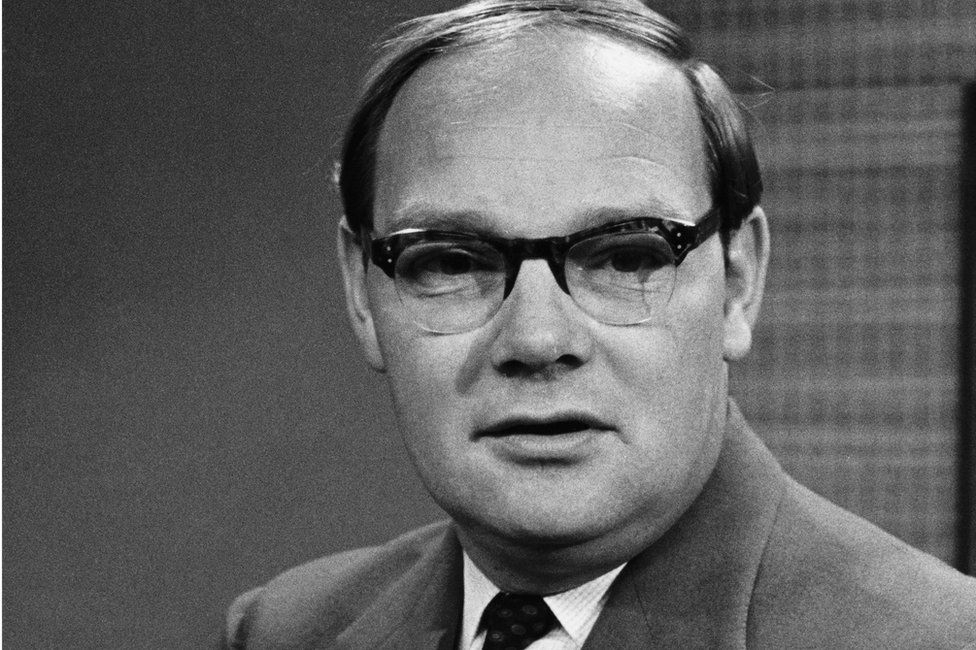
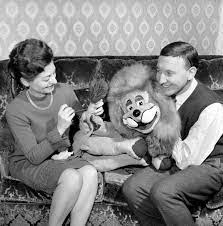
Web Page 3048 2nd March 2023 Lenny the Lion First Picture: Terry and Lenny
Second Picture: Lenny at Home
Third Picture: Lenny and Emu
Forth Picture: Terry Hall blue plaque
Terence "Terry" Hall. He appeared regularly on television with his puppet, Lenny the Lion, whose catchphrase was "Aw, don't embawass me!" Terry Hall is credited with having been one of the first ventriloquists to use a non-human puppet. He was born on 20th November 1926 in Chadderton, Lancashire, where his parents ran a local working men's club and was educated at St Patrick's School in Oldham and at De La Salle College in Pendleton, Salford. t was clear from an early age he would be talented and he played the accordion at Nimble Nook Working Men's Club from the aged of 12. He initially worked as a ventriloquist with a boy dummy, named Mickey Finn, and he won a talent show aged 15. Terry Hall created Lenny the Lion in 1954 after he visited the zoo while working at the summer season in Blackpool. Lenny was made from an old fox fur and papier-mĂ¢chĂ©, with a golf ball for the nose. He originally had a mouthful of fearsome teeth, but they were removed at the suggestion of the singer Anne Shelton to avoid scaring children in the audience. Terry and Lenny first appeared on BBC Television in 1956, in a variety show entitled Dress Rehearsal that also signaled Eric Sykes's television debut. The Lenny the Lion Show ran on from 1957 to 1960, followed by Lenny's Den in 1959 to 1961, and the pop music show Pops and Lenny in 1962 to 1963 and in 1958 Bill Mevin created a comic strip based on Lenny the Lion. Terry and Lenny visited the United States in 1958, making his debut on The Ed Sullivan Show that year. Throughout the 1960s, Terry Hall and Lenny appeared on stage in Blackpool and on television. The Beatles made one of their early TV appearances in a 1963 episode of Pops and Lenny, singing "From Me to You" and "Please, Please Me". David Bowie's father, Hayward Jones, worked on the show, and launched the Lenny the Lion Fan Club. Lenny advertised Trebor mints for three years and Terry Hall released a single, "Lenny's Bath Time", in 1963. In spite of the fact that Terry was a staunch Oldham Athletic fan, during the 1957–58 English football season, he took Lenny to the Den which was then the home of Millwall F.C. and allowed Lenny to pose with his "fellow Lions" for publicity shots, much to the delight of all present in the ground. They continued to work in variety through the 1970s, appearing on television in programmes such as Crackerjack and 3-2-1. From 1977 to 1980, They regularly appeared in the educational television programme Reading With Lenny. He wrote the Kevin the Kitten series of children's reading books which accompanied the series. Terry Hall married twice. He had two daughters from his first marriage to Kathleen Mary Hall, who died. He married a second time in 1980, to dance teacher Denise Francis. He suffered from Alzheimer's disease in later life, and died in 2007 in Coventry aged 80. The Lenny the Lion Song "I'm Lenny The lion and I'd like to say I'm strong and ferocious, but I'm not that way. I wish I had courage then I'd shout with glee that I'm Lenny the Lion, so Don't Embawass me!" Stay in Touch Peter gsseditor@gmail.com

Thursday, 23 February 2023

Web Page 3046 24th February 2023 Victor Silvester First Picture: Victor Silvester
Second Picture: 78 rpm record
Third Picture: Victor Silvester Orchestra
Forth Picture: The Twist
Victor Marlborough Silvester OBE (25 February 1900– 14 August 1978) was an English dancer, writer, musician and bandleader. He was a significant figure in the development of ballroom dance during the first half of the 20th century, and his records sold 75 million copies from the 1930s through to the 1980s He was born the second son of a vicar in Wembley and was educated at Ardingly College, St. John's School, Leatherhead and John Lyon School, Harrow, from all of which he absconded. He claimed that he enlisted in the British Army on 4 September 1916, during the First World War, serving as a private in the Argyll and Sutherland Highlanders, and that he lied about his age to the recruiting authorities, stating this as 20 whereas he was only 16. He supposedly took part in the Battle of Arras, and said he was a member of five execution squads, where deserters were shot. However, the release of his service records in 2000 revealed that he had been discharged from the Argyll and Sutherland Highlanders as underage on 12 September 1916, after just a week of service. However, he immediately joined the First Aid Services (the Red Cross and St John Ambulance), and served with them in France from 1 October 1916 to June 1917, before transferring to the First British Ambulance Unit For Italy. On 4 September 1917 at Sella di Dol while acting as a stretcher bearer to evacuate wounded Italian servicemen during a heavy bombardment was injured in the leg by a shell burst, but refused medical treatment until the other wounded had been attended to. For his gallantry he was awarded the Italian Bronze Medal of Military Valour. In a letter to parents dated 20 September 1917, his Commandant wrote: "He is certainly one who will be deservedly loved wherever he goes in life, and he is besides made of sterling stuff." After the war he studied at Worcester College, Oxford for a year. He decided to resume a military career when he was offered a place at the Royal Military College, Sandhurst, but he quickly decided it was not for him. He also studied music at Trinity College, London, having already had private piano lessons as a child. His interests had turned to dancing. He was one of the first post-war English dancers to feature the full natural turn in the slow waltz. This was a factor in his winning the first World Ballroom Dancing Championship in 1922 with Phyllis Clarke as his partner. He married Dorothy Newton a few days later He competed again in 1924, coming second. he was a founding member of the Ballroom Committee of the Imperial Society of Teachers of Dancing and published the first book embodying the new standards in 1927. He went on to open a dancing academy in London, which eventually developed into a chain of 23 dance studios. By the early 1930s, his teaching had become famous and he had taught some of the top celebrities of the day. He had his own BBC television show through the 1950s, called BBC Dancing Club and was later the President of the Imperial Society of Teachers of Dancing. The lack of what he felt were adequate records for dancing led him in 1935 to form his own band, later named Victor Silvester and his Ballroom Orchestra. He insisted his recordings conform precisely to the beats per minute recommended for ballroom dances, In British eyes he became indelibly associated with the catch-phrase "slow, slow, quick-quick-slow". His band always had a distinctive sound, achieved by an unusual line-up including, as well as the usual rhythm section, alto saxophone, a lead solo violin and two pianos, one taking turn in solos and the other maintaining an improvised tinkling continuo in the background throughout every piece. Silvester himself usually did not play (he was a violinist), but stood in front of his orchestra in white tie and tails, conducting with a flourish. He continued to make music for half a century, mostly covering the popular music standards and show tunes, sometimes swing, trad jazz and in latter years, especially from 1971 when the orchestra continued under his son, Victor Silvester Jr, rock and roll, disco and pop. There were other bands led by musicians who were capable of recording in strict time. The best for ballroom competitions was probably Joe Loss, who had an even longer musical career. He was the subject of This Is Your Life in 1957 when he was surprised by Eamonn Andrews at the BBC Television Theatre. Victor Silvester was appointed OBE in 1961. He died while on holiday in the south of France at the age of 78. The orchestra remained in existence under his son's direction until the 1990. Victor, his wife and son are memorialised at Golders Green Crematorium, London. Stay in Touch Peter gsseditor@gmail.com

Thursday, 16 February 2023

Web Page 3044 17th February 2023 Lionel Blair First Picture: Publicity Picture
Second Picture: Lionel and his wife
Third Picture: Lionel in his early tv days
Forth Picture: Wedding picture with Bernie Winters
Lionel Blair was born Henry Lionel Ogus on12th December 1928 and was a Canadian-born British actor, choreographer, tap dancer, and television presenter. From the late 1960s until the early 1980s, he made regular appearances as a dancer and entertainer on British television. He also presented the quiz programme Name That Tune, and was a team captain on the televised charades gameshow Give Us a Clue. Henry Lionel Ogus was born in Montreal to Jewish parents, Myer Ogus and Debora "Della" Greenbaum. His father, a barber, emigrated from Russia to Canada to start a new life, and his wife joined him shortly afterwards. Lionel Blair came to Britain when he was two years old, and the family settled at Stamford Hill in north London, where his father continued to work as a barber. Although his parents were Jewish they were not orthodox; they would eat chicken on a Friday night, but also ate bacon. Due to the anti-semitism of the time, his father changed the family name to Blair. Lionel’s first public performances were with his sister Joyce (1932–2006) in the Manor House station air raid shelters and on the trains of the Piccadilly line during the air raids of the Second World War. During the Blitz, mother and children were evacuated to Oxford, but when they saw a German plane crash from the back garden, the family decided they might as well be in London. When Blair was thirteen, his father died after what should have been a routine operation on an ulcer. After this, Blair became the breadwinner for the family and took to the stage. He started out with girlish parts, as his voice had not yet broken. He was singled out in several reviews for his performance as one of the children in a touring performance of the play Watch on the Rhine during 1943, and attended the Royal Shakespeare Theatre in Stratford in 1944. In 1946, he joined a touring company called the Savoy Players. He rekindled his passion for musical theatre and began working in the West End. He gave up acting for dancing in 1947, although he subsequently appeared in a national tour of Who Killed Agatha Christie. He took his stage name around this time later changing it by deed poll just before he married in 1967; his sister also decided to use the same surname professionally Before his break into television, he had played the juvenile lead in The Five Past Eight Show at the Alhambra Theatre, Glasgow, where he played straight man to many Scottish comedians, including Jimmy Logan. By the mid-1950s he was choreographing shows at the Alhambra which were considered stylish and were hugely popular. He came to the fore in the 1960s when, with his dance troupe, he appeared on television variety programmes. He also appeared in the films The Limping Man (1953), The World of Suzie Wong (1960), The Cool Mikado (1963), The Beauty Jungle (1964), A Hard Day's Night (1964), Maroc 7 (1967) and Absolute Beginners (1986), cameoed in an episode of The Persuaders!, and appeared in television comedy, including the short film, The Plank. In addition, he choreographed films such as Jazz Boat (1960), in which he made an uncredited appearance, and The Magic Christian (1969). He appeared in Miss World 1969 and 1970 at the Royal Albert Hall in London. He was one of the team captains on the game show Give Us a Clue from 1979 until the early 1990s, and was the second presenter of the British version of Name That Tune in the 1980s. In 1980, he made a small contribution to the children's music album Captain Beaky and His Band. In 1983, he appeared as the celebrity dart player for charity on Bullseye. He published his autobiography Stagestruck in 1985. In 2005, he took part in the Channel Five reality series, The Farm. Until 2005, he appeared extensively in pantomime, for which he earned up to £15,000 a week. In 2003, he released his first full-length album as a singer, in a tribute to Fred Astaire titled Blair Sings Astaire. He continued to work as an actor, having filmed an episode of BBC One's medical soap opera Doctors in 2014. He appeared in the British short film Evil's Evil Cousin in 2016. On 14 December that year, he guested on the ITV panel show, Loose Women, to announce and celebrate his recent 88th birthday. The panellists presented him with a personalised cake. In 2017, He was one of the celebrities appearing in the second series of the BBC reality series The Real Marigold Hotel. In 2018, he joined 26 other celebrities at Metropolis Studios, to perform an original Christmas song called "Rock with Rudolph. The song was recorded in aid of Great Ormond Street Hospital In 2019, he was named "Oldie of the Year" at the annual awards promoted by The Oldie magazine. He always found working on pantomime particularly lucrative and reported that he could earn £100,000 for a six-week run. He married Susan Davis at Kensington Register Office on 21 March 1967, with Bernie Winters as best man. They had three children and three grandchildren and celebrated their 50th wedding anniversary on 21 March 2017. The couple lived in Banstead, Surrey. On 21 September 2006, he and comedian Alan Carr helped save a man about to fall from a pier in Blackpool. The man was holding on by his fingers.[36] Lionel Blair died on the morning of 4 November 2021, at the age of 92. Stay in Touch Peter gsseditor@gmail.com Forth Picture: Wedding picture with Bernie Winters Lionel Blair was born Henry Lionel Ogus on12th December 1928 and was a Canadian-born British actor, choreographer, tap dancer, and television presenter. From the late 1960s until the early 1980s, he made regular appearances as a dancer and entertainer on British television. He also presented the quiz programme Name That Tune, and was a team captain on the televised charades gameshow Give Us a Clue. Henry Lionel Ogus was born in Montreal to Jewish parents, Myer Ogus and Debora "Della" Greenbaum. His father, a barber, emigrated from Russia to Canada to start a new life, and his wife joined him shortly afterwards. Lionel Blair came to Britain when he was two years old, and the family settled at Stamford Hill in north London, where his father continued to work as a barber. Although his parents were Jewish they were not orthodox; they would eat chicken on a Friday night, but also ate bacon. Due to the anti-semitism of the time, his father changed the family name to Blair. Lionel’s first public performances were with his sister Joyce (1932–2006) in the Manor House station air raid shelters and on the trains of the Piccadilly line during the air raids of the Second World War. During the Blitz, mother and children were evacuated to Oxford, but when they saw a German plane crash from the back garden, the family decided they might as well be in London. When Blair was thirteen, his father died after what should have been a routine operation on an ulcer. After this, Blair became the breadwinner for the family and took to the stage. He started out with girlish parts, as his voice had not yet broken. He was singled out in several reviews for his performance as one of the children in a touring performance of the play Watch on the Rhine during 1943, and attended the Royal Shakespeare Theatre in Stratford in 1944. In 1946, he joined a touring company called the Savoy Players. He rekindled his passion for musical theatre and began working in the West End. He gave up acting for dancing in 1947, although he subsequently appeared in a national tour of Who Killed Agatha Christie. He took his stage name around this time later changing it by deed poll just before he married in 1967; his sister also decided to use the same surname professionally Before his break into television, he had played the juvenile lead in The Five Past Eight Show at the Alhambra Theatre, Glasgow, where he played straight man to many Scottish comedians, including Jimmy Logan. By the mid-1950s he was choreographing shows at the Alhambra which were considered stylish and were hugely popular. He came to the fore in the 1960s when, with his dance troupe, he appeared on television variety programmes. He also appeared in the films The Limping Man (1953), The World of Suzie Wong (1960), The Cool Mikado (1963), The Beauty Jungle (1964), A Hard Day's Night (1964), Maroc 7 (1967) and Absolute Beginners (1986), cameoed in an episode of The Persuaders!, and appeared in television comedy, including the short film, The Plank. In addition, he choreographed films such as Jazz Boat (1960), in which he made an uncredited appearance, and The Magic Christian (1969). He appeared in Miss World 1969 and 1970 at the Royal Albert Hall in London. He was one of the team captains on the game show Give Us a Clue from 1979 until the early 1990s, and was the second presenter of the British version of Name That Tune in the 1980s. In 1980, he made a small contribution to the children's music album Captain Beaky and His Band. In 1983, he appeared as the celebrity dart player for charity on Bullseye. He published his autobiography Stagestruck in 1985. In 2005, he took part in the Channel Five reality series, The Farm. Until 2005, he appeared extensively in pantomime, for which he earned up to £15,000 a week. In 2003, he released his first full-length album as a singer, in a tribute to Fred Astaire titled Blair Sings Astaire. He continued to work as an actor, having filmed an episode of BBC One's medical soap opera Doctors in 2014. He appeared in the British short film Evil's Evil Cousin in 2016. On 14 December that year, he guested on the ITV panel show, Loose Women, to announce and celebrate his recent 88th birthday. The panellists presented him with a personalised cake. In 2017, He was one of the celebrities appearing in the second series of the BBC reality series The Real Marigold Hotel. In 2018, he joined 26 other celebrities at Metropolis Studios, to perform an original Christmas song called "Rock with Rudolph. The song was recorded in aid of Great Ormond Street Hospital In 2019, he was named "Oldie of the Year" at the annual awards promoted by The Oldie magazine. He always found working on pantomime particularly lucrative and reported that he could earn £100,000 for a six-week run. He married Susan Davis at Kensington Register Office on 21 March 1967, with Bernie Winters as best man. They had three children and three grandchildren and celebrated their 50th wedding anniversary on 21 March 2017. The couple lived in Banstead, Surrey. On 21 September 2006, he and comedian Alan Carr helped save a man about to fall from a pier in Blackpool. The man was holding on by his fingers.[36] Lionel Blair died on the morning of 4 November 2021, at the age of 92. Stay in Touch Peter gsseditor@gmail.com

Thursday, 9 February 2023

Web Page 3042 10th February 2023 Cremola Foam First Picture: Drums of Cremola Foam
Second Picture: Cremola mug
Third Picture: Cremola advert
In 2005, Allan McCandlish of Cardross started producing a re-creation of Creamola Foam under the name ‘Kramola Fizz’. In April 2019, his daughter Agnes and son Andrew of McCandlish Farmhouse Confectionery relaunched the product under its original name of Creamola Foam (registered trademark) and is now available on the shelves again in Scotland as well as worldwide. Creamola Foam came in the form of coloured crystals which were dissolved in cold water to form a sweet, fizzy drink. It was packaged in a small tin labelled with a cartoon girl and boy drinking with straws. The drink originally came in raspberry, orange, and lemon flavours; and cola was a later addition to the range. The product was originally owned by Rowntrees before coming under the banner of Nestle UK until being sold off to Premier Foods. The relaunched Creamola Foam drink now comes in 17 different flavours, including the original flavours which are Raspberry, Orange, Lemon, and Cola. The original packaging consisted of a small tin with a tight metal lid, normally pried off with a teaspoon. A paper seal covered the foam crystals. The packaging included the phrases: • "CREAMOLA FOAM CRYSTALS" • "MAKES 10 BIG DRINKS" • "FULLY SWEETENED" The original ingredient list read: • Sugar • Fruit acids • Sodium bicarbonate • Gum acacia, a thickener/stabiliser • Saccharin • Saponin, a foaming agent • flavouring • colour A revision was introduced in the 1980s featured a plastic lid and modernised branding. The label reads, "Creamola FOAM". The ingredients were: • Sugar • Citric acid • Sodium bicarbonate • Tartaric acid • Flavoring • Saccharin, sweetener • Gum acacia, stabiliser • Extract of quillaia, a foaming agent • Carmine, food coloring agent (in this example, raspberry flavor) The effervescence, when the powder dissolves as it is stirred into water, is due to the reaction of the citric and tartaric acids with sodium bicarbonate, forming carbon dioxide gas. These weak organic "fruit" acids also provide a sharp taste. The addition of stabiliser and saponaceous foaming agents extends the life of the bubbles. The artificial colouring and flavouring, plus the fruit acids, give the impression of a fruity base, although the recipe is essentially synthetic. Stay in Touch Peter gsseditor@gmail.com

Wednesday, 1 February 2023

Web Page 3040 5th February 2023 Eli Woods First Picture: Eli Woods
Second Picture: Jimmy James
Third Picture: Roy Castle, Jimmy James and Eli Woods
Eli Woods was born John Casey on the 11th January 1923 comic actor, who was born in Stockton-on-Tees in County Durham and, possibly best known for his work with stage comedian Jimmy James (who in reality his uncle), and particularly for his part in the famous 'elephant-in-the-box' routine. He made his first professional appearance on the stage of the Hippodrome Theatre in Aldershot in Hampshire. Jimmy James developed his famous act over many years, but from the first it required two 'stooges'. One was John "Jack" Casey—tall and stick-thin, with a bony face and a stammering delivery—who originally appeared as "Bretton Woods" (named after the location of the famous 1944 United Nations monetary and financial Conference), and only later redubbed as "Eli" Woods (often "Our Eli"). The other stooge, 'Hutton Conyers' would be played either by members of the Casey family - including, on occasion, James Casey - or (from 1956 to 1959) by Roy Castle. Much later, Eli Woods was in the support cast of Castles in the Air, a comedy series that was on BBC Radio 2. During the late 1970s and early 1980s, Eli Woods featured in three Eddie Braben scripted comedy shows: The Worst Show on the Wireless (20 episodes, 1973 -75) The Show With Ten Legs (26 episodes, 1978–80) and The Show with No Name (13 episodes, 1982–84). Both shows harked back to the UK’s music hall tradition. As a performer, Eli Woods turned his lifelong stutter to his advantage, using it to comic effect in many contexts. For many years he was active as a stage and radio performer, he also appeared in a number of television comedies, as well as playing small parts in a variety of films including A Private Function released in 1984. The apex of his career (in terms of recognition) was appearing in a comedy sketch (the elephant in a box routine) with James Casey and Roy Castle in the 1982 Royal Variety Performance in which they also sing Kisses Sweeter than Wine. Although Eli Woods's birth name was John Casey, he was always better known to his family as Jack. He died at home in Stockton-on-Tees in the early hours of Thursday 1st May 2014, aged 91 Stay in Touch Peter gsseditor@gmail.com