Total Pageviews

Translate

Wednesday, 26 July 2023

Web Page 3091 29th July 2023 First Picture: Farlington Naval Estate
Second Picture: Farlington Race Course
Third Picture: The Marshes
Forth Picture: The George
Sitting in the sunshine in my garden in Gosport the other day I thought back to the days when I grew up in the Drayton/Farlington area, the days when the sun always shone and the biggest problem that we had was what to spend our pocket money on in Mr Shaws’ corner tuck shop in Highlands Road and Solent Road. Our play area when we were kids was enormous stretching from Portscreek to way over the hill to Widley, from Forty Acres tM Cosham High Street also taking in the Highbury estate. Farlington Marshes was always a favourite area for us, especially the bit of derelict land, where the Farlington Racecourse used to be before the war, between the Eastern Road and the Cosham Railway Triangle. Here we could explore the area which,, by that time was covered by bracken and brambles. Here we would make dens, float home made rafts and of course go fishing after having dug up the lugworms from the mud to use as bait. I only ever remember catching crabs, never ever a fish. The other side of the Eastern Road, which is now the nature conservation area, was also a favourite. Here we could discover abandoned military buildings and various other items of wartime use. Here we could dig up the underlying cordite and blow large holes in the mud. Highly dangerous but very enjoyable. Another source of enjoyment was the number of chalk pits which could be explored. Our favourites were two, the one at the top of Gillman Lane, this had some very strong vegetation through which we could climb across the chalk face of the pit and the pit at the top of Drayton Lane. This last one was rather overgrown and was a great favourite with most of us providing we did not upset the elderly gentleman who lived in a green painted corrugated iron hut in the neighbouring pit on the other side of the Lane. The hill itself was an adventure playground. In the late 1950’s and early 60’s the land was left unattended and so come the summer the whole of the hill was covered in long grass. This was to provide a fun area from the days of riding your bike through the long grass hoping not to hit a rabbit hole right through to our courting days. (You could not beat the long grass!!) Further along the hill we would explore around the forts and surrounding areas and up into Deadmans Wood, which today is a shadow of its former self as it has been manicured to fit in with the golf course off Crookhorn Lane on which it now stands. All this seemed to start to come to an end in the early 1960’s when the council granted permission for the Royal Naval estate to be built at the top of Farlington Avenue with the road pushed through to the hilltop road. This was followed by building permission being given for houses and industrial units to be built on a lot of the vacant plots of land on which we played. Such is progress. But still I have the memories of happy hours spent on the hill and the marshes, around Flint House and the chalk pits and of an evening buying a bag of chips from Mr Francis chip shop in Drayton and eating them on the way home having added the obligatory salt and vinegar and maybe the server would have also have included just a few scraps to help the snack on its way. I must be getting old. Stay in touch Peter gsseditor@gmail.com Griff Writes:- I can't remember if the pet shop in the Drayton parade of shops had a name or not but there is a good chance it was probably called "Drayton Pet Shop". I think it was next door to the Co-op? My memory has faded on the positioning of some of these Drayton shops. Anyway it's a good time to resurrect Tiggy the Tortoise who has just spent his two weeks Summer holiday with us whilst my Son and family went on holiday. Tiggy is still in fine fettle and in the best of health. Fed on the finest wafer thin sliced carrots and cucumber and dandelion leaves and the flower heads. To turn him into a turbo tortoise he gets his sugar rush from a fresh strawberry and then does he speed around the garden lawn. Contrary to popular belief tortoises can move fairly quickly when they want to and they are thoroughly warmed up by the Sun. I have had Tigs. since I was 10 years old, bought from the Drayton pet shop for 2/6d. He is a Moroccan tortoise and would have been around 3-5 years old when he came to the UK in or around 1958'ish. He does hibernate in the Winter from November to March in his own purpose built tortoise des. res. detached house built by my Son. My two Granddaughter's look after him at my Son's house. Just think he will outlive all of us as a healthy tortoise can easily live to 150 years old.
Regards to all Melvyn (Griff) Griffiths.
Web Page 3089 21st July 2023 First Picture: Start-Rite Poster
Second Picture: Childrens sandals
Third Picture: X Ray machine
Forth Picture: Norwich Factory
Start-rite is a brand of children's shoes that purportedly is Britain's oldest and one of the first shoe manufacturers in the country. The company was established in 1792 in Norwich by James Smith. His grandson, James Southall, gave the firm its current name; and it rose in prominence during the 20th century thanks in part to an iconic poster, reading Children's shoes have far to go, which was displayed on the London Underground for 20 years from 1947. Controversy exists around the origins of the image in this poster. It has been attributed to artists Andy Wood, William Grimmond, Joe Wilkinson of Stanley Studios, Susan Pearce, Nancy Gardner and to the company's own advertising agent. In 1955 Start-rite was granted a royal warrant by the late Queen Elizabeth II to supply footwear for the young Prince Charles, Princess Anne, Prince Andrew and Prince Edward. The company was granted a second royal warrant in 1989 by the Prince of Wales to supply children's footwear for Prince William and Prince Harry. This royal warrant was withdrawn in 2003 on production being moved from the UK. In 2016 Prince George was pictured wearing Start-rite shoes in an official portrait taken to commemorate the 90th birthday of the Queen. In 2003 the company ceased production in the UK, outsourcing its operations to India and Portugal The cost cutting move came amid a £600,000 annual loss, which the company reversed the following year to turn a £1.5 million profit. Sales further increased by 20% to 2007. The company focuses on correctly fitting shoes to children's feet, and was the first to introduce variable width fittings for children's shoes. In 1943 the company carried out the first ever nationwide survey of children’s feet, bringing together experts not just in shoemaking, but in medicine and education and the findings transformed the way children’s shoes are designed and fitted. Startrite stated that they believed small things could make a big difference when it comes to enabling children to move with comfort and confidence, and they took the decision to create their shoes in multi-width fittings and in half as well as whole sizes. As proud experts in children’s foot health they committed to quality of care and supporting children’s healthy foot development and this remains a core part of their product development.. The iconic advertising image of the twins, called by Startrite as their twin adventurers have been at the heart of the Start-Rite brand for over 70 years. The two adventurers represent the journey of a child’s development – with Start-Rite here to support them every step of the way. The twins are the ultimate visualisation of their pioneering spirit. Start-Rite proudly say is a business built by, and for, families. I remember that my mother would only ever buy me Start-Rite shoes and sandals when I was a kid. She always bought them from Smith’s shoe shop on the Havant Road in Drayton. The shop was run by a short Welshman, Mr Smith, despite having one of the enormous foot x-ray machine it looked really incongruous set in the rather tatty and dusty shoe shop. Stay in touch Peter gsseditor@gmail.com

Wednesday, 12 July 2023

Web Page 3087 14 th July 2023 First Picture: As Sir Lancelot Spratt
Second Picture: Poster
Third Picture: With Diana Dors
Forth Picture: With Margaret Rutherford
James Robertson Justice was born on 15th June 1907 and died 2nd July 1975. He is best remembered for portraying pompous authority figures in comedies including the films in the Doctor series. He also co-starred with Gregory Peck in several adventure movies, notably The Guns of Navarone. Born in south-east London to a Scottish father, he became prominent in Scottish public life, helping to launch Scottish Television (STV) and serving as Rector of the University of Edinburgh (1957-60 and 1963-66). His father Aberdeen-born mining engineer James Norval Justice and Edith (née Burgess), James Robertson Justice was born James Norval Harald Justice in Lee, Lewisham . Educated at St Hugh's School, Bickley, Kent and Marlborough College in Wiltshire, he studied science at University College London, but left after a year and became a geology student at the University of Bonn, where he again left after a year. He spoke many languages including Spanish, French, Greek, Danish, Russian, German, Italian, Dutch and Gaelic. He returned to the UK in 1927, and became a journalist with Reuters alongside Ian Fleming. After a year, he emigrated to Canada, where he worked as an insurance salesman, taught English at a boys' school, became a lumberjack and mined for gold. He came back to Britain penniless, working his passage on a Dutch freighter washing dishes in the ship's galley to pay his fare. On his return to Britain, he served as secretary of the British Ice Hockey Association in the early 1930s and managed the national team at the 1932 European Championships in Berlin to a seventh-place finish. He combined his administrative duties in 1931–32 with a season as goalie with the London Lions. He entered driving a Wolseley Hornet Special in the JCC Thousand Mile Race at Brooklands on 3 and 4 May 1932. The car was unplaced. The following year a "J. Justice (J.A.P. Special)" competed in the Brighton Speed Trials: "Justice's machine 'Tallulah' noisily expired before the end of the course, and was pushed back to the start by way of the arcade under the terrace." He left Britain again to become a policeman for the League of Nations in the Territory of the Saar Basin (a region of Germany occupied and governed by France and Germany under a League of Nations Treaty of Versailles). After the Nazis came to power, he fought in the Spanish Civil War on the Republican side. It was here that he first grew his signature bushy beard, which he retained throughout his career. On returning to Britain, he joined the Royal Naval Volunteer Reserve, but after sustaining a wound in 1943 he was honourably discharged from the service with a pension. He married nurse Dillys Hayden in Chelsea in 1941, and they had a son, named James. On his return from the war, he reinvented himself with stronger Scottish roots, dispensing with his two middle names and acquiring the new middle name Robertson out of his habit of wearing Robertson tartan. Feeling strongly about his Scottish ancestry. He unsuccessfully contested the North Angus and Mearns constituency for the Labour Party in the 1950 general election. With his earnings from the film Doctor in the House (1954), he purchased a cottage in the Scottish Highlands village of Spinningdale. In 1966 he appeared as a narrator in five episodes of the BBC children's television series Jackanory, telling stories and legends from Scotland. He pursued acting after joining the Players' Theatre in London. Under the chairmanship of Leonard Sachs, who latterly was the chairman of The Good Old Days, the club would stage Victorian music hall nights. With his domineering personality, bulky physique (he played rugby for Beckenham RFC First XV alongside Johnnie Cradock who would become the partner of 1950s TV chef Fanny. With his rich, booming voice, he soon established as a major supporting actor in British comedy films Best remembered as the demanding surgeon Sir Lancelot Spratt in the "Doctor" series of film. On 31st August 1957, he helped launch the TV station Scottish Television (STV). From 1957 to 1960, and again from 1963 to 1966, he was Rector of the University of Edinburgh. After a series of affairs and the accidental drowning of his four-year-old son in 1949 near his watermill home in Whitchurch, he separated from his wife; she eventually divorced him in 1968. He met actress Irene von Meyendorff in 1960 and they remained together, eventually marrying in 1975 three days before he died. Stay in touch Peter gsseditor@gmail.com Mary writes I really enjoyed reading today`s blog as it brought back so many happy memories. I remember visiting Dennis the chemists with my mother, who always said what a wonderful couple Mr& Mrs Dennis were. Many yrs later I worked in the pharmacy of Boots the Chemists in Cosham high St & met their daughter in law. I was taken to that shoe shop from an early age for my Startrite shoes. I often bless my parents as I still have nice straight toes! Another favourite place was the ice cream parlour. My mother would buy fresh fish from Slapes. I still enjoy fish today, although it`s quite expensive these days. Fish was considered a cheap meal in those days. There was the woolshop run by Miss Moffat. Apparently aged 3 I told my father we`d been in Miss Mocktit`s shop! He managed to suppress a giggle my mother told me. The fried fish & chip was a favourite special treat & my father had worked for them. Nappers also springs to mind,

Wednesday, 5 July 2023

Web Page 3085 7th July 2023 First Picture: Lights Ironmongery
Second Picture: The Broadway with Slapes
Third Picture: Broadway Garage
Forth Picture: Havant Road
Richard Newman’s Drayton Memories Part Two Shopping in Drayton Shopping was usually in Drayton with my mother. Once Dysart Road had been extended this provided a shorter route to the shops and the west side of Lower Drayton Lane contained Privett’s lorry yard behind a long brick wall, an old barn and a lane to Drayton farmhouse. At the top of Lower Drayton Lane, adjacent to the Wellington Terrace “cut off” a squirrel that lived in the large trees On a Monday afternoon we would visit Pinks the grocers (230-232 Havant Road) who had stores all over the Portsmouth and surrounding areas. It was very much a typical grocery with a general counter to the left and a bacon/cheese counter to the right with displays in the middle of the shop. At the back was the managers office (Mr Marshall subsequently succeeded by Mr Southern); this was built of a dark timber with plenty of windows to view the shop and there was a clock in the middle of the frontage. The order would be placed on a Monday – inscribed appropriately on a pink carbon form – with delivery of the goods in a cardboard box in their green van on a Thursday. While my mother debated whether she needed jam, marmalade, Golden Syrup or Quix washing up liquid I would clamber onto the round backed chair and wait patiently knowing that in due course we would catch a bus Bedhampton where I could play on the iron rocking horse in the Recreation Ground. Edwards the greengrocers (at 157) also offered a similar delivery service and Vivienne, the owner’s daughter would call at the house on her bicycle to collect the order each Tuesday. Another cardboard box containing fruit and veg would be delivered on Thursday. Meat was purchased from Street’s but when this became a motorcycle supplier under the ownership of Doreen, Mr Street’s wife, after her husbands death my mother crossed over the road and shopped at Cooper’s. As required she would visit Stewart the chemist (at 246) where there was a distinctive blue enamelled weighing machine. Campions (214), Smith and Vospers (228) or Westons, later Greens (256) for bread and cakes; the Post Office which was divided into a stationary shop run by Mrs Brown the postmistress; Slapes for wet fish and Flemings (234) the newsagent usually to pay for the weeks delivered newspapers. My father would buy his pipe tobacco at Jarmans (244) the sweat shop and tobacconist run by Mr and Mrs Keys, While if I needed a haircut I would be take to the hairdressers run by Jack England in a room behind the sweet shop. Occasional visits would be made to Nappers or Lights (129/131) for ironmongery or garden requirements. Mr Smiths shoe shop (260) if I required a new pair of Start-Rite shoes or sandals (Mr Smith was a Welshman and he and he and his wife kept an elderly cat that would be curled up on the shoe boxes). Wynns toy shop in the wartime Nissan hut formerly used as the British Restaurant and in the same building Mr Jones the watchmaker set up business. There was a shop to the front of Herberts Nursery (served by Miss Herbert) for seeds or plants. We also visited Pocklington’s Nursery a few doors down to purchase cucumbers or tomatoes and would walk down the driveway beyond the house to a wooden shed near the greenhouses where the produce was grown. An old school type bell was hung at the door of the shed and when this was rung the late Florrie Smith (whose father was Cosham’s postman when there would only have been one) would emerge from a greenhouse to deal with the order. Florrie had been in the Land Army during the war and could be seen riding her trusty bicycle fitted with a wooden box over the rear wheel. She had lived her whole life in Cosham and was insistent that it was pronounced Cos-ham and not Cosh-am as had been corrupted over the years. An occasional visit to the doctor would mean a trip to No 183 Havant Road where Dr Ian Partington had his surgery within his house, although he later moved to North End. Dry cleaning requirements were taken to Chapmans laundry (153) the branch being run by a lady called Barbara whilst Denis the chemist a few doors away was sometimes patronised. I always enjoyed bus travel and the Havant Road was served by twelve daytime services per hour, this would be enhanced by with a further more Farlington - Dockyard Services. The Corporation had in 1947 obtained powers to run trolley buses along the Havant Road but this never came to fruition. Drayton also had its own bus route (N022). This was introduced in 1958 between Upper Drayton (Troon Crescent) and Cosham soon after Lonsdale Road had been metalled and used wartime Bedford OB 26 seater buses which had been reseated with horsehair cushions Drayton was referred to as ‘the village’ by many people and was a wonderful thriving community you could always meet someone to stop and chat to. Griff Writes I see in your latest Manor Court blog the article written by Richard Newman that Flint House has been mentioned again. I have researched in years past for any photo's of Flint House without any success but I believe you had one Peter which you published years ago. If only we had mobile phones in the 1950's fitted with camera's the photo's we could have taken. Flint House and the grounds were my playground back then and I can confirm that one Charlie Harris and myself both young 10 year old residents of Station Rd. entered into Flint House by gently removing the corrugated iron that was blocking the window off as a security measure. We went all around the floors of Flint House and I have to say it was in very good condition inside from what I remember. The one thing I do clearly remember though was the line of coat hooks with childrens names under the hooks and that would confirm what I discovered many years later that Flint House was used as a temporary children's home during WW2. Charlie and I went inside Flint House many times and we were always very careful to cover our tracks by ensuring that the corrugated iron security panel was put back and looking as if nobody had touched it. Regards to All Melvyn (Griff) Griffiths. Stay in touch Peter gsseditor@gmail.com

Wednesday, 28 June 2023

Web Page 3083 30th June 2023 First Picture: Drayton Manor
Second Picture: Farlington station
Third Picture: Cosham station 1966
Forth Picture: St Philips Highbury
Richard Newman’s Drayton Memories Part One Homelife and Schooldays My parents purchased what was to become the family home in Dysart Avenue for £325 in 1939. The houses on the north side were built in 1938 but our property was not completed until 1940 because of wartime building materials shortages. The Dye (Ernie was the father) constructed these houses which was part of the Drayton Manor Estate – a name only used in the planning stages They rented out a number of houses in the road retaining ownership until the last 1960’s .My parents had married in 1939 so had to live with my grandfather in North End until their house was ready for occupation, although my father, working for the Admiralty in Southampton rented in Portswood because the train services were frequently disrupted by air raids. When built, the houses in Dysart Avenue had an uninterrupted view across undeveloped land to the railway line (between Cosham Junction and Farlington Junction) and my father had an allotment on the land later developed as Braemar Avenue. A bomb dropped near the railway and the blast blew in the French Doors and at the back of the house and blew out the front door. The bathroom wash basin was broken by a stone hot water bottle being blown into it. The only other incident recollected by my parents was the dropping of an incendiary onto the flat veranda of the house next door but one. My father and his neighbours, fire watching, managed to extinguish the fire before it got control. I was born in 1948 and grew up in Dysart Avenue. By then the wartime Andersen shelter had been removed but a slight dip in the back garden lawn indicated where it had been. In those days a trip to Drayton shops necessitated walking via Tregaron Avenue and the Havant Road as access was not permitted through the grounds of the empty Drayton Manor which had bee requisitioned during the war. In the early 1950’s part of the manor was demolished (creating a woodworm problem elsewhere) and the main house and stables became inhabited again. New houses were built in the grounds and Dysart Avenue extended into Lower Drayton Lane with the removal of some lofty trees. A regular Sunday walk was to see the electric trains from the wartime girder bridge spanning the tracks at the site of (closed in 1937)/ En route we would follow the lane passing the derelict Flint House and on the other side the Coop Sports Ground behind the Bakery complex. Plenty of blackberries could be found in the lane come autumn. In later years I watched the trains, with school friends from Cosham Junction (opposite St Phillips church) from the scrubland behind Kinross Crescent. I started school in April 1953 installed in the old chapel at the end of Mulberry Path but in the next academic year I was one of the first pupils in the new infants school constructed at the junction of Court Lane and Hilary Avenue (then unadopted and full of potholes). The teachers at the chapel were Mrs Pattern, Miss Box and Miss Habershaw-the latter could be slightly frighting to a five year old but we contributed to her retirement gift of an umbrella. Miss Waters, who lived in Carnarvon Avenue, was the headmistress of the new school, T the age of seven I moved to the junior school which was situated in the prewar buildings further down Hilary Avenue. However during the first year we occupied an overflow annex in the Goodwyns Youth Club near the Old Lamplighters’ cottage at the end of Salisbury Road. Form 1 boys was a happy class taught by Mr Jones an accomplished artist who was eager to encourage and educate his pupils. The building was adjacent to the railway line and Mr Jones raise no objection if we looked out of the window at the trains during class. We moved back to the main school for the next three educational years and were well taught by Messrs. Butler, Woodall and Ternooth. Next time shopping in Drayton Richard Newman’s Drayton Memories Part Two Shopping in Drayton

Wednesday, 21 June 2023

Web Page 3081 23rd June 2023 First Picture: Kit Kat
Second Picture: Orange Kit Kat
Third Picture: Chunky Kit Kat
Forth Picture: Vegan Kit Kat
Kit Kat Kit Kat the chocolate covered wafer was created by Rowntree's of Yorknand is now produced by Nestlé (which acquired Rowntree's in 1988, except in the United States, where it is made under licence by a division of the Hershey Company . The standard bars consist of two or four pieces composed of three layers of wafer, separated and covered by an outer layer of chocolate. There are many flavours of Kit Kat, including milk, white, and dark chocolate. The original four-finger version was developed after a worker at Rowntree's factory put forward a suggestion for a chocolate bar that a man could take to work in his lunch pack. It was launched in September 1935 in the UK as Rowntree's Chocolate Crisp, and the later two-finger version was launched in 1936. It was renamed Kit Kat Chocolate Crisp in 1937, and just Kit Kat after World War II. Since making its first television appearance in a UK commercial in 1958, the slogan for the Kit Kat in the UK and elsewhere has been "Have a break... have a Kit Kat". Use of the name Kit Kat goes back to the 18th century, when mutton pies known as a Kit Kat were served at meetings of the political Kit-Cat Club in London owned by pastry chef Christopher Cat. The origins of what is now known as the Kit Kat brand go back to 1911, when Rowntree's trademarked the terms Kit Cat and Kit Kat. The names were not used immediately and Kit Kat first appeared in the 1920s, when Rowntree's launched a brand of boxed chocolates entitled Kit Cat. This continued into the 1930s, when Rowntree's shifted focus and production onto its Black Magic and Dairy Box brands. Kit Cat decreased and was eventually discontinued. The bar was officially launched on 29 August 1935, under the title of Rowntree's Chocolate Crisp (priced at 2d), and was sold in London and throughout southern England. Rowntree's Chocolate Crisp was renamed Kit Kat Chocolate Crisp in 1937. The colour scheme and first flavour variation came in 1942, owing to World War II, when food shortages prompted an alteration in the recipe. The flavour of Kit Kat was changed to dark chocolate; the packaging abandoned its Chocolate Crisp title, and was coloured blue. After the war the name became Kit Kat, with the original milk chocolate recipe and red packaging[. Following its success in the UK in the 1940s Kit Kat was exported to Canada, South Africa, Ireland, Australia, and New Zealand. In 1957, Donald Gilles, The brand further expanded in the 1970s when Rowntree created a new distribution factory in Germany to meet European demand and established agreements to distribute the brand in the US through the Hershey company, and in Japan through Fujiya In June 1988, Swiss company Nestlé acquired Kit Kat through the purchase of Rowntree's, giving Nestlé global control over the brand, except in the US, and production and distribution increased with new facilities in Japan and additional manufacturing operations set up in Malaysia, India and China. Variants in the traditional chocolate bar first appeared in 1996 when Kit Kat Orange was introduced in the UK. Its success was followed by several varieties including mint and caramel, and in 1999 Kit Kat Chunky was launched and received favourably by international consumers. Kit Kat bars are produced in 16 countries. 2003 was a turning point for the Kit Kat bar. The popularity of low carb diets, and healthier eating stifled sales in many parts of the world. In addition competition from Cadbury's newly formed Dairy Milk superbrand contributed to Kit Kat sales decreasing considerably in its home market. . In September 2006, Nestlé announced that they would be cutting 645 jobs in their York factory and moving all Smarties production to their Hamburg factory. In 2010, a new £5 million manufacturing line was opened by Nestlé in York, to produce more than one billion Kit Kat bars each year. As dark chocolate has seen increased demand in September 2006 the four-finger Kit Kat Fine Dark was launched in the United Kingdom as a permanent product. Nestlé now manufactures two-finger Kit Kats with natural flavourings, and in February 2021 announced the rollout of the first vegan Kit Kat, called "KitKat V". Sometimes considered a biscuit, in 2020 sales of Kit Kats were second to McVitie's biscuits in the UK in the biscuit category. Stay in touch Peter gsseditor@gmail.com

Saturday, 17 June 2023

Thursday, 15 June 2023

Web Page 3077 16th June 2023 First Picture: Gardeners World
Second Picture: Percy Throwers Garden Centre
Third Picture: Percy Thrower Memorial
Forth Picture: Percy Throwers Garden
Percy John Thrower MBE was born on 30th January 1913 and died on 18th March 1988 and he was a gardener and horticulturist, broadcaster and writer born at Horwood House in the village of Little Horwood, Buckinghamshire. He became nationally known through presenting gardening programmes, starting in 1956 with the BBC's Gardening Club, then the BBC's Gardeners' World from 1969 until 1976. The surname Thrower is peculiar to East Anglia, where Percy's father worked as a gardener at Bawdsey Manor, Suffolk, before moving to Horwood House near Bletchley, as head gardener. Percy Thrower was determined from an early age to be a head gardener like his father, and worked under him at Horwood House for four years after leaving school. He then became a journeyman gardener in 1931, at the age of 18, at the Royal Gardens at Windsor Castle, on £1 a week. He lived in the bothy at Windsor, along with twenty other improver gardeners and disabled ex-servicemen who were employed on full wages. He spent five years there under the head gardener, Charles Cook, who was subsequently to become his father-in-law. Percy Thrower left Windsor on 1st August 1935 for the City of Leeds Parks Department as a journeyman. There he passed the Royal Horticultural Society's General Exam. In 1937, he moved to Derby Parks Department, initially as a journeyman, but was promoted to be a foreman, General Foreman and finally the Assistant Parks Superintendent. At Derby, he met John Maxfield, whom he considered to be the best gardener he ever worked under. Percy studied and passed the National Diploma in Horticulture at the second attempt He also became a lecturer at Derby Technical College. He became engaged to Connie (Constance Margaret Ina) Cook, the daughter of Charles Cook, now the head gardener at Sandringham, having moved from Windsor, where Edward VIII and Mrs Simpson had interfered with the running of the gardens. In order to help him, Queen Mary, in residence at Sandringham after the death of her husband George V, instigated his move from Windsor to Sandringham. On 9th September 1939, at Sandringham, Percy and Connie married. The couple received a wedding gift of a set of Burslem china dishes from Queen Mary While at Derby, Thrower became a leading light in the "Dig for Victory" campaign in the Second World War, carrying out educational visits to many of the local parks and even Derby Sewerage Works. Percy became a Special Constable on fire-watching duties after twice being turned down for active service after volunteering. A football pools win of £52 enabled him to buy his first car, a Morris Eight. His final career move was to Shrewsbury where on 1st January 1946, he was appointed Parks Superintendent, becoming the youngest parks superintendent. He had a staff of 35. He had reached the top of his profession at just 32 years of age and it was his sole ambition in life. He remained in post until 1974 though he expected to stay only four or five years. From his first year in Shrewsbury he helped the post-war revival of the Shrewsbury Flower Show. In 1951, he was asked to design a garden in the Tiergarten area of Berlin on the lines of an English garden. He did this and the foreign Secretary Anthony Eden opened the garden in May 1952. Percy made his first TV appearance in 1951 in a programme about this garden. For many years he was the leading face and voice of British gardening on television and radio. Godfrey Baseley, the presenter of a Midland regional BBC radio programme, Beyond the Back Door, spotted his enthusiasm and he was offered a regular slot. The first TV series with which he was associated was Country Calendar, followed by Out and About. When colour television came along, this programme was renamed Gardeners' World. He became nationally known through presenting these programmes and regularly presented Gardeners' World from 1969 until 1976. He was also the gardener on Blue Peter from 1974 until 1987, appearing in over a hundred broadcasts and establishing the Blue Peter garden at BBC TV Centre. In 1983, the Italianate garden was destroyed by vandals, ruining all of his work and leaving him desolate. Percy Thrower's work for the BBC was not restricted to gardening. In the 1960s, a habitual pipe smoker, he was asked by the radio producer Tony Shryane to provide sound effects for The Archers. He gave up smoking after a heart attack in 1985. In 1963, he built his own house, "The Magnolias", near Shrewsbury, on land he acquired with a friend in the small village of Merrington,. This gave him a garden of about one and a half acres to "play with", something which he had never had before. The garden subsequently became the location for some of the episodes of Gardeners' World. He opened the garden to the public in 1966, and this became an annual event to raise money for charity. The Magnolias was demolished in 2014 as a result of structural damage. In 1967, he became involved with the development of what was one of the first garden centres, Syon Park, near Brentford, owned by the Duke of Northumberland and backed by Plant Protection, a division of ICI, who had leased 50 acres from the Duke. The centre was a success at first, but then sales tailed off and he left the project. He retired in 1974 from the post of Superintendent of Parks as Shrewsbury and started a weekly column for the Daily Mail in 1975. He also wrote for several other papers, he wrote for the magazine Amateur Gardening and also wrote many books. The BBC dropped him in 1975 when he agreed a contract with Plant Protection, for a series of commercials on independent television. He did this in the full knowledge of what the repercussions would be with the BBC, and later said it was the best contract he ever signed. As a television personality he appeared with Morecambe and Wise (1971) and Benny Hill. He was also the subject of a This is Your Life programme in 1976. |He was appointed a Member of the Order of the British Empire (MBE) in 1984. He became involved in hosting gardening tours in Europe, and established the Percy Thrower Floral Tours Company, chartering ships for lecture cruises and he was also involved in English Gardening Weekends. On one of these he was taken ill, and a decline in his health set in. He never fully recovered from a heart bypass operation in 1987 and eventually Hodgkin's disease was diagnosed. He made his last recording for Blue Peter from hospital one week before he died. Percy and Connie had three daughters: Margaret, born 1944, Susan, born 1948, and Ann, born 1952. They were all involved with the Percy Thrower Garden Centre. Percy had a succession of black Labradors, and was a fan of West Bromwich Albion Football Club. Maureen Remembers{- A little story about another Harry Worth. A gentleman called Harry Worth probably father of Brian Worth lived between Drayton and Cosham and frequented The New Inn. He bought a brand new Mini, when Mini’s were mini, and visited the launderette in Drayton, parked the car outside, popped the laundry in the machine and continued to the New Inn for a pint. Later he returned, collected his laundry, popped it in the car and started to drive home. He was stopped by the Police who accused him of stealing the car, when they asked his name he said “ my name is Harry Worth” and the police were not amused. It all got sorted when the police discovered his car still outside of the laundrette next to where the other mini had been parked and surprisingly his car keys fitted both cars. I understand it was common practice in the early days for more than one car to have the same key. Loved Griff’s memories of the Coronation. I have few recollections of the Coronation except we were part of the Fleet Review. Father (RN) was on his ship in the review, probably in the engine room as that is where he was most comfortable and Mother, Maurice and I were bobbing on one of the tiny boats that made up the flotilla weaving in amongst the ships. I don’t know how but Father managed to get us tickets. I also recall lining up in the playground of Solent Road School to be presented with the blue covered book “Our Queen” and a plastic beaker with the Coronation crest printed on it. I believe all school children received these gifts. Stay in touch Peter

Wednesday, 7 June 2023

Web Page 3075 9th June 2023 First Picture: Harry Worth
Second Picture: Typical scene
Third Picture: This is Your Life
Forth Picture: Blue Plaque
Harry Bourlon Illingsworth (20 November 1917 – 20 July 1989), professionally known as Harry Worth, was a comedy actor, comedian and ventriloquist. He portrayed a charming, gentle and genial character, totally bemused by life, creating confusion wherever he went. He was born in Hoyland Common, Yorkshire, the youngest child of a miner. He had ten siblings. When he was only five months old, his father died from injuries resulting from an industrial accident. He left school at 14 and was a miner for eight years. He earned 2 shillings 2½ pence a day and worked near the lift in the mine; he said he hated every minute of it. He joined the Royal Air Force (RAF) in 1941. As a teenager, he was in the Tankersley Amateur Dramatics Society and taught himself ventriloquism from a book he borrowed from the library, buying his first dummy in 1936. During the Second World War, he performed in an RAF variety show in India. He warned his audience beforehand that he was not very good andthis was the start of his apologetic and inept style. He was a variety act for many years before he became well known and was often at the bottom of any 'bill'. Having left the RAF, and adamant he would never go down the mines again, he started in show business with his first booking at the Bradford Mechanics' Institute in 1946. In 1947 he married his wife Kay and in 1948, like many other comedians from the forces, he got an audition at London's Windmill Theatre. He passed, along with Morecambe and Wise and Tony Hancock. He did six shows a day as comedian between fan dancers. In 1948 he also made his first radio appearance in a show New to You. He now had two dummies for his ventriloquist act, Fotheringay and Clarence, but meanwhile developed his performing voice. He toured for two years with Laurel and Hardy towards the end of their careers. He said he could always go in and talk with them and they told him about Hollywood and their work there. When Oliver Hardy watched his show in Nottingham in 1952, he persuaded him to drop the ventriloquist routine and concentrate on becoming a comedian, which he then did. His first stage act without ventriloquism was in Newcastle. He continued to include ventriloquism in his cabaret act through his career, performing much of the material that he had used during the war. This included three appearances in the Royal Variety Show. After appearing a number of times on Variety Bandbox, he gained his own radio show, Thirty Minutes Worth. He took his scripts seriously and did not ad lib. He said he built a style of dithering in his shows without even realising it. His first television appearance was a five-minute standup on Henry Hall's Guest Night in 1955. He became well known to the public and even appeared at the London Palladium. In 1960, the television programme The Trouble With Harry was broadcast. He made this style his own by creating a character with whom the public could connect. He once said, "If Harry (the character) ever looked directly at the camera, or the audience, it would all be over". The character was Harry and everyone saw Harry as Harry. He is now best remembered for his 1960s series Here's Harry, later re-titled Harry Worth, which ran for 10 years and over 100 episodes. The opening titles of Harry Worth featured him stopping in the street to perform an optical trick involving a shop window: raising one arm and one leg which were reflected in the window, thus giving the impression of levitation. Reproducing this effect was popularly known as "doing a Harry Worth". The shop window sequence first used in Here's Harry was filmed at St Ann's Square, Manchester, at Hector Powes tailor's shop. One famous comic sketch involved Worth and his family preparing for a royal visit to the area, during which the Queen was to visit his house. His fussing about the house drove his family mad. Just before the Queen was due to arrive, a beggar arrived at the door and kept coming back as an increasingly frustrated Harry Worth tried to get him to go away. When a knock came on the door one more time he grabbed a bucket of filthy water and threw it out of the door at the caller, only to find that it was not the beggar but the Queen standing there, and he had just soaked her. Although never scripted, his catchphrase was generally known as "My name is Harry Worth. I don't know why – but, there it is!". One running joke in the television show involved references to Harry's never seen aunt known only as "Auntie. He was the subject of This Is Your Life in October 1963 when he was surprised by Eamonn Andrews at Manchester's Gaumont cinema. By the early to mid-1980s he was forced by health problems to retire early from his shows, but he continued working in radio until a few months before he died. Among the last regular appearances of his career were leading roles in the sitcoms How's Your Father? ) and Oh Happy Band! (BBC TV 1980). His last TV appearance was on Comic Relief in 1989 where he appeared with Melvyn Hayes in the BT Tower taking donation calls. He married Kay (Daisy) née Flynn who was a Principal boy. They decided early on that he would continue with his act whilst Kay became a housewife. They had a long and happy marriage and she cared for him during his long illness with cancer. After several short-lived recoveries, He finally succumbed to spinal cancer. He died at his home in Berkhamsted with his wife, daughter (Jobyna) and grandchildren (Dane and Emma-Jo) at his side. Kay lived on for another 10 years. Harry Worth resisted attempts by publishers to write his biography; it was over 16 years after his death before a book, My Name Is Harry Worth, was published. At his memorial service, Sir Harry Secombe said "Harry has left a legacy of laughter and we have all been enriched by his presence here on Earth". On 20 July 2010 a British Comedy Society blue plaque was unveiled by comedian Jimmy Cricket, a friend of Harry Worth, on the house where he was born in Hoyland Common. He has also been commemorated by plaques elsewhere, including those at Teddington Studios, BBC Television Centre and Blackpool Comedy Carpet. Griff remembers the Coronation:
I was living in Purbrook for the 1953 Coronation where a big street party was laid on for us Kid's including a Magician who pulled a bright new shiny 1953 penny coin from behind my ear and gave it to me. Now that's magic to a 7 year old Kid with no money. There was a band and a Punch and Judy show which made the afternoon and early evening turn into a big event. The Kid's fancy dress competition was very well supported and my Mum decided that I had to go in dressed as Robin Hood. I had no idea who he was but as I had a bow and arrow set and a side sword and dagger it was okay by me. Cute picture eh! No, I didn't win which is hardly surprising. I now know my Robin Hood hat looked more like a flying saucer from War of the Worlds than a proper Sherwood Forest side cap with a big feather to the side like Errol Flynn wore in the 1938 movie. I probably got marked down for that dress error. At least I was dressed correctly in Lincoln Green and had my photo taken! I remember Dad (ex RN) took the family to the top of Portsdown Hill when the Queen's Royal Coronation Fleet Review took place. What a glorious and magnificent sight that was and I remember it so very well especially the fireworks display afterwards. The RN Fleet was all lit up and there were row after row of Royal Navy ships. Could never happen today on that scale. Take Care Everyone Melvyn ( Griff ) Griffiths. Stay in touch Peter gsseditor@gmail.com

Wednesday, 31 May 2023

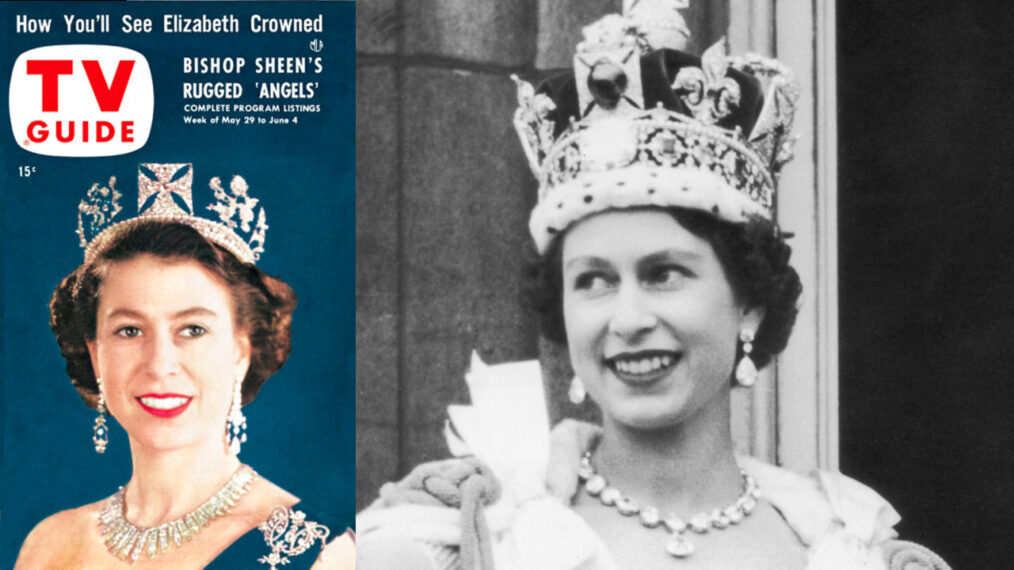
Web Page 3073 2nd June 2023 First Picture: Front Page TV Guide
Second Picture: Arch in The Mall
Third Picture: Review of the Fleet
Forth Picture: Model Coronation Coach
Fifth Picture: Me, bottom right with the bare knees, as a herald at the Coronation Pageant
Sixth Picture: Maureen’s Coronation certificate
Coronation If one event summed up the hope and aspirations after the World War, it was the Coronation of the late Queen. The nation had been shocked by the early death of her father King George VI in 1952. He had been an immensely popular man The Coronation was eagerly anticipated. People planned trips to London to join the crowd of well-wishers, while others arranged street parties and celebrations at home in their local communities. Woolworth had spotted the opportunity and its Buyers had surpassed themselves. They had cleverly held the price of decorations artificially low, offering Gold Foil Crowns (measuring about 12.5 x 7.5 cm) selling for just 3d (1½p), the royal coat of arms for 9d (4p) and an alphabet of gold letters, including the obligatory E and R, at 6d (2½p) each. Shoppers were encouraged to display their own special messages. Other souvenir items including flags, bunting, tablecloths, mugs, glass plates, china teapots special bars of chocolate were offered at regular prices to balance the margin. The offer as a whole helped to establish F.W. Woolworth as the Coronation store, and secured its reputation with a new generation. Very detailed instructions and photographs were issued to stores, showing how to lay out the windows. Each item was numbered in the photographs to match it to the stock in-store. Each ticket in the picture was left blank, as the prices were kept secret right up to the day when the windows were built. Setting up the displays took each store's window dresser a whole day per window. Everyone agreed it was time well spent, as the results were stunning! Sales of the Coronation Ranges exceeded even the most optimistic expectations at headquarters. From the stockroom to the boardroom, everyone was proud to play a part in the celebrations. Many remember 1953 as the happiest year of their careers. "In a Golden Coach (There's a Heart of Gold)" Words and Music by Ronald Jamieson was a Woolworth customers' favourite. The sheet music was offered in store for two shillings (10p). Almost a million copies were sold. On disc the song became a number one hit for two artists Dickie Valentine and Teddy Johnson. I remember my father decorating the front of our house with flags and bunting. It never crossed my mind as to where the decorations came from until I wrote the above. Stay in touch Peter gssedtor@gmail.com ________________________________________
Wednesday, 24 May 2023

Web Page 3071 25th May 2023 First Picture: Portrait
Second Picture: Grave in Somerset
Third Picture: As Lurcio
Forth Picture: In Carry on Doctor
Francis Alick Howard OBE was born on 6th March 1917 and died 19th April 1992),was better known by his stage-name Frankie Howerd, was an English actor and comedian. He was the son of soldier Francis Alfred William and Edith Florence Howard in York. His mother worked at the Rowntree's chocolate factory. For his first two and a half years, He later said he had only one memory of living in York and that was of falling down the stairs, an experience which left him with a life-long dread of heights. His family moved to Eltham, London when he was young, and he educated at Shooter's Hill Grammar School. His first stage appearance was at age 13 but his early hopes of becoming a serious actor were dashed when he failed an audition for RADA. He began to entertain during World War II in the Army. In 1944 he became a bombardier in Plymouth, was promoted to sergeant, and on 6th June 1944 was part of the D-Day effort but was stuck on a boat off Normandy. Despite suffering from stage fright, he continued to work after the war, beginning his professional career in the summer of 1946 in a touring show. His act was soon heard on radio, when he made his debut, in early December 1946, on the BBC's Variety Bandbox programme with a number of other ex-servicemen. He then toured the Music Hall circuit with an act including what became his standard catch-phrases such as "titter ye not". He also became a regular in the 1950s editions of the weekly hard-copy comic Film Fun. In 1954 he made his screen debut opposite Petula Clark in The Runaway Bus, which had been written for his comic talent. Filming took five weeks, with a budget of £45,000. He then experimented with different formats and contexts, including stage farces, Shakespearean comedy roles, and television sitcoms. At the start of the 1960s, he began to recover his old popularity and was boosted by success on That Was the Week That Was in 1963 and on stage with A Funny Thing Happened on the Way to the Forum (1963–1965), which led into regular television work. In 1966 and 1967, he co-hosted a 90-minute Christmas show called The Frankie and Bruce Christmas Show with Bruce Forsyth, featuring many top acts of the day. He was known for his seemingly off-the-cuff remarks to the audience, especially in the show Up Pompeii! (1969–70. His television work was characterised by direct addresses to camera and by his littering monologues with verbal tics such as "Oooh, no missus" and "Titter ye not". A later sale of his scripts, however, showed that the seemingly off-the-cuff remarks had all been meticulously planned. He appeared as Francis Bigger, one of the lead characters in 1967's Carry On Doctor. The success of the film version of Up Pompeii in 1971 saw British exhibitors vote him the ninth most popular star at the British box office that year.. He was awarded an OBE in 1977. In 1978, he appeared in the Hollywood musical Sgt. Pepper's Lonely Hearts Club Band playing Mean Mr Mustard. After six years without a regular television show he returned to TV screens in 1987 in the Channel 4 show Superfrank!. In the last years of his career, he developed a following with student audiences and performed a one-man show at universities and in small theatrical venues. Throughout his career, he hid his homosexuality from both his audience and his mother. In his early career, he suffered from a stutter, which caused him some distress, but which he turned to an advantage in developing his delivery style as a comic For the last 20 years of his life, he and his partner lived in Wavering Down, a house in the village of Cross, Somerset. Having contracted a virus during a Christmas trip to the Amazon in 1991, Frankie Howerd suffered respiratory problems at the beginning of April 1992 and was taken to a clinic in London's Harley Street, but was discharged at Easter. He collapsed and died of heart failure two weeks later, on the morning of 19th April 1992, aged 75.[Two hours before he died, he was speaking on the telephone to his TV producer about new ideas for his next show.[He died the day before fellow comedian Benny Hill. His grave is at St. Gregory's Church in Weare, Somerset. Stay in touch Peter GSSEDITOR@gmail.com

Thursday, 18 May 2023

Web Page 3069 18th May 2023 First Picture: Portrait
Second Picture: With Hattie Jacques and Eric Sykes
Third Picture: With Marilyn Munroe in The Prince and the Showgirl
Forth Picture: With Eric Sykes
RICHARD WATTIS Richard Wattis was a British character actor who for over 40 years was the face of pompous officialdom whether he was portraying a civil servant, a secretary, or clerk. He was the man who began a sentence with a rather disinterested "Can I help you?", would listen to you explain your predicament and then frustrate you with an equally dispassionate "I'm awfully sorry, there's absolutely nothing I can do to help you." He was the man who would look down his nose at you with an air of superiority and dismissive-ness in the safe knowledge that the wheels of bureaucracy would always turn in his favour.. Richard Cameron Wattis was born on 25th February 1912 in Wednesbury and was moved to Walsall at the age of four. His uncle was MP for Walsall in the mid-1920's and as a child Richard Wattis became star-struck, idolising the screen actor Robert Donat who he frequently wrote to asking for advice on acting. He attended King Edward's School, Birmingham and Bromsgrove School, and upon finishing his education went to work for the family electrical engineering firm. It is doubtful that he ever showed any interest in the job and he soon left. Having avoided one lacklustre career he then managed to manoeuvre himself away from chartered accountancy and secured a position (on the advice of Robert Donat) at Croydon Rep in 1935. Here he learned his craft with the likes of John Barron, John Le Mesurier, Jon Pertwee and Dennis Price. By the end of the decade he was acting regularly on stage as well as producing and also appeared on the BBC's pre-World War II television broadcasts. One of the first actors to do so. He made his big-screen debut with a role in the 1939 feature A Yank at Oxford with Vivien Leigh and Robert Taylor, but like most in his profession his career was interrupted by the the war serving in the Royal Medical Corp., as a Second Lieutenant. Upon being demobbed he returned to acting and soon found himself much in demand, first on radio and then in films, playing "pompous, dry, deadpan authority figures, snooping civil servants, and other comical pests."¹ During the 1950s he starred in numerous Ealing comedies as well as the St Trinian films. He also appeared in Around The World in 80 Days and made his international debut in The Prince and the Showgirl. Later he appeared in ‘Carry On's,’ Norman Wisdom films, and starred in over 100 films in all. On television he became a comic foil for Tony Hancock, Dickie Henderson and other comedians of the day. When Eric Sykes made his first television sitcom, he wrote a character called Mr Brown; a next-door neighbour who, far from being neighbourly, was snooty, pompous and fastidious. When casting the series Eric Sykes made it quite clear that he wanted no one else but Richard Wattis. In return, Richard Wattis was delighted to be given the part, because as he developed the role, Mr Brown became much more vulnerable and amiable than the type of character he usually played. Richard Wattis was far removed from his screen persona: "A cheerful, somewhat camp and relatively worldly bon vivant, he was a great thrower of parties and frequenter of high-class restaurants, and an avid student of history, the arts and literature. He was also quite mischievous and a good sport." For the second series of Sykes and A... his agent asked for Richard's fee to be increased. The BBC's reaction was to ask Eric Sykes to write Mr Brown out of the series. This request was. In his autobiography, Eric Sykes wrote "...it is my firm belief that you can't buy talent on the cheap, so my cast remained unchanged, and I made sure that Richard was with us until the day he died many years later." Richard Wattis died of a heart attack whilst dining in a Kensington restaurant on 1st February 1975, just three weeks before his 63rd birthday. His Memorial Service was held at St Pauls Church in Covent Garden (The Actor's Church), where there is a plaque in memory of him not far from his friend and colleague Hattie Jacques. Stay in touch Peter gsseditor@gmail.com