Total Pageviews

Translate

Thursday, 23 November 2017

Web Page  No 2426

27th  November 2017

First Picture: Don Lang
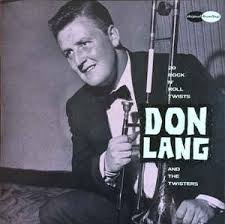
Second Picture: Don Lang and his Frantic Five

Third Picture: On Set of 6-5 Special

Forth Picture: The Big Hit The Witch Doctor ( I bet you can all still sing the chorus!)


Don Lang

Gordon Langhorn (Don Lang), was a trombonist who was born in Halifax on 19th January 1925 and died of Cancer in London on 3rd August 1992.
He was that rare species, a popular entertainer and household name during his heyday in the late 1950s who still retained the respect of his fellow jazz musicians, critics alike. A natural performer, he could stir an audience to cheers with one of his 300-words-a-minute vocal workouts and the next instant pick up his beloved trombone and play a sublime jazz ballad in the style of his favourite, Bill Harris.

Born Gordon Langhorn he had the physique even as a child to follow his father and grandfather into professional rugby football but preferred first the piano, then double bass, only progressing to trombone at 21 after hearing recordings of the American jazzman Jack Teagarden. An obvious natural, he was soon asked to play with the local dance bands while still working daytime as an electrician. But his first fully professional engagement, on the Isle of Man in 1947, this set the course for the rest of his life.

Spells with Peter Rose and the Teddy Foster orchestra led to a call from Vic Lewis, then putting together a 'progressive' big band to tour Europe, for an inventive and creative trombone voice. As featured soloist, he left behind a series of fine solos on Lewis recordings such as 'Sunday Girl' and 'The Man I Love'.

It was during the next four years with the Ken Macintosh band that he began to sing regularly, initially as a gag with the in-house vocal quartet the Macpies but, as his confidence grew, and he often broadcast as a solo artist. It was with Macintosh that he co-wrote and recorded the hit instrumental 'The Creep', covered no less than 17 times in the US alone, notably by Stan Kenton.

Encouraged by his success and tired of spending his life 'up and down the A5', he decided to form his own group and develop his own vocal style - setting to the music lyrics to known jazz solos, usually at a breakneck tempo. After producing his own demonstration recording in this style he was immediately signed to HMV in 1955 and the resulting record 'Cloudburst' was an instant success. Whilst King Pleasure and Annie Ross had recorded in this style, no one had managed to combine fast tempos with such clear diction, a fact not lost on the 'Cloudburst' lyricist and famed American vocaliser John Hendrix, who professed himself an admirer and wrote 'Jumping to Conclusions' specifically for the now-renamed Don Lang. This abbreviation of his real name was chosen because 'the shorter the name, the bigger the billing'.

In 1956, he was chosen with his band the Frantic Five to be one of the cornerstones of the new BBC informal 'teenage' show The Six Five Special and for two years appeared as resident accompanist and in his own right, performing every week on live television such hits as 'Six Five Hand Jive', 'Red Planet Rock' and 'I Want You To Be My Baby'.

Whilst enjoying his popularity and a firm believer in giving the public what it wanted, on the demise of the Six Five Special in 1968 he retained his firm foothold in the jazz and big-band fields, but continued to make successful records like 'The Witchdoctor'. As a sight-reading musician the rocketing popularity of the Merseybeat did not affect him as badly as many of the other rock-and- rollers: indeed, when he was a session man on one of the Beatles' recordings, John Lennon actively sought him out to say hello.

Working in cabaret with his own band and as featured sideman with larger bands followed throughout the Seventies and early Eighties, but the last few years saw him in virtual retirement, apart from the occasional rock-and-roll revival show and some rehearsal band workouts just to keep his lip and trombone in good shape.

A strong but gentle man, who could keep you amused for hours over a long lunch, he retained the affection and respect of both the public and the many musicians who knew him. Typically his long fight with cancer was born bravely and with humour.

Anyone who ever heard him sing The Witch Doctor or The Auctioneer will never forget Don Laing.

Keep in touch

Yours

Peter

DUSTYKEAT@aol.com

You Write:


News and Views:

On this day 27th  November 1960-1965

On 27/11/1960 the number one single was It's Now Or Never - Elvis Presley and the number one album was South Pacific Soundtrack. The top rated TV show was Take Your Pick (AR) and the box office smash was Psycho. A pound of today's money was worth £13.68 and Tottenham Hotspur were on the way to becoming the Season's Division 1 champions.

On 27/11/1961 the number one single was Little Sister/His Latest Flame - Elvis Presley and the number one album was Another Black & White Minstrell Show - George Mitchell Minstrels. The top rated TV show was Sunday Night at the London Palladium (ATV) and the box office smash was One Hundred and One Dalmations. A pound of today's money was worth £13.25 and Ipswich Town were on the way to becoming the Season's Division 1 champions.

On 27/11/1962 the number one single was Lovesick Blues - Frank Ifield and the number one album was Out of the Shadows - Shadows. The top rated TV show was Coronation Street (Granada) and the box office smash was Lawrence of Arabia. A pound of today's money was worth £12.89 and Everton were on the way to becoming the Season's Division 1 champions.

On 27/11/1963 the number one single was You'll Never Walk Alone - Gerry & the Pacemakers and the number one album was Please Please Me - The Beatles. The top rated TV show was Conservative Party Political Broadcast (all channels) and the box office smash was The Great Escape. A pound of today's money was worth £12.64 and Liverpool were on the way to becoming the Season's Division 1 champions.

On 27/11/1964 the number one single was Baby Love - Supremes and the number one album was A Hard Day's Night - Beatles. The top rated TV show was Coronation Street (Granada) and the box office smash was Dr Strangelove. A pound of today's money was worth £12.24 and Manchester United were on the way to becoming the Season's Division 1 champions.

On 27/11/1965 the number one single was Get Off Of My Cloud - Rolling Stones and the number one album was The Sound of Music Soundtrack. The top rated TV show was Take Your Pick (AR) and the box office smash was The Sound of Music. A pound of today's money was worth £11.69 and Liverpool were on the way to becoming the Season's Division 1 champions.


Thursday, 16 November 2017

Web Page  No 2424

20th  November 2017

First Picture: Teddy Girl.

Second Picture: Teddy Girl Group

Third Picture ; Teddy Boy fashion

Forth Picture: Teddy Boys and girl

Fifth Picture: Warning Poster


The Ted’s
We all remember the ‘Teddy Boys’ and the havoc that some of them caused in the late 1950’s but who remembers the ‘Teddy Girls’?
The Teddy Boy, was characterized by an unlikely style of dress and fashion inspired by Edwardian period dandies fused together with American rock ’n roll fashion. They originally formed gangs based in East London through to North Kensington and became high profile rebels in the media and within a short space of time the movement had spread nationwide. But an important sub-subculture of the Teddy Boys, was the unlikely female element, The Teddy Girls.
In 1955, freelance photographer Ken Russell was introduced to Josie Buchan, a Teddy Girl, who introduced him to some of her Teddy Girl friends in Notting Hill. He vividly remembered a 14 year-old teddy girl, who, he said, had attitude by the truckload. The teddy boys were tough, they’d been born in the war years and food rationing only ended in about 1954. They were proud. They knew their worth. As they had the money they just wore what they wanted.
To understand the teddy girls style, we first have to go back to the boys culture. They emerged in England as post-war austerity was coming to an end and working-class teenagers were able to afford good clothes and began to adopt the upper-class Saville Row revival of dandy style Edwardian fashion. By the mid-1950s, second-hand Edwardian suits were becoming readily available on sale in markets around the country as they had become unwearable by the upper-class gentlemen once the Teddy Boys had started sporting them.
The ‘Teds’, as they called themselves, wore long coloured drape jackets, velvet collars, slim ties and began to pair the look with thick rubber-soled creeper style shoes and the ‘greaser’ hairstyles of their American rock ’n’ roll idols. Despite their overall smart style of dress the Teds were a teenage youth culture which were out to shock their parents’ generation, and they quickly became associated with trouble by the media.
Teddy girls were mostly working-class teenage girls as well, but considered less interesting by the media who were more concerned with sensationalizing the violent working-class youth culture of the boys. While teddy boys were known for hanging around on street corners, looking for trouble, a young working-class woman’s role at the time was still focused around the home.
But even with lower wages than the boys, teddy girls would still dress up in their own style of drape jackets, rolled-up jeans, flat shoes, tailored jackets with velvet collars and to put their feminine spin on the Teddy style with straw boater hats, brooches, espadrilles and elegant clutch bags. They would go to the cinema in groups and attend dances and concerts with the boys, collect rock ’n’ roll records and magazines. Together, they essentially cultivated the first market for teenage leisure in Britain.
In the end, it was the troublesome reputation of the teddy boys that got the better of this youth subculture. Some of the violence and vandalism, but not all, was exaggerated by the media, but there were notably a few gangs that chose a far darker path.
While most dedicated teddy boys were, at worst, involved in petty crimes, there were instances of gangs rioting and using razors, knuckledusters and knives to carry out attacks. The racist tendencies of some of the teddy boy gangs in the end lost to the unstoppable rock ’n’ roll movement centred around many African-American acts. The British pop boom of the 1960s brought new music and new youth cultures and the era of the teddy boy was coming to an end.
It’s certainly a great shame that such an interesting and elegant style of dress for young people had to be associated with such negativity and violence. The Teddy Boys were the first group in Britain whose style was self-created.
Were you one?

Keep in touch

Yours

Peter


You Write:


News and Views:

On this day 20th  November 1960-1965

On 20/11/1960 the number one single was It's Now Or Never - Elvis Presley and the number one album was South Pacific Soundtrack. The top rated TV show was Take Your Pick (AR) and the box office smash was Psycho. A pound of today's money was worth £13.68 and Tottenham Hotspur were on the way to becoming the Season's Division 1 champions.

20/11/1961 the number one single was Little Sister/His Latest Flame - Elvis Presley and the number one album was Another Black & White Minstrel Show - George Mitchell Minstrels. The top rated TV show was Sunday Night at the London Palladium (ATV) and the box office smash was One Hundred and One Dalmations. A pound of today's money was worth £13.25 and Ipswich Town were on the way to becoming the Season's Division 1 champions.

On 20/11/1962 the number one single was Lovesick Blues - Frank Ifield and the number one album was West Side Story Soundtrack. The top rated TV show was Coronation Street (Granada) and the box office smash was Lawrence of Arabia. A pound of today's money was worth £12.89 and Everton were on the way to becoming the Season's Division 1 champions.

On 20/11/1963 the number one single was You'll Never Walk Alone - Gerry & the Pacemakers and the number one album was Please Please Me - The Beatles. The top rated TV show was Conservative Party Political Broadcast (all channels) and the box office smash was The Great Escape. A pound of today's money was worth £12.64 and Liverpool were on the way to becoming the Season's Division 1 champions. The big news story of the week was Socialists win Dundee West by-election.

On 20/11/1964 the number one single was Baby Love - Supremes and the number one album was A Hard Day's Night - Beatles. The top rated TV show was Coronation Street (Granada) and the box office smash was Dr Strangelove. A pound of today's money was worth £12.24 and Manchester United were on the way to becoming the Season's Division 1 champions.

On 20/11/1965 the number one single was Get Off Of My Cloud - Rolling Stones and the number one album was Liverpool. The top rated TV show was "Coronation Street (Granada) and the box office smash was The Sound of Music.

A pound of today's money was worth £ 11.69. The big news story of the day was Take Your Pick (AR)".


Thursday, 9 November 2017


13th  November 2017

First Picture: Rupert Logo

Second Picture: Rupert Album 1958

Third Picture: Rupert and Friends

Forth Picture; Rupert and Paul McCartney


Rupert Bear

Throughout my childhood I remember having Rupert books around the house. Rupert Bear was a children's comic strip character created by the English artist Mary Tourtel and first appearing in the Daily Express newspaper on 8th November 1920. Rupert's initial purpose was to win sales from the rival newspapers the Daily Mail and the Daily Mirror. In 1935, Ruperts artist and storyteller was taken over by Alfred Bestall, who was previously an illustrator for Punch. He proved to be successful in the field of children's literature and worked on Rupert stories and artwork well into his 90s. More recently, various other artists and writers have continued the series.
The comic strip was, and still is, published daily in the Daily Express, with many of these stories later being printed in books, and every year since 1936 a Rupert annual has also been released. Rupert Bear has become a well-known character in children's culture in the United Kingdom, and the success of the Rupert stories has led to the creation of several television series based on the character. The character also has a large fan following, with such groups as The Followers of Rupert.
Rupert is a bear who lives with his parents in a house in Nutwood, a fictional idyllic English village. He is drawn wearing a red jumper and bright yellow checked trousers, with matching yellow scarf. Originally depicted as a brown bear, his colour soon changed to white to save on printing costs, though he remained brown on the covers of the annuals.
Most of the other characters in the series are also animals with humanlike form. They are all scaled to be about the same size as Rupert, regardless of species. Rupert's animal friends are usually referred to as his "chums" or "pals". Aside from his best friend Bill Badger, some of the most enduring pals are an elephant (Edward Trunk), a mouse (Willie), Pong-Ping the Pekingese, Algy the Pug,  Podgy Pig, Bingo the Brainy Pup, Freddie and Ferdy Fox, the identical twins Reggie and Rex Rabbit, and Ming the dragon. The kindly Wise Old Goat also lives in Nutwood, and helps Rupert in some of his adventures. One of the most unusual and evocative characters is Raggety, a woodland troll like creature made from twigs, who is often grumpy and annoying. In the 2006 television revival of the series, Raggety was transformed into a friendly elf with broken English.
There are also a few human characters in the stories, such as the Professor (who lives in a castle with his servant, Bodkin), Tiger Lily (a Chinese girl), her father "the Conjuror", and several less frequently occurring characters such as Sailor Sam, Gaffer Jarge, Captain Binnacle and Rollo, the Gypsy boy. There is also a recurring Merboy.
The series often features fantastic and magical adventures in faraway lands. Each story begins in Nutwood, where Rupert usually sets out on a small errand for his mother or to visit a friend, which then develops into an adventure to an exotic place such as King Frost's Castle, the Kingdom of the Birds, underground, or to the bottom of the sea. Sometimes one of the Professor's inventions opens the door to one of Rupert's adventures. At the end of the story Rupert returns to Nutwood, where all is safe and well, and where his parents seem perfectly happy about his adventures.
Unlike most modern comic strips, Rupert Bear has always been produced in the original form of strip with illustrations accompanying text as opposed to text being incorporated into the art in speech bubbles.
Alfred Bestall developed the classic Rupert story format: the story is told in picture form (generally two panels each day in the newspaper and four panels to a page in the annuals), in simple page-headers, in simple two-line-per-image verse and then as running prose at the foot enabling Rupert Annuals to be "read" on four levels.
It may be remembered that Rupert appeared in Paul McCartney's 1984 music video "We All Stand Together"; Paul McCartney also made an animated video starring Rupert called Rupert and the Frog Song.

Every year since 1936, a Rupert Bear annual has been released, even during the years of World War II, during a paper shortage in other words this years will be the 81st.

Keep in touch

Yours

Peter


You Write:


News and Views:

On this day 13th  November 1960-1965

On 13/11/1960 the number one single was It's Now Or Never - Elvis Presley and the number one album was South Pacific Soundtrack. The top rated TV show was Bootsie & Snudge (Granada) and the box office smash was Psycho. A pound of today's money was worth £13.68 and Tottenham Hotspur were on the way to becoming the Season's Division 1 champions.

On 13/11/1961 the number one single was Little Sister/His Latest Flame - Elvis Presley and the number one album was Another Black & White Minstrell Show - George Mitchell Minstrels. The top rated TV show was Coronation Street (Granada) and the box office smash was One Hundred and One Dalmations. A pound of today's money was worth £13.25 and Ipswich Town were on the way to becoming the Season's Division 1 champions.

On 13/11/1962 the number one single was Lovesick Blues - Frank Ifield and the number one album was West Side Story Soundtrack. The top rated TV show was Coronation Street (Granada) and the box office smash was Lawrence of Arabia. A pound of today's money was worth £12.89 and Everton were on the way to becoming the Season's Division 1 champions.

On 13/11/1963 the number one single was You'll Never Walk Alone - Gerry & the Pacemakers and the number one album was Please Please Me - The Beatles. The top rated TV show was Coronation Street (Granada) and the box office smash was The Great Escape. A pound of today's money was worth £12.64 and Liverpool were on the way to becoming the Season's Division 1 champions.

On 13/11/1964 the number one single was (There's) Always Something There to Remind Me - Sandy Shaw and the number one album was A Hard Day's Night - Beatles. The top rated TV show was Coronation Street (Granada) and the box office smash was Dr Strangelove. A pound of today's money was worth £12.24 and Manchester United were on the way to becoming the Season's Division 1 champions.

On 13/11/1965 the number one single was Get Off Of My Cloud - Rolling Stones and the number one album was Liverpool. The top rated TV show was "Coronation Street (Granada) and the box office smash was The Sound of Music. A pound of today's money was worth £11.69. The big news story of the day was Take Your Pick (AR)".


Thursday, 2 November 2017

Web Page  No 2420

6th November 2017

First Picture: The Appleyard Family
 Second Picture: The Opening Screen to the TV show


 Third Picture: Poor picture of a scene from the only surviving episode


Forth Picture; Christmas with the Appleyards. Note the jumper!!!

The Appleyards

The Appleyards was a British television soap opera aimed especially for children. It was made and transmitted fortnightly by BBC Television from October 1952 to April 1957, from their Lime Grove Studios. It was produced and directed by Naomi Capon.
Transmitted live on a Thursday afternoon from 4:30 to 5 p.m. with a Sunday repeat (which was not usually a recorded repeat of the first show but the same cast repeating a live performance). Each episode was about 20 minutes in length. The programme told the story of the Home Counties family Mr and Mrs Appleyard and their three children: John, Margaret, and Tommy. They were usually accompanied by their neighbour and best friend Ronnie Grant.
In the show's first year (1952) the episodes were aired live and never recorded, thus no episodes from the 1952 season exist. From 1953, the episodes were tele-recorded, but the BBC ended up wiping most of them. Only one episode (entitled "Family Treat" and originally aired on December 29th, 1956) of the entire run of 68 exists in television archives as of 2017, and can be found on YouTube. In the early days the theme music was piped into the studio from a 78 rpm recording.
Its tales of serial ordinariness made it the junior version of the BBC’s own The Grove Family, which ran for the same period. Unlike later soaps, which continue in real time, as the younger Appleyard child actors grew, they were replaced, so in this little corner of suburban England time appeared to stand still.
The title was not to the liking of the BBC Controller of Programmes, at the time, Cecil McGivern, who famously suggested that it sounded more like ‘a suet pudding with a mixture of cement’.
The last episode finished with Mrs. Appleyard and Tommy sitting on a porter's trolley at the end of a railway platform, when she announced that as most of the family were now grown up it was time to end the series.
It was of its time but also a ground-breaking family sitcom, popular with both adults and children alike but particularly the latter who saw it as embodiment of their own family. The catchy light music was called "Looking Around" by Colin Smith and recorded by conductor Robert Farnon.

As the series developed a new character, an eccentric elderly male neighbour who was always getting into the family’s activities. He was always cadging meals and was not popular with the rest of the family but Mrs Appleyard took pity on him.
Towards the end of the series the eldest son was getting married with the younger son as best man, they arrived late at the church because they could not find a bow tie for the groom and the younger son provided him with a fancy revolving one! During the wait at the church the neighbour started to sing “There I was Waiting at the Church” making himself less than popular.
A reunion programme, "Christmas with the Appleyards", went out at on Christmas Eve 1960 and was sandwiched between   The Lone Ranger at 5.00pm in an episode called “An Eye for an Eye” with
“Christmas with the Appleyards” at 5.25pm billed as a special Christmas reunion featuring the original members of the former serial  and The News at 5.50pm. This was followed by The Sports Programme and then between 6.00pm and 6.28pm by Juke Box Jury
The programme was not the starting place for many future TV actors as “The Grove Family” was with Ruth Dunning and Christopher Beany.
The cast list for “The Appleyards” did vary a bit.
Constance Fraser was Mrs. Appleyard for 76 episodes, 1952-1960
Douglas Muir as Mr. Appleyard for 64 episodes, 1953-1960
Derek Rowe as Tommy Appleyard (75 episodes, 1952-1960)
David Edwards as John Appleyard (58 episodes, 1952-1960)

Robert Dickens as Ronnie Grant (44 episodes, 1952-1960)

Pat Fryer as Margaret Appleyard (37 episodes, 1953-1960)
Also Carol Olver as Margaret Appleyard (32 episodes, 1954-1957)
All a far cry from the soap Opera of today!!!!


Keep in touch

Yours

Peter


You Write:


News and Views:

On this day 6th November 1960-1965


On 06/11/1960 the number one single was It's Now Or Never - Elvis Presley and the number one album was South Pacific Soundtrack. The top rated TV show was Bootsie & Snudge (Granada) and the box office smash was Psycho. A pound of today's money was worth £13.68 and Tottenham Hotspur were on the way to becoming the Season's Division 1 champions.

On 06/11/1961 the number one single was Walkin' Back to Happiness - Helen Shapiro and the number one album was Twenty One Today - Cliff Richard. The top rated TV show was Coronation Street (Granada) and the box office smash was One Hundred and One Dalmations. A pound of today's money was worth £13.25 and Ipswich Town were on the way to becoming the Season's Division 1 champions. The big news story of the week was severe flooding in SE England

On 06/11/1962 the number one single was Telstar - The Tornadoes and the number one album was Out of the Shadows - Shadows. The top rated TV show was The Royal Variety Performance (BBC) and the box office smash was Lawrence of Arabia. A pound of today's money was worth £12.89 and Everton were on the way to becoming the Season's Division 1 champions.

On 06/11/1963 the number one single was You'll Never Walk Alone - Gerry & the Pacemakers and the number one album was Please Please Me - The Beatles. The top rated TV show was The Royal Variety Performance (ATV) and the box office smash was The Great Escape. A pound of today's money was worth £12.64 and Liverpool were on the way to becoming the Season's Division 1 champions. The big news story of the week was Beatles perform at Royal Variety Show.

On 06/11/1964 the number one single was (There's) Always Something There to Remind Me - Sandy Shaw and the number one album was A Hard Day's Night - Beatles. The top rated TV show was Coronation Street (Granada) and the box office smash was Dr Strangelove. A pound of today's money was worth £12.24 and Manchester United were on the way to becoming the Season's Division 1 champions.


On 06/11/1965 the number one single was Get Off Of My Cloud - Rolling Stones and the number one album was The Sound of Music Soundtrack. The top rated TV show was Coronation Street (Granada) and the box office smash was The Sound of Music. A pound of today's money was worth £11.69 and Liverpool were on the way to becoming the Season's Division 1 champions.