Total Pageviews

Translate

Thursday, 30 September 2021

WEB PAGE NO. 2822 2nd October 2021 Firstly I was sad to hear of the death of Alan Hartley one time Head Boy of Manor Court School. He often came with us to the George.May he rest in peace.
1ST PICTURE: Meccano Catalogue
2nd PICTURE; CENTENARY 2001
3RD PICTURE; Meccano Magazine
4TH PICTURE: Frank Hornby Meccano Meccano was and is a model construction system created in 1898 by Frank Hornby in Liverpool. The system consists of reusable metal strips, plates, angle girders, wheels, axles and gears, and plastic parts that are connected using nuts and bolts. It enables the building of working models and mechanical devices. In 1913, a very similar construction set was introduced in the United States under the brand name Erector. In 2000, Meccano bought the Erector brand and unified its presence on all continents. In 2013, the Meccano brand was acquired by the Canadian toy company Spin Master. Meccano maintains a manufacturing facility in Calais, France. In 1901 Frank Hornby, a clerk from Liverpool invented and patented a new toy called "Mechanics Made Easy" that was based on the principles of mechanical engineering. It was a model construction kit consisting of perforated metal strips, plates and girders, with wheels, pulleys, gears, shaft collars and axles for mechanisms and motion, and nuts and bolts and set screws to connect the pieces. The perforations were at a standard ½ inch spacing, the axles were 8-gauge, and the nuts and bolts used 5/32 inch BSW threads. The only tools required to assemble models were a screwdriver and spanners . It was more than just a toy: it was educational, teaching basic mechanical principles like levers and gearing. The parts for Hornby's new construction kit were initially supplied by outside manufacturers, but as demand began to exceed supply, Hornby set up his own factory in Duke Street, Liverpool. As the construction kits gained in popularity, they soon became known as Meccano and went on sale across the world. In September 1907, Hornby registered the Meccano trade mark, and in May 1908, he formed Meccano Ltd. To keep pace with demand, a new Meccano factory was built in Liverpool in 1914, which became Meccano Ltd's headquarters for the next 60 years. Hornby also established Meccano factories in France, Spain and Argentina. The word "Meccano" was thought to have been derived from the phrase "Make and Know". The first construction sets had parts that were rather crudely made: the metal strips and plates had a tinplate finish, were not rounded at the ends and were not very sturdy. But manufacturing methods were improving all the time and by 1907 the quality and appearance had improved considerably: the metal strips were now made of thicker steel with rounded ends and were nickel-plated, while the wheels and gears were machined from brass. The first sets under the new Meccano name were numbered 1 to 6. In 1922 the No. 7 Meccano Outfit was introduced, which was the largest set of its day, and the most sought after because of its model building capabilities and prestige. In 1926, to mark the 25th anniversary of his patent, Hornby introduced "Meccano in Colours" with the familiar red and green coloured Meccano pieces. Initially plates were a light red and items like the braced girders were a pea-green. However, the following year strips and girders were painted dark green, the plates Burgundy red, while the wheels and gears remained brass. In 1934 the Meccano pieces changed colour again: the strips and girders became gold while the plates were changed to blue with gold criss-cross lines on them, but only on one side, the reverse remaining plain blue. This new colour scheme was only available in the United Kingdom until the end of the Second World War in 1945. The old red and green sets were still produced for the export market and were re-introduced in the UK after the war. In 1958 the colours were changed slightly to light red and green but this a short lifespan as the colours changed dramatically in 1964 to the black and yellow colour scheme. However, this light red and green period did see the introduction of about 90 new parts, more modern packaging, a new cabinet was introduced for the number 10 set, the first plastic parts were introduced, and the "exploded diagram" instructions made their début. World War II interrupted the production of Meccano in England when the Binns Road factory converted to manufacturing for the war effort. The Korean War in 1950 also disrupted production due to a metal shortage and it was not until the mid-1950s that Meccano production returned to normal with new parts being added to all the sets. In the early 1960s Meccano Ltd experienced financial problems and was purchased by Lines Bros Ltd (who operated under the brand name "Tri-ang"). In an attempt to redefine Meccano's image, the colour scheme was changed again, this time to yellow and black plates, with silver strips and girders. In 1970 electronic parts were introduced, and the current black-coloured plates were changed to blue. Lines Brothers went into voluntary liquidation in 1971 and Airfix Industries purchased the Meccano business in the UK and General Mills of the US purchased the French business. The French company was known as Miro Meccano. In 1978 the range of Meccano sets was reduced d. While some Airfix divisions were profitable, particularly their model kits, they needed to save money. With unions threatening industrial action if there were any job losses, Airfix shut down the Binns Road factory, bringing to an end the manufacture of Meccano in England. Meccano still continued to be manufactured in France, as the British and French businesses had different owners. At the time in the seventies Meccano France SA launched and produced their brand new dark blue MECCANO Construction Kits In 1981, General Mills bought Airfix Products and with it what was left of Meccano Ltd UK, giving it complete control of the Meccano franchise. All the existing Meccano sets were scrapped and a totally new range of sets were designed for production in Calais, France called "Meccano Junior", a new product range consisting of plastic construction kits with tools included, although these new sets would only allow the young builder to make small models. In 1985 General Mills left the toy business completely, selling off their toy divisions. Meccano was sold out to a French accountant and, once again, all existing Meccano sets were scrapped. In 1989 the accountant sold what remained of Meccano to Dominique Duvauchelle. Allen head zinc plated steel bolts replaced the original slot-headed brass-plated bolts and the "Plastic Meccano Junior" sets were brought back. In 1994 additional theme sets were introduced and a pull-back friction motor was added to the Plastic Meccano System. In 2000 Nikko, a Japanese toy manufacturer, purchased 49 per cent of Meccano and took on its marketing internationally. Development and design remained with Meccano based in Calais. Meccano today is very different from its. The target market of youngsters has not changed significantly In 2013, Meccano launched "Meccano Evolution", a new "back to basics" Meccano, which allowed smaller and more detailed models to be built using simpler and more "functional" parts. In late 2013, the company also opened a public "Meccano Lab" play space and centre, in Calais. In 2015 Spin Master launched Meccanoids, Meccano modular robots. The current range of Meccano electric motors are small DC types designed to run on domestic batteries. These are low-torque high-speed motors. These are inexpensive and suitable for small models that a child might construct from the standard range of sets. For many years, live steam engines were made and sold under the Meccano brand, although they were not made by Meccano. Earlier examples were vertical steam engines the first to be specially designed for Meccano was introduced in 1929. From 1965 to 1976, Mamod made a steam engine for Meccano, the design of which was based on the 1929 version. With a Meccano set there was a wide range of models that could be built. The instructions sometimes contained errors, which caused difficulty for small children. In 1990 Meccano built a giant Ferris wheel in France. It was modelled after the original 1893 Ferris Wheel built by George Washington Gale Ferris Jr. at the World's Columbian Exposition at Chicago. The model, the largest at the time, was 6.5 metres (21.3 ft) high, weighs 544 kilograms (1,200 pounds), was made from 19,507 pieces, 50,560 nuts and bolts, and took 1,239 hours to construct. A large model, weighing approximately 500 kg and 23 m long, was built in September 2009 by TV presenter James May and a team of volunteers who created a Meccano bridge spanning the Leeds and Liverpool Canal. A contender for the largest model on record was built in 2014 by Graham Shepherd of Grahamstown, South Africa. The fully motorised Krupp 288 Bucket Wheel Excavator (as used on large opencast mining) is complete with auxiliary conveyors. Frank Hornby had launched the Meccano Guild in 1919, to encourage boys of all ages—as well as early clubs—to become part of a central organisation, which oversaw club formation, and set guidelines for club proceedings. The Meccano Magazine was used as a means to keep Guild clubs informed of each other's activities (as well as encourage the sales of Meccano). The International Society of Meccanomen was founded in 1989 in England, nine years after the Liverpool factory closed. Today, over one hundred years since its inception, there are thousands of Meccano enthusiasts worldwide there are annual Meccano exhibitions around the world, notably in France and at Skegness.
Pam Writes:- Such coincidence that Griff has mentioned if anyone remembers Ken Ashbee. Unfortunately he was killed in Singapore in 1967 aged just 23. He was in the RAF so I don't know if it was a plane accident. I remember he was part of 'our gang' that used to meet in the evenings at the field opposite Sainsburys. I'm sure he lived in Second Avenue, Farlington. He married Marilyn Garland in 1966. I only found this out quite recently when I was at the church at Warblington and when walking round the graveyard saw a memorial stone for him. Really tragic, I wonder what happened to Marilyn. Also, I think that Alan Hartley died recently. He was Head Boy when Pauline Bugg was Head Girl, how strange that they should die so close to each other. Stay in touch
Peter gsseditor@gmail.com

Thursday, 23 September 2021

WEB PAGE NO. 2820 25th September 2021 1ST PICTURE: A Bar of Sunlight soap
2nd PICTURE; WW1 Sunlight poster
3RD PICTURE; Sunlight Washing Up Liquid
4TH PICTURE; Port Sunlight
Sunlight Soap We must all remember Sunlight household soap, every home, when we were kids used it. It was introduced by the British company Lever Brothers in 1884 and it was the world's first packaged, branded laundry soap. Designed for washing clothes and for general household use, the success of the product led to the name for the company's village for its workers, Port Sunlight. The soap formula was invented by a Bolton chemist named William Hough Watson, who also became an early business partner. Watson's process created a new soap, using glycerin and vegetable oils such as palm oil rather than tallow which were animal fats. William Lever and his brother James Darcy Lever invested in Watson's soap invention and its initial success came from offering bars of cut, wrapped, and branded soap in his father's grocery shop. This was an early labour-saving device for the housewife as prior to this, commercially made soap was bought in long bars. Sunlight soap was eventually supplanted by modern products made from synthetically produced detergents rather than naturally derived soaps. In 1971, the company rebranded Sunlight as a washing-up liquid in the UK. The new packaging for Sunlight Lemon Liquid had a large picture of a lemon, and only featured the words "washing up liquid" in small letters. There were complaints that children might mistake the product for lemon squash and drink it. The matter was discussed in the House of Lords. The company responded by changing its packaging. In several markets (e.g., Belgium and the Netherlands) Sunlight soap has survived as a personal wash product rather than a laundry detergent. Sunlight is still used in some markets as a brand by Unilever (the successor of Lever Brothers). In Sri Lanka, Sunlight laundry soap has a market share of more than 75%, and won the “brand of the year” award in 2004. In South Africa, the brand is used for bath soap, dishwashing liquid, washing powder and fabric conditioner. The brand was also used in the Philippines during the 1990s as detergents. It was discontinued until it was revived in 2015 as a liquid dish-washing detergent traded alongside the Surf line. However, production for Ireland and the UK ceased in 2009 due to low demand; it is available only as an import. In Norway it was taken over by Lilleborg in 1930. In 2003, exclusive licensing rights to the Sunlight brand for dishwashing detergents in the United States, Canada, Puerto Rico were sold along with several Unilever brands to Lehman Brothers Merchant Banking Group, which established Phoenix Brands LLC for the purpose. In 2008, the North American trademark rights to Unilever laundry brands including Sunlight were acquired by Sun Products Corporation. In early 2010, Sun Products acquired the American and Canadian business rights to the Sunlight brand. Sun Products was itself acquired by Henkel North American Consumer Goods in 2016. The Sunlight brand was used by Johnson Diversey Professional Products in Canada and the USA in 2011. In Turkey in the summer of 2010, washing-up liquids produced under the brand Cif began marketing with the new compound brand Sunlight Cif. As well as the regular liquid, a concentrated washing-up liquid was introduced in three varieties (lime, lemon and orange); when it comes into contact with water, it turns into a gel which remains in the sponge longer than regular washing-up liquid. However I am sure that we all remember the alternative version of the carol Whilst Shepherds watched their flocks by night ie….. While Shepherds washed their socks by night, All seated round the tub, A bar of Sunlight soap came down, And they began to scrub. And when their socks were squeaky clean, And sparkling like a gem, The Sheppard's put them on again, And walked to Bethlehem. And when they got to Bethlehem, All looking nice and neat, The Christ child said you've got nice socks, But next time wash your feet. You Write: This is a longshot request: Does anyone reading Peter's MC webpage remember Ken Ashbee? I believe he lived in the Drayton / Farlington / Cosham area. If you do please let me know. Ken was married to a local girl called Marilyn I believe. Also Roger ??? who wrote on the webpages last week and will be reading this, was Robert (Bob) Heyhoe a name you remember from your time at Northern Grammar School? Cheers Everyone Melvyn (Griff) Griffiths Stay in touch Peter gsseditor@gmail.com

Thursday, 16 September 2021

WEB PAGE NO. 2818 18th September 2021 Sam Kydd 1ST PICTURE: Sams typical character
2nd PICTURE; This is Your Life
3RD PICTURE; With son Jonathan and wife Pinkie
4TH PICTURE; Locally made film in which he appeared
Sam Kydd was one of those faces that kept turning up in small parts in TV productions and over 200 films more than any other British actor. He was born Samuel John Kydd on 15th February 1915 and was an Irish-born British actor.[ His best-known roles were in two major British television series of the 1960s, as the smuggler Orlando O'Connor in Crane and its sequel Orlando, and as a recurring character in Coronation Street. He was an army officer's son born in Belfast and moved to London as a child and attended Dunstable school in Bedfordshire. During the mid-1930s he was an MC for the Oscar Rabin Band and one of his "Hot Shots". He would warm up audiences with jokes and impressions (Maurice Chevalier was a favourite) and even some tap dance routines then introduce the other singers and attractions on the bill. During the late 1930s he had joined the Territorial Army serving with the Queen Victoria's Rifles and when war broke out he was called up for active service. Early in the Second World War, he went to France with the British Expeditionary Force but was quickly captured, spending the rest of the war in Stalag XX-A, a camp in German-occupied western Poland. He later wrote of his experiences as a POW in his autobiographical book For You the War Is Over. During his internment where he remained for the next five years, he took command of the camp's theatrical activities - devising and staging plays. He felt so strongly about his work there that, when he was offered repatriation after three years, he turned it down to continue with his theatrical work. In recognition of his valuable services during these years he was awarded a pair of drama masks, made by the Red Cross . Returning to Britain he applied for the film The Captive Heart, which was about life in a prison camp, and as this was an area where he had much experience, he got a part. He went on to appear in more than 240 films and 1,000 TV plays and series, including such films as The Blue Lamp, Father Brown, The 39 Steps and I'm All Right Jack. He often played the part of a strong and resilient cockney. In 1963, he appeared as the lovable smuggler Orlando O'Connor in Crane starring Patrick Allen. The programme ran for 39 episodes and was watched each week by over 16 million viewers. Sam's character was so popular that when Crane finished he was given his own programme, Orlando, a children's adventure series which ran for 76 episodes. He also appeared on TV in The Adventures of Robin Hood, The Pickwick Papers, Mess Mates, Arthur Askey, Benny Hill, Charlie Drake, Harry Worth, The Expert, Dixon of Dock Green, Fossett Saga, Curry and Chips, The Tony Hancock Show, Minder, Crossroads, Coronation Street (playing the part of Mike Baldwin's father, Frankie), The Eric Sykes Show, and Follyfoot. He was the subject of This Is Your Life in 1974. He married Pinkie Barnes, an ex-international table tennis champion (she was World Doubles Finalist in 1948) and one of Britain's first women advertising copywriters. Their son, Jonathan Kydd, followed his father into the acting profession. Sam Kydd died of emphysema in 1982 aged 67. You Write: Letter from Roger Hello Peter, It’s been a long time since I last was in touch; hope that you are still keeping well and I still enjoy reading your updates. To remind you? I was never a fellow pupil of you all, but was at Northern Grammar School September 1956 to July 1961 and was interested to read in your Page 2800, of 10th July, this year, that you held your Speech Day there in the October of ’61. I also read through the list of Members of the Choral Society, not that I ever expected to find reference to any one who I would know, and you asked if anyone might know of the whereabouts of any those “lost” members. It was with some surprise, and pleasure, that at number eight in the list of Contraltos I saw Diane Ledgers’ name. I met her, and her family, after she left the school and we both worked for the Co-op shoe department, she at Melanies, North End, and myself at Co-op House in Fratton Road, in 1962/63. We went out together steadily and then I joined the Royal Navy in 1963 and she and her family emigrated to Perth W. Australia in 1964/65. I was able to meet up with her in Geraldton, Western Australia, Christmas/New Year 1965 when the ship I was on, HMS EURYALUS, visited as part of our Australia tour. I last saw her in Portsmouth and Plymouth, for several days, when she visited England in the mid 2000’s. We still keep in touch and she still lives in Western Australia, albeit some distance from Perth in the “sticks”. I cannot be certain but she COULD be the girl in the photograph, looking at the picture, sitting 5th in from the left side, in the second row from the front. I know it is a bit late for me to be getting back to you from the date you published the item, but I often read back to previous issues and find things which I missed the first time round. With every good wish and thanks you for your, always, interesting reminders of the past. Best wishes and regards, Ray Johnson (Ex Copnor Juniors and N.G.S.B)

Friday, 10 September 2021

WEB PAGE NO. 2818 11th September 2021 1ST PICTURE: Young Russ Conway
2nd PICTURE; Royal Navy ID picture
3RD PICTURE; This is Your Life
4TH PICTURE; With Billy Cotton and Cliff Richard
The Twinkling Smile of Russ Conway Russ Conway, DSM was born Trevor Herbert Stanford on 2nd September 1925 and died on 16th November 2000 and had 20 piano instrumentals in the UK Singles Chart between 1957 and 1963, including two number one hits. He was born in Bristol and won a scholarship to Bristol Cathedral Choir School and, after leaving school at 14. He taught himself the piano during a three-year term in a borstal detention centre for stealing from his employers. During the Second World War, he was conscripted into the Royal Navy and was awarded the Distinguished Service Medal as signalman in a minesweeping flotilla "for distinguished service, efficiency and zeal" in clearance of mines in the Aegean and operations during the relief of Greece 1944–45. During his Navy service, he lost the tip of the third finger of his right hand while using a bread slicer. At the end of the war, he chose to remain in the Navy, but was discharged in 1948 because of a stomach ulcer. He joined the Merchant Navy as a baggage steward with P&O, but left after a recurrence of the complaint. In 1955, he was talent-spotted while playing in a London club, and was signed to EMI's Columbia label. At Columbia, he worked with Norman Newell, who suggested he adopt the stage name of Russ Conway ('Conway' from Newell's early recording association with the singer Steve Conway, and 'Russ' from the Russ Henderson Steel Band). He then spent the mid-1950s providing backing for artists on their roster, including Gracie Fields and Joan Regan. He recorded his first solo single "Party Pops" in 1957, a "medley of standard songs" which included "Roll the Carpet Up" and "The Westminster Waltz". Between 1957 and 1963, he had 20 UK chart hits, and in 1959 alone he achieved a cumulative total of 83 weeks on the UK Singles Chart. This included two self-penned number one instrumentals, "Side Saddle" and "Roulette", the latter deposing Elvis Presley's "A Fool Such As I". He appeared frequently on light entertainment TV shows and radio for many years afterwards, performing at the London Palladium on a number of occasions and becoming a regular on the Billy Cotton Band Show for several seasons. He also made recordings as a vocalist. Many of his hits feature accompaniment directed by Geoff Love. In 1958 he (as "Trevor H. Stanford") composed, with Norman Newell, the music for the flop musical Mister Venus, which starred Frankie Howerd and Anton Diffring, The show, with book by Ray Galton and Johnny Speight, opened at the Prince of Wales Theatre on 23rd October 1958 but closed after just sixteen performances. He was the subject of This Is Your Life in 1959, when he was surprised by Eamonn Andrews during a recording session at the BBC's Studio 1 at 201 Piccadilly, London. His career was blighted by ill health, including a nervous breakdown and subsequently a stroke, which prevented him from performing between 1968 and 1971. He also, at times, drank heavily and smoked up to 80 cigarettes a day. He was prescribed anti-depressants and had periods of severe self-doubt, but he kept up playing. Having been diagnosed with stomach cancer in the late 1980s, in 1990 he founded the Russ Conway Cancer Fund with his friend, writer and broadcaster Richard Hope-Hawkins, and they staged charity gala shows in major theatres that raised thousands of pounds for cancer charities. He appeared as himself in French and Saunders' 1994 Christmas special, playing "Side Saddle". In the documentary Frankie Howerd: The Lost Tapes, Barry Cryer, commenting on Frankie Howerd not coming out as gay, also said that Russ Conway did not either, as in 'those days' it would have been career suicide. Russ himself said in 1995 that he was unsure about his sexuality: "I haven't the faintest idea what it is....I was certainly no angel in my younger days and I have tried everything there is to try." He never married, died just two weeks after his last public performance. You Write: Colin wites that Winnie the Pooh is banned in China because the Disney Pooh looks too much like their President! Mary Writes: I was lucky enough to live in South Devon for 12 years and a nice run out was to Dartmouth. AA Milne`s son ran the bookshop there and I did visit , like many of the tourists. He was quite a shy man, but very courteous, kind and helpful. He knew of course that many people came in to see him. Years later I was at a book signing at Portsmouth Grammar School where Gyles Brandreth was the speaker, and he said he was his friend & how pleasant he was. Stay in touch Peter gsseditor@gmail.com

Thursday, 2 September 2021

Firstly it was great to see you at the Churchillian and here is a picture of Bett in her Manor Court tshirt
WEB PAGE NO. 2816 Winnie the Poh 4th September 2021 1ST PICTURE: Pooh and Piglet
2nd PICTURE; Pooh and Christopher Robin
3RD PICTURE; AA Milne with Christopher Robin
4TH PICTURE; My favourite Eeyore
Here I must admit to a lifelong devotion to Winnie the Pooh. I have just found these Winnie the Pooh quotes on life... "You can't stay in your corner of the forest waiting for others to come to you. You have to go to them sometimes." "Always watch where you are going. Otherwise, you may step on a piece of the forest that was left out by mistake." “If the person you are talking to doesn’t appear to be listening, be patient. It may simply be that he has a small piece of fluff in his ear.” “Just because an animal is large, it doesn’t mean he doesn’t want kindness; however big Tigger seems to be, remember that he wants as much kindness as Roo.” "When you first wake up in the morning, Pooh," Piglet said at last, "what's the first thing you say to yourself?" "What's for breakfast?" said Pooh. "What do you say, Piglet?" "I say, I wonder what's going to happen exciting today?" said Piglet. Pooh nodded thoughtfully. "It's the same thing," he said. “Rivers know this: there is no hurry. We shall get there some day." "People say that nothing is impossible, but I do nothing every day." "Life is a journey to be experienced, not a problem to be solved." "When all else fails, take a nap." "'What day is it?' asked Pooh. 'It's today,' squeaked Piglet. 'My favourite day,' said Pooh." "When life throws you a rainy day, play in the puddles." "The sun still shines, even when it's hiding." Winnie the Pooh quotes on friendship... "A friend is one of the best things you can have, and one of the best things you can be." "A day without a friend is like a pot without a single drop of honey left inside." "If ever there is a tomorrow when we're not together, There is something you must always remember, You are braver than you believe, stronger than you seem and smarter than you think, But the most important thing is, even if we are apart, I'll always be with you." "Sometimes the smallest things take up the most room in your heart." "A day without laughter is a day wasted." "'We'll be friends forever won't we, Pooh?' 'Even longer.'" "Any day spent with you is my favourite day. So, today is my new favourite day." "We didn't realise we were making memories, we just knew we were having fun." "As soon as I saw you, I knew an adventure was going to happen." "'I don't feel very much like Pooh today,' said Pooh. 'There, there,' said Piglet. 'I'll bring you tea and honey until you do.'" "Don't walk behind me; I may not lead. Don't walk in front of me; I may not follow. Just walk beside me and be my friend." "How lucky I am to have something that makes saying goodbye so hard." Winnie the Pooh quotes on being yourself... "The things that make me different are the things that make me." Winnie the Pooh quotes on love... "Piglet: 'How do you spell love?' Pooh: 'You don't spell it, you feel it'." "A hug," said Pooh, "is always the right size!" Stay in touch Peter gsseditor@gmail.com

Thursday, 26 August 2021

WEB PAGE NO. 2814 28th August 2021 ANITA HARRIS 1ST PICTURE: With Cliff Richard and friends
2nd PICTURE; With David Nixon
3RD PICTURE; Carry on Nurse
4TH PICTURE; Just Loving You
Anita Harris was born in Somerset in 1942; her family moved from Midsomer Norton to Bournemouth when she was seven. |By that time she had won a talent contest at the age of three. However, it was her penchant for figure skating which led to her performing career, she began skating at the neighbourhood rink, eventually becoming a regular at the Queens Ice Rink in London. Seen by a talent scout shortly before her sixteenth birthday, she was offered a chance to skate in Paris or to travel to Las Vegas where she would be a dancer in a chorus line. She accepted the latter, danced at the El Rancho Hotel in Las Vegas."We did three shows a night and on the 12th night, we had the night off", she said years later. On returning to the UK, she performed in a vocal group known as the Granadiers and then spent three years with the Cliff Adams Singers. She was still in her teens when John Barry's manager, Tony Lewis, offered her a recording contract by EMI and made her first recordings with the John Barry Seven . This first single, a double A-side of "I Haven't Got You", written by Lionel Bart and "Mr One and Only", did not reach the charts. Subsequent to their meeting, when they both auditioned for a musical revue, Mike Margolis and Anita Harris formed a personal and professional relationship marrying in 1973. He became her manager and wrote the songs which served as her second and third singles: "Lies"/"Don't Think About Love September 196) and "Willingly"/"At Last Love" February 1965. In January 1965 she performed at the San Remo Music Festival. Her duet with Beppe Cardile, "L'amore è partito", failed to reach the finals but even to participate in such a star-studded event augured well for her stardom. She made her label debut for Pye Records with the May 1965 release "Trains and Boats and Planes", although rival versions by both the song's composer Burt Bacharach (with vocals by the Breakaways) and Billy J. Kramer & the Dakotas eclipsed her recording. She had four subsequent releases on Pye, including the only recording of the Burt Bacharach/ Hal David composition "London Life". In 1966, she moved to CBS Records where her debut release was also her debut album: Somebody's in My Orchard. Her chart breakthrough came in the summer of 1967 with the single "Just Loving You", a Tom Springfield composition which singer Dusty Springfield had suggested that Tom (her brother) give to her after Dusty and Anita had performed on the same episode of Top of the Pops. Recorded at Olympic Studios "Just Loving You" had been released in January 1967 but did not reach the UK Top 50 until 29 June 1967. Even after peaking at No. 6 on 26 August 1967 "Just Loving You" remained in the UK Top 40 until the end of the year, and was reported to have accumulated UK sales of 625,000 in six months. Besides charting at No. 18 in Ireland, "Just Loving You" was a Top Ten hit in South Africa where sales reached 200,000 copies. The disc was released in September 1967 in the United States where it rose to No. 20 on the "Easy Listening" chart in Billboard. It rose no higher than No. 120. In January 1968 she made her only appearance on the UK album chart when her Just Loving You album reached No. 29. She scored a substantial hit with her 5 January 1968 release, a remake of the standard "Anniversary Waltz", which spent eight weeks in the UK Top 40, peaking at No. 21. After just missing the UK Top 50 with the single "We're Going on a Tuppenny Bus Ride" (released 17 May 1968), she made her final chart appearance with her rendition of "Dream a Little Dream of Me". Released on 26 July 1968, her single version peaked in the UK Top 50 at No. 33, whilst the Mama Cass Elliot version peaked at No. 11. A third album, Cuddly Toy, was released in 1969. Television, stage and film career Since 1961 she has made numerous television appearances, mostly as a performer, occasionally as an actress, and her few film roles included a cameo as a casino singer in Death Is a Woman (1966) and co-starring roles in the comedy films Follow That Camel (1967) and Carry On Doctor (1967). She gained her role in the latter film while working in a revue Way Out in Piccadilly with Frankie Howerd. Backstage, he introduced her to the producer and director of the series resulting in the decision to cast her as well as Frankie Howerd. In December 1970, Thames Television debuted the children's television series Jumbleland which she co-produced and in which she starred as Witch Witt Witty. She worked with David Nixon for eight years in the 1970s and appeared on the Morecambe and Wise Show in 1971 and 1973. In 1981 she was in the line-up for the Royal Variety Performance, singing "Burlington Bertie" This performance she reprised at the Queen Mother's 90th Birthday celebration at the London Palladium, in 1990, in the presence of the Queen, Princess Margaret and the Duke of Edinburgh in a large company of artistes presenting music hall, featuring many well-known television and stage personalities. That same tribute to the star she had presented several times on the BBC's variety show, The Good Old Days. She was the subject of This Is Your Life in 1982 when she was surprised by Eamonn Andrews at London's Talk of the Town. She was still appearing on television up to 2001, in particular Boom Boom: The Best of the Original Basil Brush Show, French & Saunders and Bob Monkhouse: A BAFTA Tribute. From the early 1970s, she toured in several editions of her one-woman stage show which, as Anita Harris in the Act!, was broadcast in 1981. It was essentially a recording of her performance at the Talk of the Town. In 1982 she was named Concert Cabaret Performer of the Year by the Variety Club of Great Britain. Whilst a frequent star of pantomime over the years, she made a debut in legitimate theatre in 1986 when she assumed the role of Grizabella in the West End production of Cats for two years, with subsequent credits including Bell, Book and Candle, Deathtrap, Seven Deadly Sins Four Deadly Sinners, Verdict and the stage dramatisations of House of Stairs and My Cousin Rachel. Additionally she co-starred with Alex Ferns, Will Thorp, Colin Baker and Leah Bracknell in the UK tour of the stage adaptation of Strangers on a Train in 2006. She portrayed Gertrude Lawrence in G and I at the New End Theatre in the spring of 2009. In 2010 she starred with Brian Capron in the UK national tour of Stepping Out; having previously played the leading role of Mavis, she now took on the role of Vera. She toured with a new one-woman stage show: An Intimate Evening With Anita Harris in 2013 and appeared in a production of the Emlyn Williams play A Murder Has Been Arranged at the Grand Theatre, Wolverhampton in July 2013 and at Malvern Festival Theatre in August of that year. In 2014, she appeared in a lead guest role in the prime-time BBC drama, Casualty. She continues to perform with her band around the country, including at the Royal Albert Hall. She performed in pantomime over Christmas 2014-15 by appearing as the wicked Baroness in Cinderella at the Grand Opera House in York. "I've played Aladdin, Jack and Dick Whittington and Robinson Crusoe. I've loved playing principal boy and I'm sorry that boys are now playing that role", she told a York press meeting at the time. During 2016, she toured with her show across the UK, An Evening with Anita Harris. With musical accompaniment, she revealed anecdotes from her life in showbusiness, the people she has met and the places she has been. She appeared in ITV's Last Laugh in Vegas, and was a contestant in the BBC's Celebrity MasterChef 2018. In 2019, she guest starred in the first episode of Series 20 of Midsomer Murders’ entitled "The Ghost of Causton Abbey" as Irene Taylor, an accomplice to the killer. She guest starred as a medium called Shyanna in an episode of EastEnders which aired in August 2019. Anita Harris starred in the UK Tour of Cabaret, alongside John Partridge from August 2019 to early 2020. Stay in touch Peter gsseditor@gmail.com

Thursday, 19 August 2021

2nd PICTURE Rupert and his father
3RD PICTURE Rupert Annual
4TH PICTURE Rupert and friends
Were you a fan of Rupert Bear? I know I was not, but Rupert Annuals and comics always seemed to be around when I was a child. Rupert Bear is a comic strip character created by British artist Mary Tourtel and first appearing in the Daily Express newspaper on 8th November 1920. Rupert's initial purpose was to win sales from the rival Daily Mail and Daily Mirror. In 1935, the stories were taken over by Alfred Bestall, who was previously an illustrator for Punch and other glossy magazines. He proved to be successful in the field of children's literature and worked on Rupert stories and artwork into his 90s. More recently, various other artists and writers have continued the series. About 50 million copies have been sold worldwide. The comic strip was, and still is, published daily in the Daily Express, with many of these stories later being printed in books, and every year since 1936 a Rupert annual has also been released. Rupert Bear has become a well-known character in children's culture in the UK and the success of the Rupert stories has led to the creation of several television series based on the character. The character also has a large fan following, with groups like The Followers of Rupert. Rupert is a bear who lives with his parents in a house in Nutwood, an idyllic English village. He is drawn wearing a red jumper and bright yellow checked trousers, with matching yellow scarf. Originally depicted as a brown bear, his colour soon changed to white to save on printing costs, though he remained brown on the covers of the annuals. Most of the other characters are also animals with humanoid forms and are all the same size as Rupert, regardless of species. Rupert's animal friends are usually referred to as his "chums" or "pals." Aside from his best friend Bill Badger, some of the most enduring pals are an elephant (Edward Trunk), a mouse (Willie), Pong-Ping the Pekingese, Algy Pug (who actually pre-dates Rupert), Podgy Pig, Bingo the Brainy Pup, Freddie and Ferdy Fox, the identical twins Reggie and Rex Rabbit, and Ming the dragon. The kindly Wise Old Goat also lives in Nutwood, and helps Rupert in some of his adventures. One of the most unusual and evocative characters is Raggety, a woodland troll-creature made from twigs, who is often very grumpy and annoying. In the 2006 television revival of the series, Raggety has been transformed into a friendly elf with broken English. There is also a recurring country Police Officer who is an adult dog named PC Growler. There are also a few human characters in the stories, such as the Professor (who lives in a castle with his servant, Bodkin), Tiger Lily (a Chinese girl), her father "the Conjuror," and several less frequently occurring characters such as Sailor Sam, Gaffer Jarge, Captain Binnacle and Rollo, the Gypsy boy. There is also a recurring Merboy. During his time as Rupert writer, Alfred Bestall added further characters such as the girl guides Beryl, Pauline and Janet, with Beryl's cat, Dinky. These characters were based on Girl Guides from Bestall's own church who asked him in late 1947 if they could have their own adventure with Rupert. They remain part of the comic series even today. The series often features fantastic and magical adventures in faraway lands. Each story begins in Nutwood, where Rupert usually sets out on a small errand for his mother or to visit a friend, which then develops into an adventure to an exotic place such as King Frost's Castle, the Kingdom of the Birds, underground, or to the bottom of the sea. Sometimes one of the Professor's inventions opens the door to one of Rupert's adventures. At the end of the story Rupert returns to Nutwood, where all is safe and well, and where his parents seem perfectly happy about his adventures. Unlike most modern comic strips, Rupert Bear has always been produced in the original form of strip with illustrations accompanying textas opposed to text being incorporated directly into the art; for example, within speech balloons. Much of the landscape in Rupert is inspired by the Vale of Clwyd in North Wales (Alfred Bestall himself lived for many years in the north Welsh village of Beddgelert). A Rupert Annual is still produced every year and Rupert appears each day in the Daily Express. Rupert appeared in Paul McCartney's 1984 music video "We All Stand Together"; Paul McCartney also made an animated video starring Rupert called Rupert and the Frog Song. The short film, produced won the British Academy Award. Stay in touch Peter gsseditor@gmail.com /b>

Thursday, 12 August 2021

PAGE NO. 2810 14th August 2021 Tins 1ST PICTURE: Oxo tin and seahorse
2nd PICTURE: National Dried Milk
3RD PICTURE John Bull Puncture Outfit
4TH PICTURE Colmans Mustard tin
5th PICTURE State Express 555
Tins There has always seemed to be tins with lids around or house for years. I am talking about used tine put another use. For example, my mother’s Callard and Bowser ting with the kittens on held no sweets, it was a button box. Likewise the Quality Street tin only held mothers sewing kit. Dad’s tobacco tins held nuts, bolts, screws and washers and mother always kept her mincer in a tin which was kept under the sink. This hiding hole also held Peak Freans tin that held the shoe and boot polish and brushes along with the tins of Kiwi shoe polish. I am sure most households had at least half a dozen National Dried Milk or Ostermilk tins dotted around the house in various locations. This is way before the introduction of plastic containers and I can hear my grandmother saying” don’t throw that tin away it has a nice tightfitting lid”. Tins were always useful in the craft world. Most of us will have made, in our younger years, will have covered a tin in wallpaper and decorated it as a gift to put fire spills in or as a “useful box” for someone. Most households had at least one Oxo tin be it large or small. I have one which my father’s friend, Charlie Cornelius, gave to me and inside laying on a cotton wool pad is the endoskeleton of a sea horse. Why he gave it to me I have no idea but I have had it for almost 70 years and to prove the point take a look at the first picture this week. Another selection of tins which were popular were those that the gift packs of loose tea came in. One tin that all cyclists remember was the light blue one that the John Bull Cycle Tyre Puncture Outfit. Another distinctive tin was an upright narrow tin with a yellow label and containing Colman’s mustard. Even some cigarettes came in tins “State Express” being one example especially at Christmas Player and Senior Service and of course most pipe rubbing tobacco came in tins, very handy for keeping nails and screws in afterwards. Who remembers Gibbs Dentifrice tooth paste in a tin, either a red or green one. It came in a round tin with a dome-like tin cover, and looked like a cylindrical cake of pink soap sitting on the base. You had to brush a wet toothbrush across it a few times to whip up a foam, rather as dad did with shaving cream. With this somewhat gritty pink foam you cleaned your teeth. I must have used it thousands of times as a child. It cost about 7.5d in the old money. It had flavour added, a sweet, slightly soapy, slightly sickly taste to it, and it was pink. Band Aid came in a tin as did Nescafe coffee and Vaseline , Megazones and Germoline. In the garage Castrol grease and oil came in the green and yellow tins. Christmas was the time for fancy tins when we gave our relatives tins of biscuits and each biscuit manufacturer endeavoured to produce eye catching and attractive tins. The quality of these tins must have been good because just look around home and I bet that you will find at least half a dozen 1950’ tins hidden away somewhere Stay in touch Peter gsseditor@gmail.com
/b>

Thursday, 5 August 2021

2nd PICTURE: With Perks the Porter
3RD PICTURE Daddy returns
4TH PICTURE Railway Children Train set
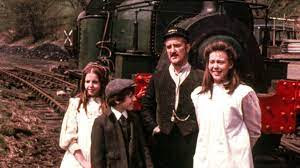
Ever since trains have existed, they have been used in books and films for dramatic effect. Hardly surprising, as they were at the cutting edge technology, as radical as the smart phone today. Trains have driven plot lines and depicted suspense, humour, emotion and danger. Heroines tied to the track in silent movies, with the train switching lines at the last moment. The smoldering 'will they won't they?' tension of Brief Encounter with Trevor Howard and Celia Johnson in the tea room at Carnforth Station; Kenneth More as Richard Hannay exiting a train while crossing the Forth Bridge to evade capture in The Thirty-Nine Steps. The complete anarchy of The Great St Trinians Train Robbery, released in 1966; "Sir the up train has left on the down line". Whoosh! "Sir, correction, the down train is running on the up line!" There are whole websites dedicated to film locations, dissecting which trains were in which films, from Oh Mr Porter to The Tit.field Thunderbolt. Then there are the novels. One Agatha Christie whodunnit hinged on the vagaries of the railway timetable, the villain's alibi unraveling because a certain train didn't stop somewhere on a certain day. And of course, Murder on the Orient Express has been reinterpreted several times. Popular though these films are, to be honest, they don't really cut it as films for railway enthusiasts. And only one of them ended up being used as the subject of a Tri-ang Hornby train set, until the arrival of a certain boy wizard many years later. The Railway Children film, released in 1970, has taken on a life of its own. E NESBIT Edith Nesbit lived from 1858 until 1924, during which time she wrote over 40 children's books. She had an unconventional marriage and was an ardent socialist, co­ founding the Fabian Society. It is Nisbet's version which has stood the test of time. The Railway Children has never been out of print since its first appearance in 1906. THE 1970 FILM VERSION Go on, admit it. You went to see the trains, but ended up paying a disconcerting amount of attention to Jenny Agutter. But she was just one of a series of happy circumstances that led to this film becoming the public's favourite train movie. It was not an auspicious time to make a film like The Railway Children. The prevailing fashion was darker, so an Edwardian children's fantasy was a big gamble. Lionel Jeffries had previously played the mad father of inventor Caractacus Potts in Chitty. Chitty Bang Bang. She lost her father when she was four, and this may have been a major influence on the tone and plot of The Railway Children. It was not her only successful book. Five Children and It and The Phoenix and the Carpet both feature fantasy and magic. Similarities have been noted between The Railway Children and a book published ten years earlier called The House by the Railway by one Ada J Graves. Whether this was a coincidence or not is not known. For Lionel Jefferies it was his first directing role, and he also wrote the screenplay. He could so easily have bagged the important part of Perks the porter for himself. It must have taken great restraint or good advice to resist it. As it turned out, he had his hands full with directing, and Bernard Cribbins delivered a perfectly superb performance. The film was a critical success from the start, and has only continued to grow in stature. One of its attractions is the Railway Children walk, to view buildings and locations from the film. These were early days for rail preservation , and the benefit to the KWVR and other fledgling preserved lines in terms of publicity and public support are incalculable. The film used Oakworth Station for key scenes. Another important reason for choosing the KWVR was the need for a tunnel. Few preserved railways have tunnels, and even then it needed a temporary canvas extension. Much of the rolling stock, including the GWR pannier tank 5700, came from the KWVR and is still there. 5700 is currently on static display in its Railway Children colours. KEEP OFF THE TRACKS Sally Thomsett who played the 11 old sister was 20 at the time and Jenny Agutter playing her older sister was only 17. Jenny Agutter actually appeared in three versions of the story; first in a radio series, then in the 1970 film as the older daughter, then in the remake when rather fittingly she played the mother year. The film’s Classification was reviewed after a complaint that The Railway Children might encourage children to trespass on the railway. Fortunately, the BBFC ruled that modern kids were unlikely to confuse the modern railway with a Victorian fantasy. Just as well or they might have then had to review flying cars and nannies using umbrellas as parachutes. Stay in touch Peter gsseditor@gmail.com >

Thursday, 29 July 2021

WEB PAGE NO. 2806 31st July 2021 Lucozade 1ST PICTURE: Original Poster
2nd PICTURE: Model Lucozade Lorry
3RD PICTURE Original bottle in yellow cellophane
4TH PICTURE Lucozade Factory
Lucozade When we were ill as kids we knew it was serious if mother produced a bottle of Lucozade! The soft drink manufactured and marketed by the Japanese company Suntory. It was actually created as "Glucozade" in the UK in 1927 by a Newcastle pharmacist, William Walker Hunter who was trading unfder the name of W. Owen & Son. Success followed and in 1938 it was acquired by Beecham's who then sold it as Lucozade, an energy drink for the sick. The company's advertising slogan was "Lucozade aids recovery". It was sold mostly in pharmacies up until the middle of 1990s before it became more readily available as a sports drink in shops across the UK. In 1953, a factory for the production of Lucozade products was opened in Brentford, which, until 2004, had an iconic sign seen on the side of the M4 motorway (now in Gunnersbury Park Museum) This glucose and water solution, was sold until 1983 as a carbonated, slightly orange-flavoured drink in a glass bottle and as we all remember it was wrapped in yellow cellophane. Pharmacists sold it, children were given it when ill, and hospital visitors would regularly arrive on the ward with a bottle and a bunch of grapes The drink was rebranded in 1978 as a "pick me up", and as a sports drink in 1983, to associate it with health rather than sickness. The company switched to a plastic bottle and introduced a range of flavours. As of 2016, a 500 ml bottle contained 62 g (15.5 cubes) of sugar, more than Coca-Cola. In 2017, to avoid sugar tax, the drink was reformulated to contain 22.5 g of sugar per 500 ml of liquid, plus the artificial sweeteners aspartame and acesulfame. In 1989, the Beecham Group merged to form SmithKline Beecham, which further merged in 2000 to form GlaxoSmithKline. In September 2013, GlaxoSmithKline sold Lucozade and another soft drink, Ribena, to the Japanese drinks conglomerate Suntory for £1.35 billion. At the time of the sale, the product was manufactured in England at the Royal Forest Factory in Coleford, Gloucestershire, in the Forest of Dean. Lucozade contains 0.01% ethanol (alcohol), which meant that the observant Muslims could not drink it. However, in 2004, the Muslim Council of Britain ruled that they saw no harm in consuming Lucozade which contains traces of ethyl alcohol that do not bear its original qualities and do not change the taste, colour or smell. GlaxoSmithKline pointed out that fruit juices and bread could also contain the same or higher trace amounts of alcohol due to natural fermentation. The various flavours of Lucozade drinks are marketed as soft drinks; a soft drinks industry spokesman said in response: "By helping people participating in sport to perform better and to recover more quickly, sports drinks can encourage people to exercise more". In May 2016, Liverpool City Council ran a "name-and-shame campaign" entitled “Is your child’s sweet tooth harming their health?”. The short-lived campaign claimed that Lucozade was "the worst offender", containing 62 grams of sugar in a 500 ml bottle, followed by Coca-Cola with 54 grams. Posters for the campaign were displayed in hospitals for a time. In its original high-sugar formulation, Lucozade was recommended by UK diabetes charities as an immediate treatment for hypoglycaemia in individuals who take insulin. Since the drink now includes artificial sweeteners, guidelines have been amended to state that Lucozade should not be used to treat this condition. Lucozade Sport is still a major sponsor of sporting events, teams and athletes in the UK and Ireland, including the Amateur Rowing Association (ARA), FA Premier League, FA Cup, England Rugby Football Union, England Football Team, the Republic Of Ireland Football Team, the London Marathon, Parkrun, Michael Owen, Steven Gerrard, Damien Duff, Ronan O'Gara and Ben Wynne. Since 2012, the McLaren Formula One team has also been sponsored by Lucozade. Stay in touch Peter gsseditor@gmail.com

Thursday, 22 July 2021

WEB PAGE NO. 2804 24th July 2021 Four Feather Falls 1ST PICTURE: Tex Tucker with the four feathers in his hat
2nd PICTURE: The Indian Chief
3RD PICTURE Gerry Anderson and Kenneth Connor
4TH PICTURE The DVD
Four Feather Falls This was the third puppet TV show produced by Gerry Anderson for Granada Television. It was based on an idea by Barry Gray, who also wrote the show's music. Thirty-nine 13-minute episodes were broadcast by Granada from February until November 1960. The setting was the late 19th-century fictional Kansas town of Four Feather Falls, where the hero of the series, Tex Tucker, is a sheriff. The four feathers of the title refers to four magical feathers given to Tex by the Indian chief Kalamakooya as a reward for saving his grandson: two of the feathers allowed Tex's guns to swivel and fire without being touched whenever he was in danger, whilst the other two conferred the power of speech on Tex's horse and dog. Tex's speaking voice was provided by Nicholas Parsons, and his singing voice by Michael Holliday. The series was sporadically repeated on British television until 1968, and was released on DVD in 2005. Gerry Anderson considered the original puppets with static heads, made for his earlier productions, to be unacceptable because the viewer could not tell which character was talking unless its puppet moved up or down. His aim was to make the puppets look as realistic as possible, the beginning of the Supermarionation puppetry process, although that term was not coined until his next series, Supercar. The puppets' papier-mâché heads were replaced by interchangeable hollow fibre glass heads with internal rods that could move the eyes from side to side. The heads also contained sound-activated solenoids, which allowed the puppets' lips to move automatically in synchronisation with the dialogue. The electronics of the day required more space than would be available in a human-scale head, therefore all the puppets in Four Feather Falls had oversized heads. Except for the pilot episode the series was produced in a converted warehouse in the Slough Trading Estate. The cast assembled to record each script without seeing the puppets and synchronization of each character's speech with the movement of its puppet's mouth was performed later. The show was filmed in black and white. Its tight budget precluded the use of special effects, and less-costly alternatives were used. For example, to achieve the effect of muzzle flashes, small specks of black paint were carefully applied to the 35 mm negatives so they would appear as white flashes on the finished prints. The wires used to control the puppets were eight feet long and made of tungsten. Being shiny, the wires had to be blackened. The puppets were made one-third life size with the puppeteers on a bridge eight feet above the set. The horses moved by being pulled along on a trolley, which meant the viewer never saw their feet when they were moving. In the first episode, Grandpa Twink related the story of how it all began to his grandson, Little Jake. Tex is riding up from the valley and comes across a lost and hungry Indian boy, Makooya, and saves him. Tex is given four magic feathers by the boy's grandfather, Chief Kalamakooya, as a reward for saving his grandson. The characters of the town are Grandpa Twink, who does little but rest in a chair; his grandson Little Jake, the only child in town; Ma Jones, who runs the town store; Doc Haggerty; Slim Jim, the bartender of the Denison saloon; Marvin Jackson, the bank manager; and Dan Morse, the telegraphist. The villains included Pedro, who was introduced in the first show and Fernando, who first appeared in the second episode as a sidekick and someone Pedro could blame when things went wrong, as they always did. Big Ben was another villain who appeared from time to time, as did Red Scalp, a renegade Indian. Not many people remember that Nicholas Parsons was the speaking voice of Sheriff Tex Tucker and Michael Holliday the singing voice). Kenneth Connor was Dusty the Dog / Rocky the Horse / Pedro the Bandit / Big Chief Kalamakooya / Bank Manager Marvin Jackson. Denise Bryer had worked with Gerry Anderson on The Adventures of Twizzle, and he wanted her to play some of the voices in Four Feather Falls. He visited her at her home with some scripts and asked her husband, Nicholas Parsons, to help by reading some of the other parts, including the sheriff Tex Tucker. Anderson liked Parsons' interpretation and offered him Tex's speaking voice. The show's music and song lyrics were composed by Barry Gray. Michael Holliday provided Tex's singing voice, and Tommy Reilly performed the harmonica pieces. The best known song to come out of the series was "Four Feather Falls", sung in some episodes by Michael Holliday in the style of Bing Crosby. The closing theme song was "Two Gun Tex of Texas." Michael Holliday was paid £2000 for his singing work on the pilot episode, equivalent to about £38,000, a significant part of the show's £6000 budget. In all, Michael Holliday recorded six songs for the series: "Four Feather Falls", "The Phantom Rider", "The Rick-Rick-A-Rackety Train", "Happy Hearts and Friendly Faces", "My Home Town", and "Two Gun Tex of Texas". The show was adapted into comics form and published as an ongoing strip in The TV Comic. The Four Feathers Falls strip was drawn by Neville Main, and appeared from issue 439 (14 May 1960) until issue 564 (6 October 1962). Jonathon Writes:- You may or may not remember a serialised story in 15 episodes in D.C Thompson's comic the Wizard in the mid 50's entitled the Yellow Sword set in the then future 1969..... It featured a conquering army called the Kushantis from Asia (read China) who conquered all of Great Britain except the mountainous parts of Scotland. It is all about this horribly cruel oppressor who the British underground fighters took on and eventually destroyed. As an 8 year old boy very into Biggles and Gimlet I found the series very very exciting. Stay in touch Peter gsseditor@gmail.com

Thursday, 15 July 2021

WEB PAGE NO.2802 17th July 2021 BRYLCREEM 1ST PICTURE: Original Brylcreem Jar
2nd PICTURE: 1950’s Brylcreem advert
3RD PICTURE The Pink Stuff
4th PICTURE Brylcreem Jar today
|One for the lads today What's the story? Keeping quiffs neatly in place since 1928, Brylcreem is an iconic product of men's hair styling. Founded in Birmingham by County Chemicals, it was created as hair cream that was originally only sold to barbers. Men flocked to Brylcreem in droves to recreate that clean, smart hairstyle that was the fashion at the time. And that not-a-hair-out-of-place look remained the fashion for another couple of decades - rather handy for Brylcreem. In fact, a brief history of Brylcreem is like a brief history of men's haircuts. During World War II, members of the RAF were known as Brylcreem Boys thanks to their tidily done dos. The 1950s saw an even further increase with Brylcreem becoming the most dominant product in men's hairstyling. Brylcreem must have been thanking their lucky stars that the super-styled Teddy Boy look was so popular. Slick hairstyles lasted until the early 60s when Brylcreem's luck began to run out. What Happened? Well it's down in part to The Beatles and other such popular music groups of the time who wore their hair much longer and much less-perfectly styled. With this, the demand for styling creams fell and so did Brylcreem's profits. Despite efforts to convince the masses that Brylcreem could still be used on these styles, sales declined and continued to do so into the 70s. Big hair equalled big problems for Brylcreem. The 80s and 90s saw a slight renaissance when the brand tried to reinvent itself for the youth market. In 1997, David Beckham became the face of Brylcreem and showed that it wasn't just for those neat hairstyles of a different era. And now? The original cream is still available in the same packaging it's been in since the 60s plus a few other waxes and gels too. People may still think of it as a product of a certain time but it has embraced the 21st century with social media campaigns and sharp adverts to appeal to the 16-30 market. A good example of this would be their 2007 Effortless campaign where the public were invited to send in clips of effortless little tricks around the house, and the accompanying musician recruited from MySpace. But the history:- In 1895 a small chemist shop was opened in the High Street Coleshill trading under the name of the "County Chemical Company" the founder specialised in oils and lubricants mainly for the car and cycle industries along with puncture repair kits but from 1896 he was trying to develope a grease free hair product for men based on the American lanollin hair gel. The lubricant side of the business was so successful that his hair project was put on hold. The majority of trading was by mail order and distribution points were set up in London, Bristol and Manchester to meet demand. Having out-grown his Coleshill premises by 1905 the company moved to Bradford Street in Birmingham. Production of lubricants continued along with the addition of cleaning products and by 1910 Golf Balls, with the trade name of "Chemico Bob" were being manufactured. It was probably around this time that the company name changed to "Chemico". With the advent of war, production was shifted to aid the war effort with emphasis again on oils and lubricants but with the addition of Body Armour and Gas Bombs (the first ever gas bomb used by the allies was made by Chemico). After the war, production returned to normal and not a lot happened but in 1928 the founders dream of a hair product finally came true when the company chemists invented "Brylcreem" and to the surprise of the company sale were phenomenal throughout the world. In 1931 another well know product was invented by the Chemico Company. It was a household cleaning paste which was sold under the brand name of "The Pink Stuff". Production at the company now concentrated on these two products until 1939 when demand for Brylcreem was so great that the company was struggling to meet it's targets. Having been made an offer, the company decided to sell Brylcreem. During the 1930’s the demand escalated beyond all dreams and in 1939 a very generous offer was made by Beecham Trust Ltd. and the product was sold to them so that the product could reach its full potential. At that time sales were 400 gross bottles per day. In 1940 the Germans seemed to get their own back when the Bradford Street factory was bombed during a raid on Birmingham. A quick purchase of a new factory was made on Stratford Rd in Shirley where production continued with the "Pink Stuff" and other cleaning products right through until 1988. The company was then subjected to a management buyout and the factory in Shirley closed. Production was moved to new premises on Cranmore Industrial Estate, Solihull where they still trade today. You Write: From Martin in New Zealand Hello;is the below item any good to you?From Martin Stanswood ex Court Lane now living in New Zealand.I remember one lass wrote upside down in my 1957/8 year book.Any chance of being able to trace her is she is still alive?I did my first year in Court Lane and then went to Portsmouth Technical High School in 1959. =================================== A very interesting item below in colour.It is 1940 and London is being bombed without mercy by the german air farce.Brave British ,Commonwealth and allied spitfire fighter pilots are doing their best against near impossible odds to shoot down the german aircraft;they are "the few" to whom so much was owed. But life goes on as normal as possible in the form of the posh London fashion show of 1940.And talking of posh do listen to the female commentator accent.Many of the lady models must have been praying for the safe return of their men folk.And a few of them were about to be conscripted into the Womans Land Army to replace the farm men in food production.Their fashion world was about to be replaced by spud digging ! Do look at the below YouTube search.Any frock ideas gals? https://www.youtube.com/watch?v=hqvtZoP7bc8 Stay in touch Peter gsseditor@gmail.com