Total Pageviews

Translate

Thursday, 26 August 2021

WEB PAGE NO. 2814 28th August 2021 ANITA HARRIS 1ST PICTURE: With Cliff Richard and friends
2nd PICTURE; With David Nixon
3RD PICTURE; Carry on Nurse
4TH PICTURE; Just Loving You
Anita Harris was born in Somerset in 1942; her family moved from Midsomer Norton to Bournemouth when she was seven. |By that time she had won a talent contest at the age of three. However, it was her penchant for figure skating which led to her performing career, she began skating at the neighbourhood rink, eventually becoming a regular at the Queens Ice Rink in London. Seen by a talent scout shortly before her sixteenth birthday, she was offered a chance to skate in Paris or to travel to Las Vegas where she would be a dancer in a chorus line. She accepted the latter, danced at the El Rancho Hotel in Las Vegas."We did three shows a night and on the 12th night, we had the night off", she said years later. On returning to the UK, she performed in a vocal group known as the Granadiers and then spent three years with the Cliff Adams Singers. She was still in her teens when John Barry's manager, Tony Lewis, offered her a recording contract by EMI and made her first recordings with the John Barry Seven . This first single, a double A-side of "I Haven't Got You", written by Lionel Bart and "Mr One and Only", did not reach the charts. Subsequent to their meeting, when they both auditioned for a musical revue, Mike Margolis and Anita Harris formed a personal and professional relationship marrying in 1973. He became her manager and wrote the songs which served as her second and third singles: "Lies"/"Don't Think About Love September 196) and "Willingly"/"At Last Love" February 1965. In January 1965 she performed at the San Remo Music Festival. Her duet with Beppe Cardile, "L'amore รจ partito", failed to reach the finals but even to participate in such a star-studded event augured well for her stardom. She made her label debut for Pye Records with the May 1965 release "Trains and Boats and Planes", although rival versions by both the song's composer Burt Bacharach (with vocals by the Breakaways) and Billy J. Kramer & the Dakotas eclipsed her recording. She had four subsequent releases on Pye, including the only recording of the Burt Bacharach/ Hal David composition "London Life". In 1966, she moved to CBS Records where her debut release was also her debut album: Somebody's in My Orchard. Her chart breakthrough came in the summer of 1967 with the single "Just Loving You", a Tom Springfield composition which singer Dusty Springfield had suggested that Tom (her brother) give to her after Dusty and Anita had performed on the same episode of Top of the Pops. Recorded at Olympic Studios "Just Loving You" had been released in January 1967 but did not reach the UK Top 50 until 29 June 1967. Even after peaking at No. 6 on 26 August 1967 "Just Loving You" remained in the UK Top 40 until the end of the year, and was reported to have accumulated UK sales of 625,000 in six months. Besides charting at No. 18 in Ireland, "Just Loving You" was a Top Ten hit in South Africa where sales reached 200,000 copies. The disc was released in September 1967 in the United States where it rose to No. 20 on the "Easy Listening" chart in Billboard. It rose no higher than No. 120. In January 1968 she made her only appearance on the UK album chart when her Just Loving You album reached No. 29. She scored a substantial hit with her 5 January 1968 release, a remake of the standard "Anniversary Waltz", which spent eight weeks in the UK Top 40, peaking at No. 21. After just missing the UK Top 50 with the single "We're Going on a Tuppenny Bus Ride" (released 17 May 1968), she made her final chart appearance with her rendition of "Dream a Little Dream of Me". Released on 26 July 1968, her single version peaked in the UK Top 50 at No. 33, whilst the Mama Cass Elliot version peaked at No. 11. A third album, Cuddly Toy, was released in 1969. Television, stage and film career Since 1961 she has made numerous television appearances, mostly as a performer, occasionally as an actress, and her few film roles included a cameo as a casino singer in Death Is a Woman (1966) and co-starring roles in the comedy films Follow That Camel (1967) and Carry On Doctor (1967). She gained her role in the latter film while working in a revue Way Out in Piccadilly with Frankie Howerd. Backstage, he introduced her to the producer and director of the series resulting in the decision to cast her as well as Frankie Howerd. In December 1970, Thames Television debuted the children's television series Jumbleland which she co-produced and in which she starred as Witch Witt Witty. She worked with David Nixon for eight years in the 1970s and appeared on the Morecambe and Wise Show in 1971 and 1973. In 1981 she was in the line-up for the Royal Variety Performance, singing "Burlington Bertie" This performance she reprised at the Queen Mother's 90th Birthday celebration at the London Palladium, in 1990, in the presence of the Queen, Princess Margaret and the Duke of Edinburgh in a large company of artistes presenting music hall, featuring many well-known television and stage personalities. That same tribute to the star she had presented several times on the BBC's variety show, The Good Old Days. She was the subject of This Is Your Life in 1982 when she was surprised by Eamonn Andrews at London's Talk of the Town. She was still appearing on television up to 2001, in particular Boom Boom: The Best of the Original Basil Brush Show, French & Saunders and Bob Monkhouse: A BAFTA Tribute. From the early 1970s, she toured in several editions of her one-woman stage show which, as Anita Harris in the Act!, was broadcast in 1981. It was essentially a recording of her performance at the Talk of the Town. In 1982 she was named Concert Cabaret Performer of the Year by the Variety Club of Great Britain. Whilst a frequent star of pantomime over the years, she made a debut in legitimate theatre in 1986 when she assumed the role of Grizabella in the West End production of Cats for two years, with subsequent credits including Bell, Book and Candle, Deathtrap, Seven Deadly Sins Four Deadly Sinners, Verdict and the stage dramatisations of House of Stairs and My Cousin Rachel. Additionally she co-starred with Alex Ferns, Will Thorp, Colin Baker and Leah Bracknell in the UK tour of the stage adaptation of Strangers on a Train in 2006. She portrayed Gertrude Lawrence in G and I at the New End Theatre in the spring of 2009. In 2010 she starred with Brian Capron in the UK national tour of Stepping Out; having previously played the leading role of Mavis, she now took on the role of Vera. She toured with a new one-woman stage show: An Intimate Evening With Anita Harris in 2013 and appeared in a production of the Emlyn Williams play A Murder Has Been Arranged at the Grand Theatre, Wolverhampton in July 2013 and at Malvern Festival Theatre in August of that year. In 2014, she appeared in a lead guest role in the prime-time BBC drama, Casualty. She continues to perform with her band around the country, including at the Royal Albert Hall. She performed in pantomime over Christmas 2014-15 by appearing as the wicked Baroness in Cinderella at the Grand Opera House in York. "I've played Aladdin, Jack and Dick Whittington and Robinson Crusoe. I've loved playing principal boy and I'm sorry that boys are now playing that role", she told a York press meeting at the time. During 2016, she toured with her show across the UK, An Evening with Anita Harris. With musical accompaniment, she revealed anecdotes from her life in showbusiness, the people she has met and the places she has been. She appeared in ITV's Last Laugh in Vegas, and was a contestant in the BBC's Celebrity MasterChef 2018. In 2019, she guest starred in the first episode of Series 20 of Midsomer Murders’ entitled "The Ghost of Causton Abbey" as Irene Taylor, an accomplice to the killer. She guest starred as a medium called Shyanna in an episode of EastEnders which aired in August 2019. Anita Harris starred in the UK Tour of Cabaret, alongside John Partridge from August 2019 to early 2020. Stay in touch Peter gsseditor@gmail.com

Thursday, 19 August 2021

2nd PICTURE Rupert and his father
3RD PICTURE Rupert Annual
4TH PICTURE Rupert and friends
Were you a fan of Rupert Bear? I know I was not, but Rupert Annuals and comics always seemed to be around when I was a child. Rupert Bear is a comic strip character created by British artist Mary Tourtel and first appearing in the Daily Express newspaper on 8th November 1920. Rupert's initial purpose was to win sales from the rival Daily Mail and Daily Mirror. In 1935, the stories were taken over by Alfred Bestall, who was previously an illustrator for Punch and other glossy magazines. He proved to be successful in the field of children's literature and worked on Rupert stories and artwork into his 90s. More recently, various other artists and writers have continued the series. About 50 million copies have been sold worldwide. The comic strip was, and still is, published daily in the Daily Express, with many of these stories later being printed in books, and every year since 1936 a Rupert annual has also been released. Rupert Bear has become a well-known character in children's culture in the UK and the success of the Rupert stories has led to the creation of several television series based on the character. The character also has a large fan following, with groups like The Followers of Rupert. Rupert is a bear who lives with his parents in a house in Nutwood, an idyllic English village. He is drawn wearing a red jumper and bright yellow checked trousers, with matching yellow scarf. Originally depicted as a brown bear, his colour soon changed to white to save on printing costs, though he remained brown on the covers of the annuals. Most of the other characters are also animals with humanoid forms and are all the same size as Rupert, regardless of species. Rupert's animal friends are usually referred to as his "chums" or "pals." Aside from his best friend Bill Badger, some of the most enduring pals are an elephant (Edward Trunk), a mouse (Willie), Pong-Ping the Pekingese, Algy Pug (who actually pre-dates Rupert), Podgy Pig, Bingo the Brainy Pup, Freddie and Ferdy Fox, the identical twins Reggie and Rex Rabbit, and Ming the dragon. The kindly Wise Old Goat also lives in Nutwood, and helps Rupert in some of his adventures. One of the most unusual and evocative characters is Raggety, a woodland troll-creature made from twigs, who is often very grumpy and annoying. In the 2006 television revival of the series, Raggety has been transformed into a friendly elf with broken English. There is also a recurring country Police Officer who is an adult dog named PC Growler. There are also a few human characters in the stories, such as the Professor (who lives in a castle with his servant, Bodkin), Tiger Lily (a Chinese girl), her father "the Conjuror," and several less frequently occurring characters such as Sailor Sam, Gaffer Jarge, Captain Binnacle and Rollo, the Gypsy boy. There is also a recurring Merboy. During his time as Rupert writer, Alfred Bestall added further characters such as the girl guides Beryl, Pauline and Janet, with Beryl's cat, Dinky. These characters were based on Girl Guides from Bestall's own church who asked him in late 1947 if they could have their own adventure with Rupert. They remain part of the comic series even today. The series often features fantastic and magical adventures in faraway lands. Each story begins in Nutwood, where Rupert usually sets out on a small errand for his mother or to visit a friend, which then develops into an adventure to an exotic place such as King Frost's Castle, the Kingdom of the Birds, underground, or to the bottom of the sea. Sometimes one of the Professor's inventions opens the door to one of Rupert's adventures. At the end of the story Rupert returns to Nutwood, where all is safe and well, and where his parents seem perfectly happy about his adventures. Unlike most modern comic strips, Rupert Bear has always been produced in the original form of strip with illustrations accompanying textas opposed to text being incorporated directly into the art; for example, within speech balloons. Much of the landscape in Rupert is inspired by the Vale of Clwyd in North Wales (Alfred Bestall himself lived for many years in the north Welsh village of Beddgelert). A Rupert Annual is still produced every year and Rupert appears each day in the Daily Express. Rupert appeared in Paul McCartney's 1984 music video "We All Stand Together"; Paul McCartney also made an animated video starring Rupert called Rupert and the Frog Song. The short film, produced won the British Academy Award. Stay in touch Peter gsseditor@gmail.com /b>

Thursday, 12 August 2021

PAGE NO. 2810 14th August 2021 Tins 1ST PICTURE: Oxo tin and seahorse
2nd PICTURE: National Dried Milk
3RD PICTURE John Bull Puncture Outfit
4TH PICTURE Colmans Mustard tin
5th PICTURE State Express 555
Tins There has always seemed to be tins with lids around or house for years. I am talking about used tine put another use. For example, my mother’s Callard and Bowser ting with the kittens on held no sweets, it was a button box. Likewise the Quality Street tin only held mothers sewing kit. Dad’s tobacco tins held nuts, bolts, screws and washers and mother always kept her mincer in a tin which was kept under the sink. This hiding hole also held Peak Freans tin that held the shoe and boot polish and brushes along with the tins of Kiwi shoe polish. I am sure most households had at least half a dozen National Dried Milk or Ostermilk tins dotted around the house in various locations. This is way before the introduction of plastic containers and I can hear my grandmother saying” don’t throw that tin away it has a nice tightfitting lid”. Tins were always useful in the craft world. Most of us will have made, in our younger years, will have covered a tin in wallpaper and decorated it as a gift to put fire spills in or as a “useful box” for someone. Most households had at least one Oxo tin be it large or small. I have one which my father’s friend, Charlie Cornelius, gave to me and inside laying on a cotton wool pad is the endoskeleton of a sea horse. Why he gave it to me I have no idea but I have had it for almost 70 years and to prove the point take a look at the first picture this week. Another selection of tins which were popular were those that the gift packs of loose tea came in. One tin that all cyclists remember was the light blue one that the John Bull Cycle Tyre Puncture Outfit. Another distinctive tin was an upright narrow tin with a yellow label and containing Colman’s mustard. Even some cigarettes came in tins “State Express” being one example especially at Christmas Player and Senior Service and of course most pipe rubbing tobacco came in tins, very handy for keeping nails and screws in afterwards. Who remembers Gibbs Dentifrice tooth paste in a tin, either a red or green one. It came in a round tin with a dome-like tin cover, and looked like a cylindrical cake of pink soap sitting on the base. You had to brush a wet toothbrush across it a few times to whip up a foam, rather as dad did with shaving cream. With this somewhat gritty pink foam you cleaned your teeth. I must have used it thousands of times as a child. It cost about 7.5d in the old money. It had flavour added, a sweet, slightly soapy, slightly sickly taste to it, and it was pink. Band Aid came in a tin as did Nescafe coffee and Vaseline , Megazones and Germoline. In the garage Castrol grease and oil came in the green and yellow tins. Christmas was the time for fancy tins when we gave our relatives tins of biscuits and each biscuit manufacturer endeavoured to produce eye catching and attractive tins. The quality of these tins must have been good because just look around home and I bet that you will find at least half a dozen 1950’ tins hidden away somewhere Stay in touch Peter gsseditor@gmail.com
/b>

Thursday, 5 August 2021

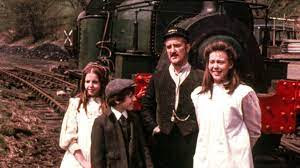
2nd PICTURE: With Perks the Porter
3RD PICTURE Daddy returns
4TH PICTURE Railway Children Train set
Ever since trains have existed, they have been used in books and films for dramatic effect. Hardly surprising, as they were at the cutting edge technology, as radical as the smart phone today. Trains have driven plot lines and depicted suspense, humour, emotion and danger. Heroines tied to the track in silent movies, with the train switching lines at the last moment. The smoldering 'will they won't they?' tension of Brief Encounter with Trevor Howard and Celia Johnson in the tea room at Carnforth Station; Kenneth More as Richard Hannay exiting a train while crossing the Forth Bridge to evade capture in The Thirty-Nine Steps. The complete anarchy of The Great St Trinians Train Robbery, released in 1966; "Sir the up train has left on the down line". Whoosh! "Sir, correction, the down train is running on the up line!" There are whole websites dedicated to film locations, dissecting which trains were in which films, from Oh Mr Porter to The Tit.field Thunderbolt. Then there are the novels. One Agatha Christie whodunnit hinged on the vagaries of the railway timetable, the villain's alibi unraveling because a certain train didn't stop somewhere on a certain day. And of course, Murder on the Orient Express has been reinterpreted several times. Popular though these films are, to be honest, they don't really cut it as films for railway enthusiasts. And only one of them ended up being used as the subject of a Tri-ang Hornby train set, until the arrival of a certain boy wizard many years later. The Railway Children film, released in 1970, has taken on a life of its own. E NESBIT Edith Nesbit lived from 1858 until 1924, during which time she wrote over 40 children's books. She had an unconventional marriage and was an ardent socialist, co­ founding the Fabian Society. It is Nisbet's version which has stood the test of time. The Railway Children has never been out of print since its first appearance in 1906. THE 1970 FILM VERSION Go on, admit it. You went to see the trains, but ended up paying a disconcerting amount of attention to Jenny Agutter. But she was just one of a series of happy circumstances that led to this film becoming the public's favourite train movie. It was not an auspicious time to make a film like The Railway Children. The prevailing fashion was darker, so an Edwardian children's fantasy was a big gamble. Lionel Jeffries had previously played the mad father of inventor Caractacus Potts in Chitty. Chitty Bang Bang. She lost her father when she was four, and this may have been a major influence on the tone and plot of The Railway Children. It was not her only successful book. Five Children and It and The Phoenix and the Carpet both feature fantasy and magic. Similarities have been noted between The Railway Children and a book published ten years earlier called The House by the Railway by one Ada J Graves. Whether this was a coincidence or not is not known. For Lionel Jefferies it was his first directing role, and he also wrote the screenplay. He could so easily have bagged the important part of Perks the porter for himself. It must have taken great restraint or good advice to resist it. As it turned out, he had his hands full with directing, and Bernard Cribbins delivered a perfectly superb performance. The film was a critical success from the start, and has only continued to grow in stature. One of its attractions is the Railway Children walk, to view buildings and locations from the film. These were early days for rail preservation , and the benefit to the KWVR and other fledgling preserved lines in terms of publicity and public support are incalculable. The film used Oakworth Station for key scenes. Another important reason for choosing the KWVR was the need for a tunnel. Few preserved railways have tunnels, and even then it needed a temporary canvas extension. Much of the rolling stock, including the GWR pannier tank 5700, came from the KWVR and is still there. 5700 is currently on static display in its Railway Children colours. KEEP OFF THE TRACKS Sally Thomsett who played the 11 old sister was 20 at the time and Jenny Agutter playing her older sister was only 17. Jenny Agutter actually appeared in three versions of the story; first in a radio series, then in the 1970 film as the older daughter, then in the remake when rather fittingly she played the mother year. The film’s Classification was reviewed after a complaint that The Railway Children might encourage children to trespass on the railway. Fortunately, the BBFC ruled that modern kids were unlikely to confuse the modern railway with a Victorian fantasy. Just as well or they might have then had to review flying cars and nannies using umbrellas as parachutes. Stay in touch Peter gsseditor@gmail.com >

Thursday, 29 July 2021

WEB PAGE NO. 2806 31st July 2021 Lucozade 1ST PICTURE: Original Poster
2nd PICTURE: Model Lucozade Lorry
3RD PICTURE Original bottle in yellow cellophane
4TH PICTURE Lucozade Factory
Lucozade When we were ill as kids we knew it was serious if mother produced a bottle of Lucozade! The soft drink manufactured and marketed by the Japanese company Suntory. It was actually created as "Glucozade" in the UK in 1927 by a Newcastle pharmacist, William Walker Hunter who was trading unfder the name of W. Owen & Son. Success followed and in 1938 it was acquired by Beecham's who then sold it as Lucozade, an energy drink for the sick. The company's advertising slogan was "Lucozade aids recovery". It was sold mostly in pharmacies up until the middle of 1990s before it became more readily available as a sports drink in shops across the UK. In 1953, a factory for the production of Lucozade products was opened in Brentford, which, until 2004, had an iconic sign seen on the side of the M4 motorway (now in Gunnersbury Park Museum) This glucose and water solution, was sold until 1983 as a carbonated, slightly orange-flavoured drink in a glass bottle and as we all remember it was wrapped in yellow cellophane. Pharmacists sold it, children were given it when ill, and hospital visitors would regularly arrive on the ward with a bottle and a bunch of grapes The drink was rebranded in 1978 as a "pick me up", and as a sports drink in 1983, to associate it with health rather than sickness. The company switched to a plastic bottle and introduced a range of flavours. As of 2016, a 500 ml bottle contained 62 g (15.5 cubes) of sugar, more than Coca-Cola. In 2017, to avoid sugar tax, the drink was reformulated to contain 22.5 g of sugar per 500 ml of liquid, plus the artificial sweeteners aspartame and acesulfame. In 1989, the Beecham Group merged to form SmithKline Beecham, which further merged in 2000 to form GlaxoSmithKline. In September 2013, GlaxoSmithKline sold Lucozade and another soft drink, Ribena, to the Japanese drinks conglomerate Suntory for £1.35 billion. At the time of the sale, the product was manufactured in England at the Royal Forest Factory in Coleford, Gloucestershire, in the Forest of Dean. Lucozade contains 0.01% ethanol (alcohol), which meant that the observant Muslims could not drink it. However, in 2004, the Muslim Council of Britain ruled that they saw no harm in consuming Lucozade which contains traces of ethyl alcohol that do not bear its original qualities and do not change the taste, colour or smell. GlaxoSmithKline pointed out that fruit juices and bread could also contain the same or higher trace amounts of alcohol due to natural fermentation. The various flavours of Lucozade drinks are marketed as soft drinks; a soft drinks industry spokesman said in response: "By helping people participating in sport to perform better and to recover more quickly, sports drinks can encourage people to exercise more". In May 2016, Liverpool City Council ran a "name-and-shame campaign" entitled “Is your child’s sweet tooth harming their health?”. The short-lived campaign claimed that Lucozade was "the worst offender", containing 62 grams of sugar in a 500 ml bottle, followed by Coca-Cola with 54 grams. Posters for the campaign were displayed in hospitals for a time. In its original high-sugar formulation, Lucozade was recommended by UK diabetes charities as an immediate treatment for hypoglycaemia in individuals who take insulin. Since the drink now includes artificial sweeteners, guidelines have been amended to state that Lucozade should not be used to treat this condition. Lucozade Sport is still a major sponsor of sporting events, teams and athletes in the UK and Ireland, including the Amateur Rowing Association (ARA), FA Premier League, FA Cup, England Rugby Football Union, England Football Team, the Republic Of Ireland Football Team, the London Marathon, Parkrun, Michael Owen, Steven Gerrard, Damien Duff, Ronan O'Gara and Ben Wynne. Since 2012, the McLaren Formula One team has also been sponsored by Lucozade. Stay in touch Peter gsseditor@gmail.com

Thursday, 22 July 2021

WEB PAGE NO. 2804 24th July 2021 Four Feather Falls 1ST PICTURE: Tex Tucker with the four feathers in his hat
2nd PICTURE: The Indian Chief
3RD PICTURE Gerry Anderson and Kenneth Connor
4TH PICTURE The DVD
Four Feather Falls This was the third puppet TV show produced by Gerry Anderson for Granada Television. It was based on an idea by Barry Gray, who also wrote the show's music. Thirty-nine 13-minute episodes were broadcast by Granada from February until November 1960. The setting was the late 19th-century fictional Kansas town of Four Feather Falls, where the hero of the series, Tex Tucker, is a sheriff. The four feathers of the title refers to four magical feathers given to Tex by the Indian chief Kalamakooya as a reward for saving his grandson: two of the feathers allowed Tex's guns to swivel and fire without being touched whenever he was in danger, whilst the other two conferred the power of speech on Tex's horse and dog. Tex's speaking voice was provided by Nicholas Parsons, and his singing voice by Michael Holliday. The series was sporadically repeated on British television until 1968, and was released on DVD in 2005. Gerry Anderson considered the original puppets with static heads, made for his earlier productions, to be unacceptable because the viewer could not tell which character was talking unless its puppet moved up or down. His aim was to make the puppets look as realistic as possible, the beginning of the Supermarionation puppetry process, although that term was not coined until his next series, Supercar. The puppets' papier-mรขchรฉ heads were replaced by interchangeable hollow fibre glass heads with internal rods that could move the eyes from side to side. The heads also contained sound-activated solenoids, which allowed the puppets' lips to move automatically in synchronisation with the dialogue. The electronics of the day required more space than would be available in a human-scale head, therefore all the puppets in Four Feather Falls had oversized heads. Except for the pilot episode the series was produced in a converted warehouse in the Slough Trading Estate. The cast assembled to record each script without seeing the puppets and synchronization of each character's speech with the movement of its puppet's mouth was performed later. The show was filmed in black and white. Its tight budget precluded the use of special effects, and less-costly alternatives were used. For example, to achieve the effect of muzzle flashes, small specks of black paint were carefully applied to the 35 mm negatives so they would appear as white flashes on the finished prints. The wires used to control the puppets were eight feet long and made of tungsten. Being shiny, the wires had to be blackened. The puppets were made one-third life size with the puppeteers on a bridge eight feet above the set. The horses moved by being pulled along on a trolley, which meant the viewer never saw their feet when they were moving. In the first episode, Grandpa Twink related the story of how it all began to his grandson, Little Jake. Tex is riding up from the valley and comes across a lost and hungry Indian boy, Makooya, and saves him. Tex is given four magic feathers by the boy's grandfather, Chief Kalamakooya, as a reward for saving his grandson. The characters of the town are Grandpa Twink, who does little but rest in a chair; his grandson Little Jake, the only child in town; Ma Jones, who runs the town store; Doc Haggerty; Slim Jim, the bartender of the Denison saloon; Marvin Jackson, the bank manager; and Dan Morse, the telegraphist. The villains included Pedro, who was introduced in the first show and Fernando, who first appeared in the second episode as a sidekick and someone Pedro could blame when things went wrong, as they always did. Big Ben was another villain who appeared from time to time, as did Red Scalp, a renegade Indian. Not many people remember that Nicholas Parsons was the speaking voice of Sheriff Tex Tucker and Michael Holliday the singing voice). Kenneth Connor was Dusty the Dog / Rocky the Horse / Pedro the Bandit / Big Chief Kalamakooya / Bank Manager Marvin Jackson. Denise Bryer had worked with Gerry Anderson on The Adventures of Twizzle, and he wanted her to play some of the voices in Four Feather Falls. He visited her at her home with some scripts and asked her husband, Nicholas Parsons, to help by reading some of the other parts, including the sheriff Tex Tucker. Anderson liked Parsons' interpretation and offered him Tex's speaking voice. The show's music and song lyrics were composed by Barry Gray. Michael Holliday provided Tex's singing voice, and Tommy Reilly performed the harmonica pieces. The best known song to come out of the series was "Four Feather Falls", sung in some episodes by Michael Holliday in the style of Bing Crosby. The closing theme song was "Two Gun Tex of Texas." Michael Holliday was paid £2000 for his singing work on the pilot episode, equivalent to about £38,000, a significant part of the show's £6000 budget. In all, Michael Holliday recorded six songs for the series: "Four Feather Falls", "The Phantom Rider", "The Rick-Rick-A-Rackety Train", "Happy Hearts and Friendly Faces", "My Home Town", and "Two Gun Tex of Texas". The show was adapted into comics form and published as an ongoing strip in The TV Comic. The Four Feathers Falls strip was drawn by Neville Main, and appeared from issue 439 (14 May 1960) until issue 564 (6 October 1962). Jonathon Writes:- You may or may not remember a serialised story in 15 episodes in D.C Thompson's comic the Wizard in the mid 50's entitled the Yellow Sword set in the then future 1969..... It featured a conquering army called the Kushantis from Asia (read China) who conquered all of Great Britain except the mountainous parts of Scotland. It is all about this horribly cruel oppressor who the British underground fighters took on and eventually destroyed. As an 8 year old boy very into Biggles and Gimlet I found the series very very exciting. Stay in touch Peter gsseditor@gmail.com

Thursday, 15 July 2021

WEB PAGE NO.2802 17th July 2021 BRYLCREEM 1ST PICTURE: Original Brylcreem Jar
2nd PICTURE: 1950’s Brylcreem advert
3RD PICTURE The Pink Stuff
4th PICTURE Brylcreem Jar today
|One for the lads today What's the story? Keeping quiffs neatly in place since 1928, Brylcreem is an iconic product of men's hair styling. Founded in Birmingham by County Chemicals, it was created as hair cream that was originally only sold to barbers. Men flocked to Brylcreem in droves to recreate that clean, smart hairstyle that was the fashion at the time. And that not-a-hair-out-of-place look remained the fashion for another couple of decades - rather handy for Brylcreem. In fact, a brief history of Brylcreem is like a brief history of men's haircuts. During World War II, members of the RAF were known as Brylcreem Boys thanks to their tidily done dos. The 1950s saw an even further increase with Brylcreem becoming the most dominant product in men's hairstyling. Brylcreem must have been thanking their lucky stars that the super-styled Teddy Boy look was so popular. Slick hairstyles lasted until the early 60s when Brylcreem's luck began to run out. What Happened? Well it's down in part to The Beatles and other such popular music groups of the time who wore their hair much longer and much less-perfectly styled. With this, the demand for styling creams fell and so did Brylcreem's profits. Despite efforts to convince the masses that Brylcreem could still be used on these styles, sales declined and continued to do so into the 70s. Big hair equalled big problems for Brylcreem. The 80s and 90s saw a slight renaissance when the brand tried to reinvent itself for the youth market. In 1997, David Beckham became the face of Brylcreem and showed that it wasn't just for those neat hairstyles of a different era. And now? The original cream is still available in the same packaging it's been in since the 60s plus a few other waxes and gels too. People may still think of it as a product of a certain time but it has embraced the 21st century with social media campaigns and sharp adverts to appeal to the 16-30 market. A good example of this would be their 2007 Effortless campaign where the public were invited to send in clips of effortless little tricks around the house, and the accompanying musician recruited from MySpace. But the history:- In 1895 a small chemist shop was opened in the High Street Coleshill trading under the name of the "County Chemical Company" the founder specialised in oils and lubricants mainly for the car and cycle industries along with puncture repair kits but from 1896 he was trying to develope a grease free hair product for men based on the American lanollin hair gel. The lubricant side of the business was so successful that his hair project was put on hold. The majority of trading was by mail order and distribution points were set up in London, Bristol and Manchester to meet demand. Having out-grown his Coleshill premises by 1905 the company moved to Bradford Street in Birmingham. Production of lubricants continued along with the addition of cleaning products and by 1910 Golf Balls, with the trade name of "Chemico Bob" were being manufactured. It was probably around this time that the company name changed to "Chemico". With the advent of war, production was shifted to aid the war effort with emphasis again on oils and lubricants but with the addition of Body Armour and Gas Bombs (the first ever gas bomb used by the allies was made by Chemico). After the war, production returned to normal and not a lot happened but in 1928 the founders dream of a hair product finally came true when the company chemists invented "Brylcreem" and to the surprise of the company sale were phenomenal throughout the world. In 1931 another well know product was invented by the Chemico Company. It was a household cleaning paste which was sold under the brand name of "The Pink Stuff". Production at the company now concentrated on these two products until 1939 when demand for Brylcreem was so great that the company was struggling to meet it's targets. Having been made an offer, the company decided to sell Brylcreem. During the 1930’s the demand escalated beyond all dreams and in 1939 a very generous offer was made by Beecham Trust Ltd. and the product was sold to them so that the product could reach its full potential. At that time sales were 400 gross bottles per day. In 1940 the Germans seemed to get their own back when the Bradford Street factory was bombed during a raid on Birmingham. A quick purchase of a new factory was made on Stratford Rd in Shirley where production continued with the "Pink Stuff" and other cleaning products right through until 1988. The company was then subjected to a management buyout and the factory in Shirley closed. Production was moved to new premises on Cranmore Industrial Estate, Solihull where they still trade today. You Write: From Martin in New Zealand Hello;is the below item any good to you?From Martin Stanswood ex Court Lane now living in New Zealand.I remember one lass wrote upside down in my 1957/8 year book.Any chance of being able to trace her is she is still alive?I did my first year in Court Lane and then went to Portsmouth Technical High School in 1959. =================================== A very interesting item below in colour.It is 1940 and London is being bombed without mercy by the german air farce.Brave British ,Commonwealth and allied spitfire fighter pilots are doing their best against near impossible odds to shoot down the german aircraft;they are "the few" to whom so much was owed. But life goes on as normal as possible in the form of the posh London fashion show of 1940.And talking of posh do listen to the female commentator accent.Many of the lady models must have been praying for the safe return of their men folk.And a few of them were about to be conscripted into the Womans Land Army to replace the farm men in food production.Their fashion world was about to be replaced by spud digging ! Do look at the below YouTube search.Any frock ideas gals? https://www.youtube.com/watch?v=hqvtZoP7bc8 Stay in touch Peter gsseditor@gmail.com

Thursday, 8 July 2021

WEB PAGE NO.2800 10th July 2021 1ST PICTURE: School Choral Society that sang The Messiah
2nd PICTURE The Messiah Programme signed by the music master John Stephens
3RD PICTURE John Stephens teaching in the Music Room
4TH PICTURE Speech Day Programme
Some time ago I was sent the list of the members of the school choral society who sang The Messiah. I reproduce it below the members in heavy type over the years I have had contact with but does anyone know where any of the other are. I know that some are no longer with us but it would be nice to know where the others are. SCHOOL CHORAL SOCIETY Sopranos Mary Abbott Kattisha Forbes Ann Piper Rosemary Bailey Gillian Gale Hazel Pratt Sharon Ball Janice Garland Barbara Quinnell Jill Budd Jean Griffiths Susan Richards Heather Butt Christine Guymer Margaret Roberts Linda Capp Christine Hall Jaqueline Stone Deborah Coates Madeline Hallman Susan Sutton Rosamund Coates Valerie Hampton June Thorn Lynda Collins Oriana Henwood Anne Turtle Susan Collins Susan Jones Jill Wakdy Kathryn Cooke Michele Laviers Jennifer Went Ann Davies Anthony Lyne Catherine Whiteman Gillian Davis Linda McIntyre Susan Whitwell Joyce Dodd Marilyn Mercer Lyn Willows Graham Elderfield Janet Munford Sheila Wilton Contraltos Maureen Albertolli Angela Ellis Pat Keers Janice Austin Roberta English Carole Langford Christine Bailey Anne Fido Diane Ledger Jean Bennett Hazel Flowers Sandra Mack Christine Biddlecombe Pauline Flowers Carole Osborne Geraldine Buckeridge Marilyn Flux Susan Perry Christine Budd Geraldine Foley Berenice Pert , Christine Butterfield Carole Gill Norma Plumb Lesley Chapman Yvonne Glasby Kay Ponsford Ann Denly Janet Huggins Diane Thomas Claudia Dunthorn Carol Janczur Irene Thorrowgood Laraine Durow Lorna Judson Ann Williams Tenors Keith Andrews Christopher Farmer Leslie Smith David Bartlett John Halford Christopher Talbot Howard Bradshaw Frank Howells Keith Taylor Peter Bridger Richard James Stuart Turtle Nigel Bridges John Pearce Philip Ward David Cookson John Quarterly Philip Wheaton Anthony Duncan Carl Randall Michael Willenbnich Frederick Dyson Alan Sawyer John Wilson Philip Woods Basses Colin Blake Stephen Carter Robert Cooke Alan Cox Adrian Gee Melvyn Griffiths Barry Jackman Peter Keat Peter Mereckel John Mortimer Peter Odell Brian Palmer Peter Westcott David Wyatt 120 members Ahh! Memories from the past! Jonathon Writes:- Good morning Peter, Greetings from lockdown in South Africa. We have not been able to return to our home in the UK for nearly two years now because of the onerous travel restrictions and the need to stay at huge expense in a government controlled Quarantine hotel ( 3000 pounds). Still we get on with life and make the most of being with our three grandchildren every day in Johannesburg. You reminded me of memories of travelling to school and cycling. My first "grown up" bike was a drop handle bar white racing bike with derailleur gears and I would cycle from Rectory Ave to Tangiers Road off the Eastern Road with my satchel strapped under the crossbar. It was perilous then...... Lord knows it would be deadly now. We had a special way of holding the satchel after dismounting ........from one of the buckle straps very cool and eschewed the use of a shoulder strap, in fact this was removed. The cycle sheds had hangers so the bikes were stored vertically and we never doubted they would be there when school finished. We would smoke secretly behind the cycle sheds with someone on watch for teachers. I eventually got expelled from school for smoking blatantly at the Tangier Road (143) bus stop in uniform. I was by then 18 years old and in my third year in the sixth form and studying for O level Latin to qualify for my College place at Emmanuel as a two language O level requirement was placed on my offer. So I studied the Latin at home and passed it with ease as the Latin teacher gave me all the set book translations before I left. (He is still alive to my knowledge and attends the school reunions currently on Covid hold). I worked my gap year at AEW (Admiralty Experiment Works Haslar) in Gosport as an Assistant Experiment Officer and signed the Official Secrets Act......so I still cannot say what I did there. As a much younger boy my brother Julian and I used to ride our much less splendid bikes from Rectory Ave along the A 27 all the way to Bosham to visit our Uncle and Aunty and three cousins in a little cottage on the sea front. Again a journey you JUST could not think about today as an 8 year old. We also used to walk from Rectory Ave to Solent Road school as littluns and also to the Scout Hut for cubs where I first met you Peter. Very happy memories Jonathan Stay in touch Peter gsseditor@gmail.com

Thursday, 1 July 2021

WEB PAGE NO.2798 3rd July 2021 1ST PICTURE: Wooden brief case
2nd PICTURE Leather Satchel
3RD PICTURE Advert for Royal Enfield Bermuda
4TH PICTURE One hot sunny day
Travelling to school. When I travelled to infant or junior school my mother walked with me, it was only a 5 minute walk and I also came home for lunch, so four trips a day. But on moving up to secondry school involved travelling further. This involved a bus trip of four stops to Court Lane. As most of us did I hoped that the bus conductor would not get to me to take my fare before I got off so I could pocket the money. This very rarely happened even though the buses were double deckers, the conductoralways seemed to manage to get to me before I got off. It was all new, new shoes, new uniform and a new school bag. My parents gave me the choice of a new satchel of a school case. I opted for the case and after a time I wish I had not. My father got the case made and it was a small wooden suitcase ith my initials PJK painted on the side. It looked very smart but was a pain to carry around. I was forever banging my shins on it, it was in the way down by my desk in the classroom and being wooden was often stood on by others, it was most certainly not the best choice. I cannot remember the demise of the think but I do know that I very soon had a leather satchel, which was much more convenient, especially when I got my first bike. I had never learnt to ride a bike until one day Colin Pratt arrived at my house with his bicycle and insisted that I try it. Well after a lot of falling off and scrapped knees, that afternoon I mastered the art of bicycling! When it came to a new bicycle I knew what I wanted and that was a Royal Enfield Bermuda in Red and Cream. So for my birthday I was taken by my mother to Wynns toy and cycle shop in Drayton, which was situated in the old wartime British Restaurant. Having bought the bike I insisted on riding home and I disappear along the Havant Road much to my mothers concern. But I was safely waiting for her at home when she had walked the mile or so home. A bicycle opened up all sorts of adventures and in fact I spent quite a bit of time building bikes to ride across the rough ground on Portsdown Hill and Farlington Marshes. But back to travelling to school. Riding to school my parents did not like the idea of me leaving my new bike in the cycle racks at school so it was arranged that I and my friend Willie would leave our machines in my fathers friends garage and then walk the final half mile to school. Which we did. Things seemed much simpler then, we spent hours on our bicycles espoecially in the summer and I think we must have explored every country lane in south Hampshire. Although cycling can cause accute embarrasment. A close friend and I wer cycling home from school when all of a sudden the zip in his trouser broke. Very embarrasing. His solution was to stop, take out his heavy yellow cycling cape and put it on. It was quite a sight seening him puffing and blowing in a thick cape on a hot sunny day whilst making his way home up Portsdown Hill.!!! You Write STAY IN TOUCH PETER gsseditor@gmail.com

Thursday, 24 June 2021

WEB PAGE NO.2796 26th JUNE 2021 1ST PICTURE: Ena Sharples 1971
2nd PICTURE Minnie Martha and Ena in the Snug
3RD PICTURE Her last appearance
4TH PICTURE The Glad Tidings Mission Hall
Ena Sharples One programme, in the early days, that my mother and grandmother would never miss was Coronation Street just to see what Ena Sharples was gossiping about this week. Ena Sharples (nรฉe Schofield) was played by Violet Carson. She appeared in the first-ever episode, broadcast on 9th December 1960, and stayed with the show until 2nd April 1980. Ena was the widowed caretaker of the Glad Tidings Mission Hall and spent much of her time criticising the activities and loose morals of the street's residents. One of the main characters during the 1960s, she was featured less regularly in the 1970s due to the declining health of Violet Carson, and was written out in 1980. Always wearing a double breasted overcoat and hairnet, she spent much of her time with her two cronies, Martha Longhurst and Minnie Caldwell, in the snug bar of The Rovers Return drinking milk stout. Ena particularly criticised Elsie Tanner whom she believed had loose morals. In turn, Elsie strongly disliked Ena for her seemingly incessant gossip and desire to know about the private lives of others; and the two confronted each other frequently. The final episode featuring Ena was broadcast on 2nd April 1980. It attracted little media or public attention, as the producers intended her to continue in the serial – the character was merely going to stay with a friend in St Annes while her flat was being renovated. Unfortunately, all subsequent storylines involving Ena had to be scrapped owing to Violet Carson being too ill to appear. She died on Boxing Day 1983 at the age of 85, thus putting to rest any rumours of Ena's return. Following her departure in 1980 no further mention of Ena was made, and it was assumed she had moved to St Annes permanently. The back story is this:- Ena Schofield was born in Weatherfield on 24th November 1899. She had two elder siblings, Alice Raynold (nรฉe Schofield) (1885–1965) and Tom Schofield (d.1973). During her school days Ena met Martha Hartley and Minnie Carlton establishing lifelong friendships. A student with a strong Christian upbringing, Ena became devoted to her religion and developed a firm belief in the importance of rules, regulations and morals. She also quickly learned to be self-sufficient, taking on factory work when she was 11. In 1915, Ena became engaged to Phil Moss, he enlisted for military service in the Great War and was killed. Around 1917, Ena met Alfred Sharples, who had been sent home because of a leg injury. Ena was upset to learn he was already married, and broke with him. When the war ended Alfred and Ena met up again and he told her that his marriage had been in name only – he'd had to marry the daughter of someone his father had owed money to. Alfred informed Ena that his wife had recently died, so Ena decided to give him another chance. Ena married Alfred in 1920 and they had three children: Vera, Madge and Ian. Ian died after only two days and Alfred died in 1937 during the Depression, leaving Ena a widow with two children. As Vera and Madge grew up Ena alienated them through her judgemental and frequently interfering nature. Madge and her mother became almost completely estranged after Madge emigrated in 1950. In 1960, Ena was in conflict with the Mission's new lay preacher Leonard Swindley who objected to her frequenting the Rovers. Ena collapsed due to the stress, but walked out of hospital to return to her post so that Martha Longhurst who had taken on her responsibilities while she recovered, could not steal her job. In 1961, Ena was sacked for spreading a rumour that Coronation Street was being demolished, which turned out to be untrue. Mr. Swindley was forced to re-hire her when a suitable replacement could not be found (Ena had bribed the other candidates to turn the job down). Still unhappy with the working conditions Ena walked out of the job later in the year and moved in with Minnie Caldwell . She was eventually offered her job back. Ena had a health scare in 1962 when she suffered a minor stroke, she quickly regained her speech and mobility, but the following year was diagnosed with arteriosclerosis. Despite her willingness to gossip Ena was very guarded about her private life, and berated Martha for discussing her health problems with Ena's daughter, Vera. Ena's great nephew visited and invited her to her brother's home in the US for an extended stay. Ena jumped at the chance to meet the family she never knew she had. Upon her return, Ena was horrified to see the Mission converted into a Community Centre with a social worker employed there full-time. She quit upon hearing the news and moved in with Minnie. Despite being out of work a disoriented Ena was caught accidentally stealing from a supermarket. In court Ena pleaded not guilty, but refused to give her age when questioned, saying only that she was over 21. She was subsequently fined 40/-. When the Community Centre at the Mission closed down, Ena moved back into the vestry. Ena’s daughter was ill for several weeks until she died in Ena's bed in January 1967. The Mission was closed permanently a year later, when it was demolished along with the factory to make way for a block of two-storey maisonettes. Ena was offered a place at an old people's nursing home, which she unsurprisingly declined, nevertheless when the maisonettes were built Ena moved into No.6, a purpose-built OAP ground floor flat. Ena was pleased, as it occupied the exact spot where the vestry had been. In 1969, Ena became bored with the maisonette and moved into a flat over the camera shop. With Glad Tidings gone, the closest place of worship was the Victoria Street Mission, and Ena kept close tabs on the comings and goings there. When the maisonettes were demolished in 1971, one of the buildings which replaced them was a community centre. Despite her age, Ena was determined to secure the position of caretaker, and scared off her competitor by warning her about the violence in the area. With no-one else to take the job, Ena was selected for the job and she moved into a flat adjacent to the Centre. Ena's age and ability to do the work was a constant concern to the Council. A co-caretaker was foisted on her though she insisted on being called Senior Caretaker. In 1973, Ena suffered two heart attacks, but refused to move away as she wanted to die in the street. When she disappeared with the Centre keys at Christmas, preventing the children from getting any presents, Ena assumed she'd be sacked; she left to stay in St. Annes, however she was allowed to keep her job. Martha had died in 1964 and Minnie left in 1976 Angered by the lack of progress in the redecoration of her flat that prevented her from moving back into her home, Ena left to stay in St. Annes, unsure about whether or not to return to Coronation Street. Ena was never seen in Weatherfield again, and all subsequent references to her were in the past tense You Write STAY IN TOUCH PETER gsseditor@gmail.com

Friday, 18 June 2021

WEB PAGE NO.2794 19H JUNE 2021 Crayola Crayons 1ST PICTURE: Range of Crayons
2nd PICTURE Original Packaging
3RD PICTURE Tin of Crayons
4TH PICTURE Crayola Factory and Crayola Experience
Crayola Crayons Today you can buy a box of Crayola crayons in 152 colorus today, but way back in 1903, they only came in eight colours. And that first-ever box of Crayola brand crayons was a huge improvement over the first crayons ever sold, which only came in black. Wax crayons were mostly used for industrial purposes until two cousins Edwin Binney and Harold Smith introduced their brightly coloured crayons for kids. Edwin’s wife, Alice, made up the name Crayola by combining “craie” (French for chalk) with “oleaginous” (which means oily). In other words, oily chalk! It’s hard to understand just how different modern crayons are from their ancestors without a look at the history of the crayon. In 1864 Edwin’s dad, Joseph Binney, started the Peekskill Chemical Works in upstate New York. The firm made charcoal and lamp black, a black pigment made from the soot left over when oil is burnt. When the two cousins took over in 1885, they started making new things, like a red pigment for barn paints and a carbon black that made rubber tires stronger. They made a number of industrial products, but from 1900 to 1902, they started making pencils and dustless chalk for school blackboards. Coloured crayons were a natural next step. But the original pigments they had used were not safe for children so they developed crayons that would be safe if swallowed. The first box they sold had just eight colours and the colours were black, brown, blue, red, purple, orange, yellow, and green.. Over the years, as the company has grown, it has introduced more than 400 different colours. You can find metallic crayons, crayons with glitter in them, crayons that smell like flavours’, crayons that wash out of clothes, and even egg-shaped crayons. Nowadays, plenty of other companies make coloured crayons for children too. However, europe was the birthplace of the “modern” crayon, a man-made cylinder that resembled contemporary sticks. The first such crayons are purported to have consisted of a mixture of charcoal and oil. Later, powdered pigments of various hues replaced the charcoal. It was subsequently discovered that substituting wax for the oil in the mixture made the resulting sticks sturdier and easier to handle. Surprisingly every one of these iconic art supplies are made at a factory in Easton, Pennsylvania. The plant churns out the top-selling crayons at a rate of 650 crayons per minute, with a total production of up to 13.5 million per day in 400 different colours. On average, the facility makes 3 billion Crayola crayons per year. Beyond Crayola, other brand name crayon manufacturers today include Rose Art Industries and Dixon Ticonderoga, the successor to the American Crayon Company. Numerous suppliers create generic brand or store brand crayons. These are typically found in supermarkets. In 2000 there was concern about potential contamination of asbestos in many popular brands of crayons after the Seattle Post-Intelligencer reported in May of that year that they had tests performed finding that three brands of crayons contained asbestos. In a follow-up study released in June the U.S. Consumer Product Safety Commission (CPSC) found traces of asbestos fibres in three crayons and larger amounts of transitional fibres which can be misinterpreted as asbestos as a result of using talc as a binding agent in additional crayons. CPSC declared the risk to be low, but said that because of the concerns it had asked manufacturers to reformulate the concerned crayons and commended them for their swift agreement to do so. I remember using Crayola Crayons at school and also buying them for my children and grandchildren. Isn’t it great to know that there are some things that have not changed over the years!!! STAY IN TOUCH PETER

Thursday, 10 June 2021

WEB PAGE NO.2792 12TH JUNE 2021 JUNIOR SCHOOL 1ST PICTURE: MY CLASS AT JUNIOR SCHOOL
2ND PICTURE:. THE DREADED OUTSIDE TOILETS
3RD PICTURE :ICE IN THE PLAYGROUND
4TH PICTURE: COCONUT MATTING
WHAT DO YOU REMEMBER OF YOUR JUNIOR SCHOOL DAYS? EVEN THOUGH WE ALL CAME FROM VERY DIFFERENT FAMILIES I AM WILLING TO BET THAT WE ALL REMEMBER THE SAME OR VERY SIMILAR THINGS. TO START WITH MANY OF US REMEMBER THE DIFFERENT SMELLS AS WE PROGRESSED AROUND THE SCHOOL. FIRSTLY, WINTERS AT SCHOOL IN THE 1950’S WERE VERY DIFFERENT THAN WHAT THEY ARE TODAY. MY THREE OVERWELLING MEMORIES AT SCHOOL IN WINTER ALL INVOLVE THE TEMPERATURE. THE SCHOOL HAD SOLID FUEL BOILERS WHICH WERE FIRED BY COKE WHICH WHEN AT FULL POWER FILLED THE ATMOSPERE WITH A CLINGING GASEOUS VAPOUR WHICH WAS FAR FROM PLEASANT. THE SECOND THING IS THE EXTRA DAYS OFF WHEN THE OUTSIDE TOILETS FROZE. THIS WAS A GREAT DELIGHT TO US BUT NOT SO TO OUR PARENTS. FINALLY MAKING MY WAY TO THE LOWER PLAYGROUND THROUGH THE ICE AND SNOW AND CONSTRUCTING LONG ICY SLIDES UNTIL ONE OF THE TEACHERS CALLED US OFF AND STOPPED US USING THEM. AN EARLY EXAMPLE OF HEALTH AND SAFETY REGULATIONS I SUPPOSE! ONCE OUT OF THE PLAYGROUND IT WAS INTO THE CLOAKROOM WITH ITS PERFUME OF WET CLOTHES AND WARM KIDS WITH A SUBTILE UNDERLYING ODOUR OF CLEANING FLUID AND DISCINFECTANT. THEN IT IS OFF TO THE CLASSROOM FOR OUR NEXT NASAL EXPERIENCE. THIS CONSISTED OF CHALK DUST, POLISH, GLUE OR PASTE, MILK AND CRAYONS. THE CLASSROOM PERFUMES VARIED DEPENDING WHO THE TEACHER WAS. I REMEMBER ONE TEACHER WHO WAS ALWAYS ACCOMPANIED EVERYWHERE (I DON’T KNOW HOW IT WAS ALLOWED) BY HER CORGI, SHE ALWAYS SMELT OF DOG. ANOTHER TEACHER LIBERALLY USED EAU DE COLOGNE AND ANOTHER ASHES OF ROSES, QUITE OVER POWERING. FINALLY MANY OF THE MALE TEACHERS OFTEN PROJECTED EITHER THE SMELL OF WOODBINES OR PIPE TOBACCO AND ONE EVEN SNUFF! STILL TALKING ABOUT THE WINTERS DURING THE HARSH WINTERS IT WAS A COMMON SIGHT TO SEE THE SMALL CRATES OF MILK OUTSIDE THE CLASSROOMS WITH THE SHINY BOTTLE TOPS STANDING PROUD ABOVE THE BOTTLES ON A COLUMN OF FROZEN MILK. OF COURSE, THE ONLY WAY TO DEFROST THE SCHOOL MILK WAS TO PLACE IT BY THE RADIATOR, AND THEN WE WERE ALL DRANK WATERY, LUKEWARM MILK. OUT IN THE PLAYGROUND MOSTLY THE AIR WAS FRESHER AND CRISP IN THE WINTER. BUT THEN CAME THE SUMMER MONTHS WHEN WE HAD PT OR PE IN THE OPEN AIR. THIS IS WHEN WE HAD TO GRAB AN INDIVIDUAL RUBBER MAT OR A COCONUT MAT TO LAY ON TO DO OUR EXCERCISES. BOTH THESE MATS HAD A TERRIBLE SMELL WHEN YOU LAID ON THEM. BUT THE RUBBER ONES WERE MOST DEFINITELY THE WORST ! IN MOST SCHOOLS THERE WAS ALWAYS THE OVERARCHING SMELL IN THE BACKGROUND OF SCHOOL DINNERS. SOMETHING THAT I NEVER EXPERIENCED LIVING SO CLOSE TO HOME. FINALLY, I MUST TAKE A LOOK AT THE MEDICAL INPUT AT OUR PRIMARY SCHOOL. VISITS FROM THE SCHOOL NURSE I HAVE WRITTEN ABOUT BEFORE BUT IT WOULD BREAK UP THE DAILY ROUTINE. THE NIT NURSE USED TO MAKE REGULAR VISITS TO CHECK FOR HEADLICE AND ALL THE CHILDREN IN EACH CLASS WOULD LINE UP TO BE EXAMINED IN TURN, THEIR HAIR BEING COMBED CAREFULLY WITH A NIT COMB TO SEE IF THERE WAS ANY INFESTATION. THERE WERE ALSO ROUTINE EYE AND HEARING TESTS, AND VISITS FROM THE SCHOOL DENTIST. THERE WAS ALSO THE POLIO VACCINE, GIVEN AT SCHOOL TO EVERY CHILD ON A SUGAR LUMP. MEASLES, GERMAN MEASLES AND MUMPS WERE NOT VACCINATED AGAINST; MOST CHILDREN CONTRACTED THESE DISEASES IN CHILDHOOD. GERMAN MEASLESCAN AFFECT UNBORN BABIES IF CONTRACTED IN PREGNANCY, AND SO IF A GIRL IN THE CLASS CAUGHT GERMAN MEASLES, IT WAS NOT UNCOMMON FOR HER MOTHER TO THROW A TEA PARTY FOR THE REST OF THE GIRLS SO THEY COULD ALSO CATCH THE DISEASE. OF COURSE THIS WAS ALSO THE AGE OF THE 11-PLUS, A SERIES OF TESTS THAT THE CHILDREN IN THE OLDEST CLASS AT JUNIOR SCHOOL WOULD TAKE BEFORE MOVING ON TO FURTHER EDUCATION. WE WOULD PRACTICE PREVIOUS PAPERS IN SCHOOL IN ORDER TO PREPARE FOR THESE TESTS, WHICH INCLUDED WRITING AN ESSAY, A MATHS PAPER AND REASONING PAPERS DESIGNED TO TEST A CHILD’S IQ WITH A PUZZLES AND PROBLEM-SOLVING QUESTIONS. ALWAYS – AND STILL SO TODAY – A CONTENTIOUS METHOD OF SCHOOL SELECTION. AHHH MORE MEMORIES STAY IN TOUCH PETER

Thursday, 3 June 2021

WEB PAGE NO.2790 5TH JUNE 2021 WHAT IT WAS LIKE TO USE PUBLIC TELEPHONES IN 1940S/1950S BRITAIN 1ST PICTURE: THE TYPICAL RED PUBLIC PHONE BOX
2ND PICTURE:. THE PHOTO GIVES A VERY GOOD IDEA OF INSIDE A RED PUBLIC PHONE BOX. NOTE THE TELEPHONE ON ITS CRADLE, THE FABRIC-INSULATED LEAD, THE COIN SLOTS, THE BUTTON A, BUTTON B AND THE LARGISH COMPARTMENTS FOR TELEPHONE DIRECTORIES.
3RD PICTURE: WOODEN BOOTHS OF PUBLIC TELEPHONES AS FOUND IN THE LARGER RAILWAY AND COACH STATIONS AND OTHER PUBLIC PLACES, SOMETIMES DEPARTMENT STORES.
4TH PICTURE: A PHONE AND PAYING MECHANISM AS SEEN IN PUBS AND GUEST HOUSES.
VERY FEW FAMILIES HAD PHONES AT HOME IN THE EARLY 1940S, AND 50’S IN FACT WE NEVER HAD A PHONE AT HOME AT ALL WHEN I WAS YOUNG. SO THE PUBLIC PHONES WHEREVER THEY WERE SITUATED WERE IN FREQUENT USE FOR KEEPING IN TOUCH AND MAKING ARRANGEMENTS. TELEGRAMS WERE USED IN AN EMERGENCY OR FOR SPECIAL GREETINGS AT THAT TIME. FINDING A PUBLIC TELEPHONE PUBLIC TELEPHONES COULD EASILY BE RECOGNISED ON THE STREETS BECAUSE THEY WERE IN BRIGHT RED TELEPHONE BOOTHS AND THERE WERE PLENTY OF THEM IN POPULATED AREAS. THE TELEPHONE BOX WAS THE SMALLEST THING DESIGNED BY THE ARCHITECT SIR WILLIAN SCOTT, WHEREAS THE LARGEST THING WAS LIVERPOOL’S ANGLICAN CATHEDRAL. IT IS NOTED THAT IN A SIDE AISLE OF THE CATHEDRAL IS A TELEPHONE BOX (NOT CONNECTED TO THE SYSTEM) SO SIR GILBERTS ACHIEVEMENTS BOTH LARGE AND SMALL CAN BE SEEN IN THE ONE PLACE. MIND YOU IN LATER YEARS OUT ON THE STREETS YOU WERE LUCKY TO FIND ONE WITH A TELEPHONE DIRECTORY IN IT AND UNVANDALIZED. IN BUS AND TRAIN STATIONS, SEVERAL WERE LOCATED TOGETHER, USUALLY IN MORE SUBDUED WOODEN BOOTHS. HOWEVER, FINDING A PUBLIC PHONE BOX DID NOT NECESSARILY MEAN THAT IT WAS WORKING OR THAT IT WAS UNOCCUPIED. THERE WAS QUITE OFTEN A QUEUE AND IT WAS RATHER OFF-PUTTING TO TRY TO CHAT WHILE PEOPLE WERE WAITING OUTSIDE, POSSIBLY EVEN BANGING ON THE WINDOW, IF THEY THOUGHT THAT A CONVERSATION WAS TAKING TOO LONG. ANOTHER REASON FOR PEOPLE WAITING OUTSIDE PUBLIC PHONE BOXES WAS THAT THEY WERE WAITING FOR A CALL. PUBLIC PHONE BOXES HAD THEIR OWN NUMBERS AND COULD BE PHONED INTO. SO, PEOPLE WOULD ARRANGE TO PHONE ONE ANOTHER AT AN AGREED TIME AND THEN WAIT OUTSIDE THE PHONE BOX UNTIL THEY HEARD ITS PHONE RING. MAKING A PHONE CALL FROM A PUBLIC PHONE USING BUTTON A AND BUTTON B IS SOMETHING I HAD TO TEACH MY WOLF CUBS WHEN I WAS A SCOUT LEADER. IN ORDER TO MAKE A CALL FROM A PUBLIC PHONE BOX, YOU HAD TO HAVE THE RIGHT COINS. THIS WAS NOT TOO ONEROUS BECAUSE COINS WERE IN EVERYDAY USE AS THERE WERE NO CREDIT CARDS. NEVERTHELESS, IT WAS NOT AT ALL UNUSUAL TO BE STOPPED IN THE STREET AND ASKED IF ONE HAD CHANGE FOR A PHONE CALL. PEOPLE ALWAYS TRIED TO OBLIGE EACH OTHER IN THIS RESPECT, AND I NEVER KNEW OF ANYONE GETTING MUGGED WHEN THEY GOT OUT A PURSE OR DELVED INTO THEIR POCKETS FOR MONEY. CALLERS PUT THEIR COINS INTO THE COIN SLOT, DIALLED THE NUMBER THEY WANTED AND PRESSED BUTTON A TO BE HEARD OR BUTTON B TO GET THEIR MONEY BACK IF NO-ONE ANSWERED. IN BUSY CITIES QUEUES WOULD FORM, ALTHOUGH IN URBAN AND RURAL AREAS THIS WAS UNUSUAL. SOME PEOPLE RECALL THAT IN THEIR TEENAGE YEARS THAT IF TWO FRIENDS WISHED TO 'ACCIDENTALLY' BUMP INTO SPECIAL YOUNG LADIES, THEY WOULD COVER THEIR LIKELY ROUTES OF TRAVEL AND USE THE PUBLIC TELEPHONE TO ADVISE WHERE A FORTUITOUS MEETING COULD OCCUR. OTHER USES FOR BUTTON B AS A CHILD, YOU DID NOT PASS A PHONE BOOTH WITHOUT PUSHING BUTTON B ON THE OFF-CHANCE IN CASE THE LAST CALLER HAD FORGOTTEN TO COLLECT THEIR LEFT-OVER COINS. IT WORKED MORE OFTEN THAN YOU MIGHT HAVE THOUGHT AND 4D BOUGHT YOU A LOT OF SWEETS. HOWEVER, SOME CHILDREN STUFFED A RAG UP THE REFUND CHUTE ON THE WAY TO SCHOOL AND ON THE WAY HOME PULLED IT OUT HOPING THAT BUTTON B HAD BEEN PRESSED IN THE MEANTIME. IF SO THE REFUNDED MONEY, HAVING BEEN BLOCKED BY THE RAG, CAME TUMBLING OUT. STAY IN TOUCH PETER